Access provision
MNU is committed to public learning through activities delivered in collaboration with schools, government agencies, employers, community organisations and other stakeholders. These initiatives bring educational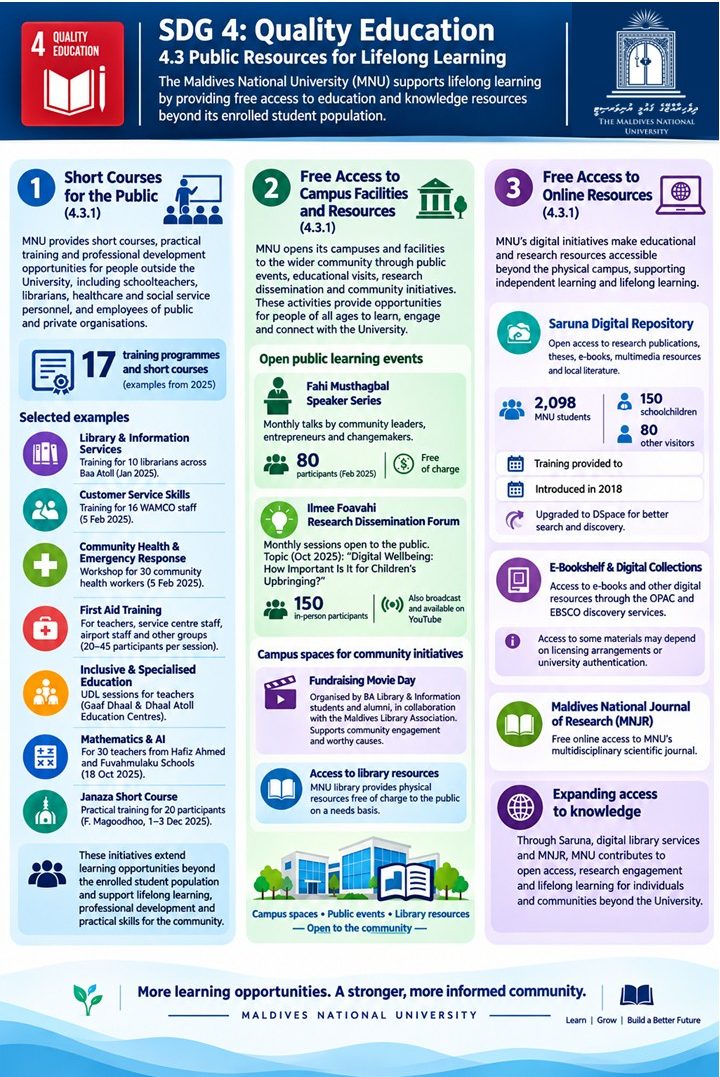 opportunities closer to people who are not necessarily enrolled at the University, including school students, teachers, working professionals, job seekers and members of island communities.
Examples include: the Fahi MNU Outreach Trip to Island Schools, which provided teacher development, student study skills and career guidance, and parent-awareness sessions across six island schools; MNU Faculty of Arts collaborated with Baa Atoll Education Centre to provide a short training for school librarians, to fill a gap in professional development opportunities; MNU Thinadhoo Campus delivered first-aid training for school teachers and community service staff; while the University’s library promotes open-access educational materials and digital knowledge resources.
1. Free courses leading to certificate award
The Maldives National University (MNU) provides short courses, practical training, and professional development opportunities for members of the wider community, including schoolteachers, librarians, healthcare and social service personnel, and employees of public and private sector organisations. Delivered through the University’s faculties, schools, and campuses, these initiatives extend learning opportunities beyond the enrolled student population and support lifelong learning, professional development, and the acquisition of practical skills relevant to community and workplace needs.
During 2025, MNU delivered a range of training programmes and educational activities for external participants, often in collaboration with schools, local councils, government and service organisations, and national and international partners. Examples include:
-
-
Library and information services: In January 2025, MNU, in collaboration with Baa Atoll Education Centre, the Maldives Library Association, and the Reading Room, delivered Training on Enhancing Library Services and Library Collaborations for 21st-Century Skills in B. Eydhafushi. The opportunity was made available to schools across Baa Atoll, providing professional development for 10 librarians.
-
Workplace and customer service skills: MNU Business School delivered Customer Service Training for 16 employees of the Maldives Waste Management Company (WAMCO) on 5 February 2025. The programme focused on professional communication, telephone etiquette, customer interactions, and customer-centred service delivery.
-
Community health and emergency response:
MNU provided practical health-related training to a range of external groups. A capacity-building workshop organised by the Faculty of Health Sciences in collaboration with UNICEF on 5 February 2025 strengthened the knowledge and skills of 30 community health workers in preventive health promotion and routine health screening.
First aid training was also provided to staff of the GDh. Family and Children Service Centre (20 participants across two batches), teachers at GA. Maamendhoo School (33 participants), teachers at GDh Atoll Education Centre (45 participants), employees of M7 (20 participants), and staff of Kaadedhdhoo Airport (28 participants). In addition, six participants in Kaadedhdhoo Airport’s Advanced Firefighter Course received a six-hour medical first aid session.
-
Teacher professional development and inclusive education: MNU delivered professional development sessions to school teachers on inclusive classroom practices through the lens of Universal Design for Learning (UDL), including sessions for teachers at Gaaf Dhaal Atoll Education Centre and GDh Atoll School. Other sessions addressed student mental health, classroom management, and team building, including a programme for 19 teachers at H.Dh. Hirimaradhoo School. The Faculty of Education also conducted a session on mathematics teaching and the use of artificial intelligence for 30 teachers from Hafiz Ahmed School and Fuvahmulaku School on 18 October 2025.
-
Health promotion and professional collaboration: In May 2025, the Faculty of Health Sciences, in collaboration with Mahidol University in Thailand, hosted the workshop Collaborative Pathways in Health Promotion: Challenges, Opportunities, and Future Directions. The workshop brought together 34 academics, health professionals, policymakers, and other stakeholders to strengthen collaboration in health promotion in the Maldives.
-
Community-based practical learning: In December 2025, the Faculty of Shariah and Law, in collaboration with F. Magoodhoo Council and through its Departments of Islamic Studies and Shariah, conducted a three-day Janaza Short Course. The programme provided 20 participants with practical knowledge and skills relating to funeral practices.
These initiatives demonstrate MNU’s engagement in extending education and skills development to people outside its formal student body. The programmes respond to varied learning needs, ranging from workplace competencies and professional development to health, safety, inclusive education, and practical community knowledge. The programs listed above represent at least 344 participants across the listed activities. They also demonstrate the University’s use of partnerships with schools, community organisations, employers, and other educational institutions to make learning opportunities available in different local contexts.
The programs were offered free of charge to the participants. The participants were offered certificates recognising their participation either as a short course or professional development training/workshop.
2. Free access to campus facilities and equipment
The MNU extends learning opportunities beyond its enrolled student population by opening its campuses and educational activities to members of the wider community. University facilities provide venues for public lectures, research dissemination, community engagement, educational visits, and charitable initiatives. Through these activities, MNU supports lifelong learning, public access to knowledge, and engagement between the University and society.
Open-access public learning events
MNU organises educational events that allow members of the public to access knowledge and engage with experts without participation fees.
The Fahi Musthaqbal Speaker Series hosts monthly talks by community leaders, entrepreneurs, and changemakers who share experiences and lessons on personal development, motivation, and life skills. The sessions are open to the public and free to attend. For example, the February session, Leave Your Comfort Zone, attracted 80 participants from both the University and the wider community. The initiative provides an accessible learning space for participants to gain new perspectives, strengthen self-confidence, and reflect on personal development.
Similarly, Ilmee Fovahi, MNU’s research dissemination forum, provides a regular monthly platform for sharing research and facilitating dialogue on issues relevant to the University and society. The monthly sessions are open to the public free of charge. For instance, in October 2025, the forum featured Digital Wellbeing: How Important Is It for Children’s Upbringing, which attracted 150 in-person participants. The discussion was also broadcast and made available through MNU’s YouTube channel, extending access to the session’s learning content beyond those able to attend on campus.
Access to campus spaces for community initiatives
MNU also makes campus spaces available for selected student-led, alumni-led, and collaborative community initiatives, including fundraising activities that support educational and professional development or contribute to wider social causes. For example, students and alumni of the Bachelor of Arts in Library and Information Management programme organised a fundraising movie day in collaboration with the Maldives Library Association. This initiative demonstrates how university spaces can support community partnerships, collective action, and activities with educational and social benefits.
Access to library resources
MNU’s library resources provide another means of extending educational support to people beyond the University. Physical library resources may be made available to members of the public free of charge, based on individual needs and applicable access arrangements. Among many example, one significant activity is work experience and skills-development opportunities for participants of the Care Society Job Training Programme, following a request from Care Society. The initiative provided participants with an inclusive and supportive environment in which to develop practical workplace competencies, build confidence and gain experience within a professional library setting. Similar provision helps support independent learning, reading, and information-seeking among community members who are not enrolled at MNU.
Together, these initiatives demonstrate MNU’s commitment to making learning opportunities and selected university resources accessible to the wider community. Public events, research dissemination activities, community partnerships, and library services enable people to engage with educational content outside formal programmes of study and contribute to a culture of lifelong learning.
3. Free access to online resources
The MNU supports digital learning and lifelong learning through initiatives that improve the discovery and availability of educational and research resources online. These include an institutional digital repository, electronic books and library discovery services, and a multidisciplinary research journal. Together, these initiatives provide opportunities for students, researchers, schoolchildren, and other members of the wider community to discover and engage with educational content beyond the traditional classroom.
Saruna Digital Repository
MNU Library provides free access to a growing collection of research publications, theses, e-books, multimedia resources, and local literature through the Saruna Digital Repository. In 2025, the repository was upgraded to the latest DSpace platform to improve search functionality, navigation, and resource discovery. The initiative supports the preservation and dissemination of scholarly and locally relevant knowledge, making research and educational materials more accessible online.
The University’s reporting records indicate that approximately 150 schoolchildren and 80 other visitors were introduced to Saruna during the reporting period, in addition to 2,098 MNU students. This outreach demonstrates engagement with potential users beyond the University’s enrolled student population and supports wider awareness of digital learning resources.
Electronic Books and Digital Library Collections
MNU Library provides electronic resource discovery through its Online Public Access Catalogue (OPAC), including an E-Bookshelf feature that enables users to discover and access electronic books using phones, tablets, and computers. Integrating digital books into the catalogue alongside print collections helps users identify relevant learning materials and supports flexible access to resources from different locations.
The Library also uses EBSCO discovery services to facilitate access to electronic collections and other digital materials. These services support teaching, learning, research, and continuing professional development by enabling users to discover resources through a central library platform.
Maldives National Journal of Research
The Maldives National Journal of Research (MNJR) provides free online access to multidisciplinary scholarly research published by MNU. By making research outputs available online, the journal supports the dissemination of knowledge to academic and professional audiences as well as interested members of the wider public. Free online access helps reduce barriers to engaging with scholarly work and supports research-informed learning beyond formal university programmes.
Contribution to Lifelong Learning
Through Saruna, its digital library services, and the Maldives National Journal of Research, MNU contributes to the wider availability and dissemination of educational and research resources. These initiatives support independent learning, research engagement, and access to knowledge beyond physical campus settings. The open-access repository and journal provide particularly relevant examples of online resources available without the usual barriers associated with enrolment in a university programme.


 Through practical, locally relevant learning, participants explore the Sustainable Development Goals and actions towards a sustainable future. Upon successful completion, learners receive an MNU digital badge. This initiative extends access to quality education beyond traditional classrooms and promotes Education for Sustainable Development across the Maldives and beyond.