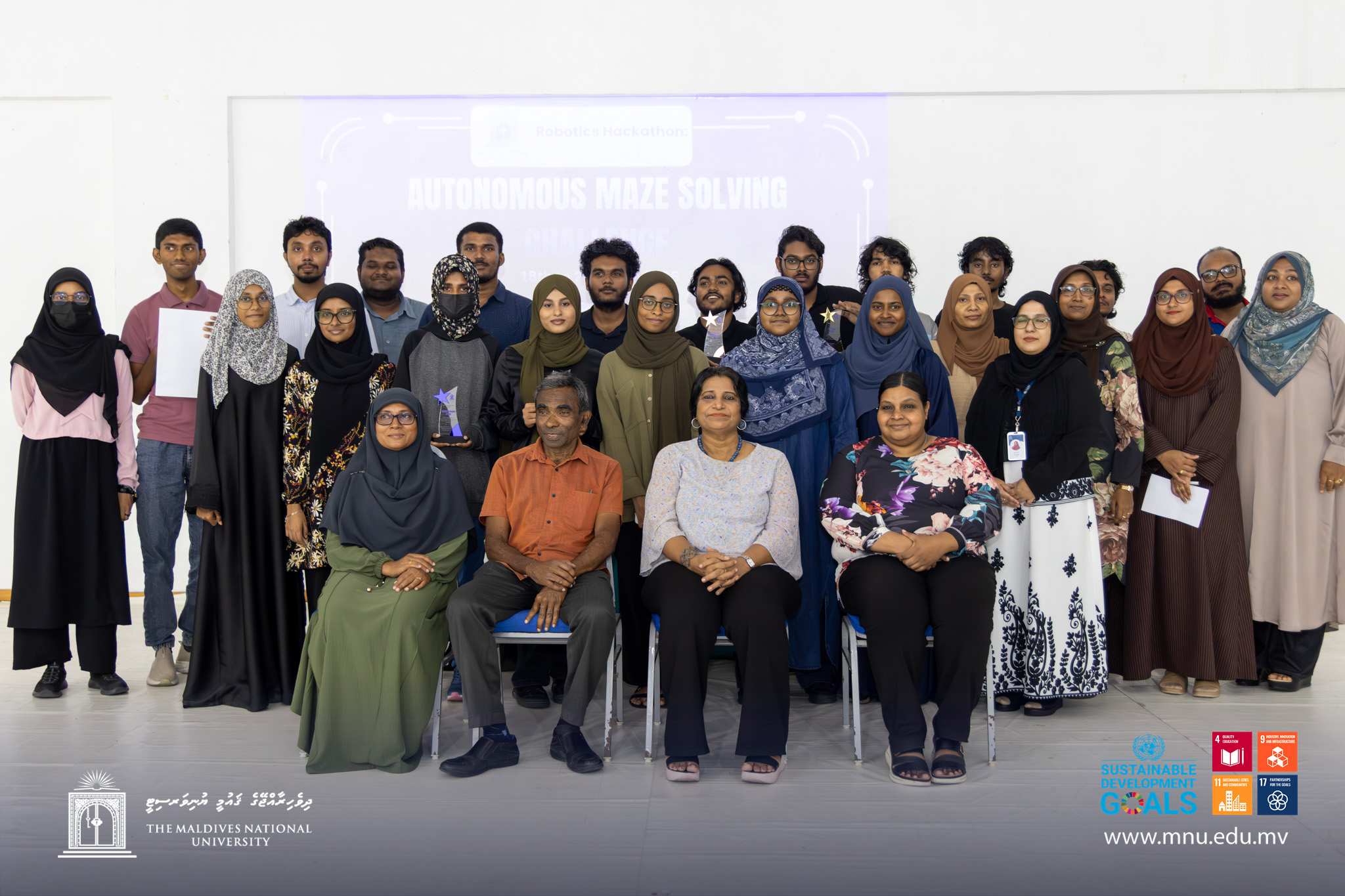
The Faculty of Engineering, Science and Technology (FEST) of The Maldives National University (MNU) successfully hosted the Robotics Hackathon 2026: Autonomous Maze Solving Challenge from 18 to 20 June 2026 — bringing together students to demonstrate innovation, technical excellence, and engineering creativity in an intensive three-day competition. The hackathon stands as one of FEST’s most hands-on and compelling student events of the year, offering participants a real-world platform to push the boundaries of what they can design, build, and programme.
The Challenge: Building Robots That Think for Themselves
Organised under the Electronics for Robotics course, the hackathon engaged 12 students in one of the most demanding formats in applied engineering education the autonomous maze solving challenge.
Participants were tasked with designing, building, programming, testing, and demonstrating autonomous robots capable of navigating a maze entirely without human intervention. From the first day of design through to the final competition, students were required to integrate hardware and software systems seamlessly — drawing on their understanding of sensors, control systems, embedded programming, and autonomous navigation technologies.
The challenge was not merely technical. It demanded creativity, precision, resilience, and the ability to think critically under pressure qualities that define the kind of engineers and technologists MNU is proud to produce.
Three Days of Applied Learning
Across the three days of the hackathon, students worked collaboratively and intensively to develop their robots, refine designs, troubleshoot technical problems, and adapt their approaches in real time. The experience was a vivid demonstration of experiential learning in action. Participants moved fluidly between theory and practice — applying knowledge from robotics, electronics, programming, and engineering design to a tangible, real-world challenge that demanded both technical depth and innovative thinking.
Beyond the technical skills developed, the hackathon also strengthened participants’ abilities in teamwork, problem-solving, communication, and critical thinking — competencies that are increasingly essential across engineering disciplines and the broader technology sector.
The Final Showdown
The hackathon concluded with a final competition and judging session in which participants presented their completed robots and competed to achieve the most efficient and accurate maze navigation performance. The final session was a fitting culmination of three days of focused effort a moment for students to showcase not only the technical capability of their robots, but the depth of thinking, planning, and perseverance that went into building them. The results were a testament to the calibre of engineering students at FEST and to the quality of applied learning that underpins their education at MNU.
Preparing Students for the Technology-Driven Future
Initiatives such as the Robotics Hackathon reflect FEST’s unwavering commitment to ensuring that students graduate not just with academic knowledge, but with the practical skills, technical fluency, and innovative mindset needed to thrive in a rapidly evolving technological landscape.
By creating platforms where students engage with emerging technologies including autonomous systems, robotics, and embedded programming FEST is actively preparing the next generation of engineers and technology professionals to contribute meaningfully to the Maldives and beyond. MNU remains committed to fostering a culture of innovation, applied learning, and technological advancement and the Robotics Hackathon 2026 is a strong example of what that commitment looks like in practice.
Supporting the Sustainable Development Goals
The Robotics Hackathon 2026 connects with MNU’s commitment to the United Nations Sustainable Development Goals, particularly:
SDG 4: Quality Education — by delivering an experiential, applied learning experience that deepens students’ technical knowledge and equips them with skills relevant to the demands of modern engineering and technology careers.
SDG 9: Industry, Innovation and Infrastructure — by encouraging student innovation in robotics, autonomous systems, and embedded technology — fields that are central to the development of smart, resilient infrastructure and industry capability.
SDG 8: Decent Work and Economic Growth — by building graduates who are technically skilled, industry-ready, and equipped to contribute to the growth of the technology and engineering sectors in the Maldives.
SDG 17: Partnerships for the Goals — by embedding industry-relevant challenges into the academic curriculum, strengthening the connection between university education and real-world technological application.
About the Faculty of Engineering, Science and Technology
The Faculty of Engineering, Science and Technology (FEST) is one of MNU’s leading academic faculties, offering programmes across engineering, information technology, and applied sciences. FEST is committed to producing technically excellent, innovative, and industry-ready graduates who can drive technological progress and contribute to the sustainable development of the Maldives
Tags: FEST | Robotics | Hackathon 2026 | Autonomous Maze | Engineering | Innovation | Applied Learning | MNU Events | SDG 4 | SDG 8 | SDG 9 | SDG 17