Introduction
As an island nation with 99 per cent oceanic territory, Maldives is a ‘big ocean state’. However, despite being surrounded by ‘water’ on all sides, it faces acute water shortage internally. Maldives, with 26 atolls comprising 1192 islands, is composed of sandbars and coral reefs that create shallow aquifers, with groundwater and freshwater becoming scarce.
Compounded by the problem of unpredictable rainfall and sea level rise, water scarcity is becoming severe in Maldives. This water scarcity is creating a dual effect: it is adversely affecting the wellbeing of the Maldivian citizenry and potentially affecting the tourism industry, which is the backbone of the Maldivian economy.
Maldives must prioritise water security as a key component of its national security policy since water (in)security acts as a ‘force multiplier’ in threatening the nation’s security.
This analysis focuses on Malé’s approach to water insecurity as a policy issue and discusses diplomatic and policy-relevant solutions to the problem.
Physical Formation and Water Consumption
The geographic dispersion of Maldives plays a critical role in shaping the nation’s water security landscape, producing both structural vulnerabilities and adaptive strengths. Comprising some 1190 islands spread across a vast expanse of the Indian Ocean Region, Maldives lacks the geographic compactness that facilitates centralised infrastructure systems. This dispersion increases the complexity of delivering essential freshwater, as transportation between islands depends on marine conditions and air connectivity.
Historically, freshwater needs in Maldives were met through shallow groundwater wells. Until five decades ago, these freshwater resources – i.e., formed by rainwater accumulating above saline groundwater – were sufficient for domestic consumption.
However, population growth, urban density and inadequate wastewater management have led to groundwater contamination. Saltwater intrusion, pollution from sewage systems, and declining recharge capacity have also degraded groundwater quality across Maldives. Groundwater has become unsuitable for drinking, forcing the islands to seek alternative water sources and manage the water crisis.
These drastic events have necessitated the adoption of desalination technologies, particularly reverse osmosis (RO) systems, across both inhabited islands and tourist resorts. Rather than relying on a single national or regional water supply system, each island has adopted its own desalination infrastructure, producing freshwater directly from seawater.
The decentralised model has reduced inter-island dependency, allowed for localised management of water resources, and enhanced resilience by preventing system-wide failures. In effect, each island functions as a self-sufficient water production unit, capable of meeting its immediate needs without relying on external supply chains under normal conditions. However, despite decentralisation, existing vulnerabilities continued to exist.
Comparing Water Security in Malé and other Locations
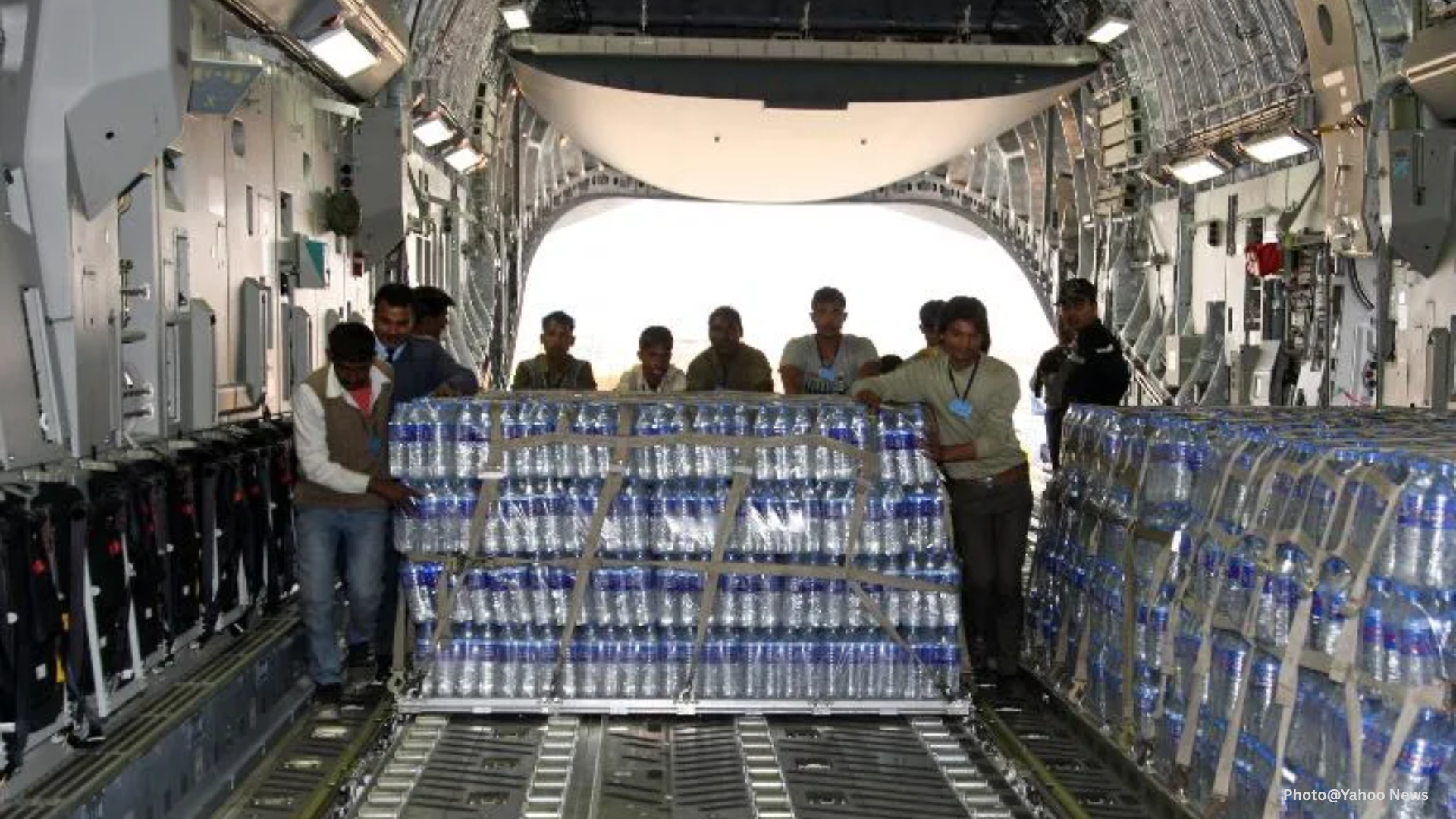
A crisis ensued in Malé after a fire at a water treatment plant cut off drinking water in the city in 2014 when about 100,000 residents lost access to water. The government took immediate note, and as a remedial measure, water was made available to the residents in Malé from India, Sri Lanka and China.
The Indian defence forces, especially the Indian Air Force (IAF), launched Operation Neer (Water) and airlifted packaged water from Delhi to Arakkonam and thereon to Malé as part of its Humanitarian Assistance and Disaster Relief (HADR) efforts. Eventually, the IAF airlifted 374 tonnes of drinking water to Malé to meet the needs of the Maldivian capital’s population during this contingency.
Indian naval vessels with freshwater and mobile desalination units were made available to the local population. Indian Naval Ship (INS) Sukanya, on patrol along the coast of Kochi in India, was diverted to Malé to deal with the contingency. Additionally, INS Deepak, a fleet tanker was sent to Maldives with 100 tons of water daily during the crisis in 2014. This assistance by the Indian defence forces strengthened India’s position within Maldives as the “first responder” in crisis.
However, this crisis demonstrated how Maldives’ own response to the water crisis differed depending on the ‘location’ of the crisis. While the 2014 crisis saw a quick response, the crisis in Fuvahmulah in 2025 only entailed a limited response with residents still affected by the crisis. This contradiction has come to explicate Maldives’ own perception of the water crisis, where adhoc responses on the part of the state have prevailed, thereby ensuring that the root cause of the issue i.e. groundwater depletion has remained unaddressed.
Moreover, the response has differed depending on who the “affected party” is, depending on whether the resident was located in an economic centre or a distant island thereby, ensuring a limited response.
Managing the Water (In)Security in Maldives
Maldives could make water security a national security goal and adopt a whole-of-nation approach to manage water insecurity, involving coordination between multiple agencies including the Maldives National Defence Force (MNDF) led frameworks.
The Indian Border Security Force (BSF’s) Water Wing show a relevant example. Water security could entail improving access controls around desalination plants.
Maldives could also improve water infrastructure maintenance, repair and overhaul (MRO) around desalination plants.
The South Asian Association for Regional Cooperation (SAARC) Coastal Zone Management Centre provides a framework that can facilitate engagement on disaster risk reduction and better water management. This specialised centre could become the arbiter of knowledge with engagement being facilitated by experts and regional specialists.
Maldives could invest in building university-based frameworks on water management along the lines of the Institute for Water Education and the Indian Institute of Water Management (IIWM).
At the community level, nature-based solutions (NbS) and efforts could be tailored to meet the nation’s needs and climatic conditions. The interaction between geographic dispersion and decentralised desalination systems illustrates a nuanced balance between vulnerability and resilience.
Therefore, water security policy must focus on strengthening redundancy, maintenance capacity, and emergency preparedness to maximise the benefits of decentralisation while mitigating its inherent risks.
Conclusion
Water security should not be viewed as a subset of climate change within Maldives, but as an independent unit. In this regard, water security through the efficient management of critical civilian infrastructure should be managed at the local, national and international level through the inculcation of efficient practices and the right mechanisms such that the impending water crisis can be better managed across the islands.
Author
Ms Anuttama Banerji is an Associate Fellow at the Centre for Aerospace Power and Strategic Studies (CAPSS) in New Delhi. She is also an Honorary Adjunct Fellow at the National Maritime Foundation, New Delhi. She graduated with a Masters in International Relations from the London School of Economics in 2018. Her research focuses on water and maritime security as well as South Asian geopolitics.