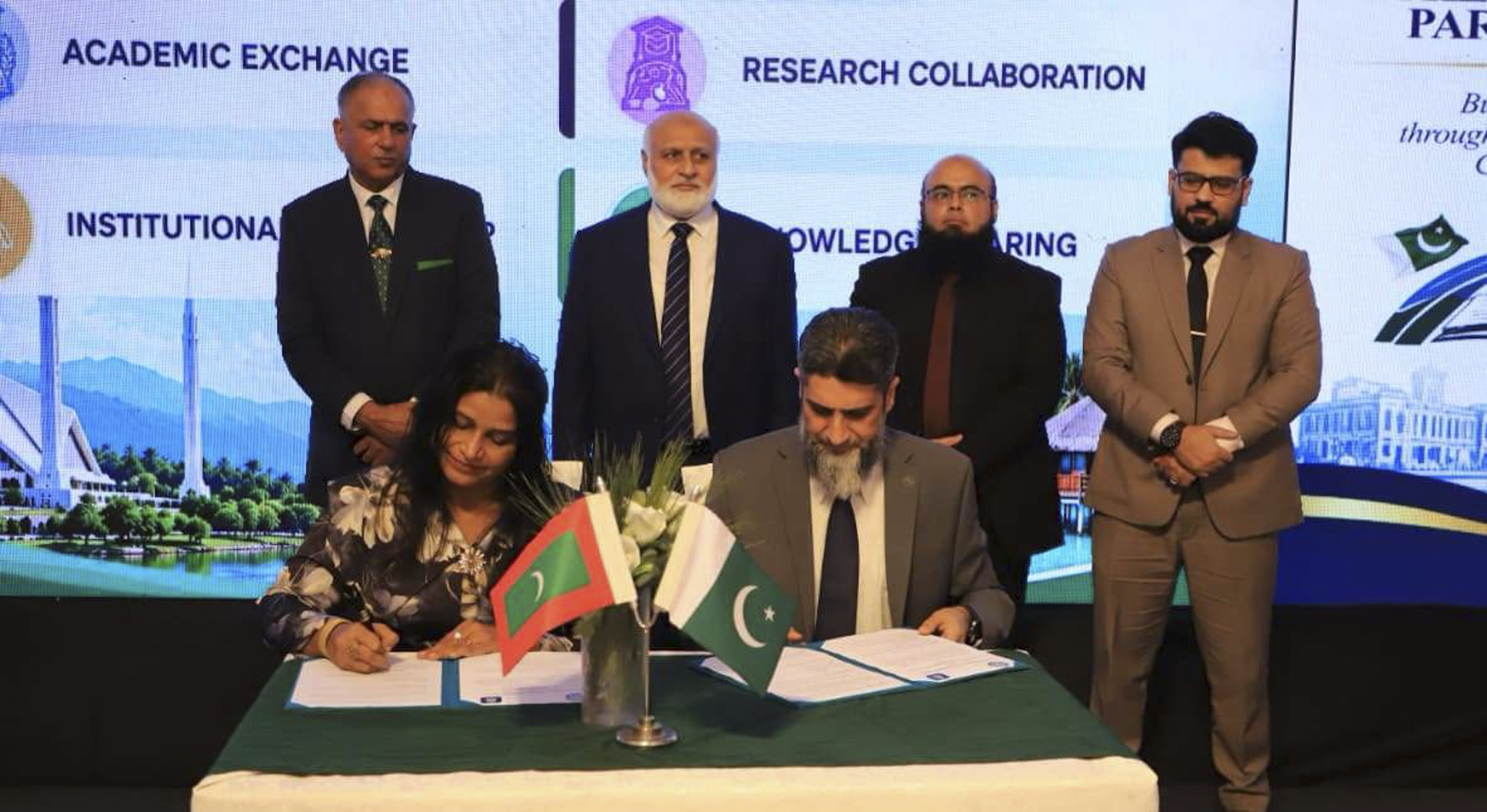
The Maldives National University (MNU) has further strengthened its international academic partnerships through the signing of five Memoranda of Understanding (MoUs) with Pakistani universities at a special gathering hosted by the Higher Education Commission (HEC) of Pakistan in Islamabad.
The event, held at the HEC Secretariat, brought together Vice Chancellors and senior representatives from universities in Islamabad and surrounding areas, including institutions beyond those participating in the MoU signing. The gathering provided a valuable opportunity to strengthen existing academic relationships and explore new areas of cooperation.
The MoUs were signed by MNU Vice Chancellor Dr. Aishath Shehenaz Adam with the heads and representatives of the National University of Sciences and Technology (NUST), PMAS-Arid Agriculture University Rawalpindi, University of Wah, Government College University Lahore, and Foundation University Islamabad.
Addressing the gathering, HEC Chairman Professor Dr. Niaz Ahmad Akhtar highlighted the importance of strengthening academic cooperation between Pakistan and the Maldives, particularly through joint research, faculty and student exchanges, academic conferences, seminars, and joint and dual degree programmes.
In her address, Dr. Aishath Shehenaz Adam expressed her sincere appreciation to Professor Dr. Niaz Ahmad Akhtar for his kind invitation, warm hospitality, and particularly for his personal initiative in bringing together such a large gathering of university leaders to strengthen academic collaboration with MNU. She described the occasion as a great honour for the University, and a meaningful gesture of friendship and goodwill.
The Vice Chancellor also expressed her appreciation to HEC’s Global Engagement Division, and the HEC team for their excellent coordination of the event. She also acknowledged the presence of the High Commissioner of Pakistan to the Maldives and the continued support of the Pakistan High Commission in strengthening educational ties between the two countries.
Reflecting on MNU’s longstanding relationships with Pakistani higher education institutions, Dr. Shehenaz highlighted several examples of successful academic collaboration, including partnerships with Riphah International University, COMSATS University Islamabad, PMAS-Arid Agriculture University, and Lahore University of Management Sciences, which have contributed to strengthening MNU’s academic programmes, institutional capacity, and research and development initiatives.
She emphasised that these existing collaborations demonstrate the value of sustained institutional partnerships and the importance of translating formal agreements into practical outcomes.
The five MoUs are expected to create further opportunities for joint research, postgraduate studies, staff and student exchanges, academic capacity building, and knowledge sharing. Dr. Shehenaz also highlighted the importance of mutually beneficial partnerships, noting that while MNU has much to gain from the expertise of Pakistani universities, the Maldives also offers valuable opportunities for collaboration in areas such as tourism and hospitality, marine sciences, environmental sustainability, climate change, and the challenges faced by small island nations.
The Vice Chancellor emphasised that signing an MoU is only the beginning of a partnership and that its real value lies in the opportunities and outcomes that follow.
Concluding her address, she stated:
“I firmly believe that the true success of these agreements will be measured not by the number of MoUs we sign, but by the opportunities we create, the knowledge we share, and the positive difference we make in the lives of our students and communities.”
The initiative reflects MNU’s continued commitment to strengthening international academic engagement and aligns with its Strategic Plan 2026–2030, particularly the priorities of Academic Excellence, Research and Innovation, and Engagement.
MNU looks forward to building upon these agreements to develop meaningful and sustainable collaborations that benefit students, academics, researchers, and communities in both countries.