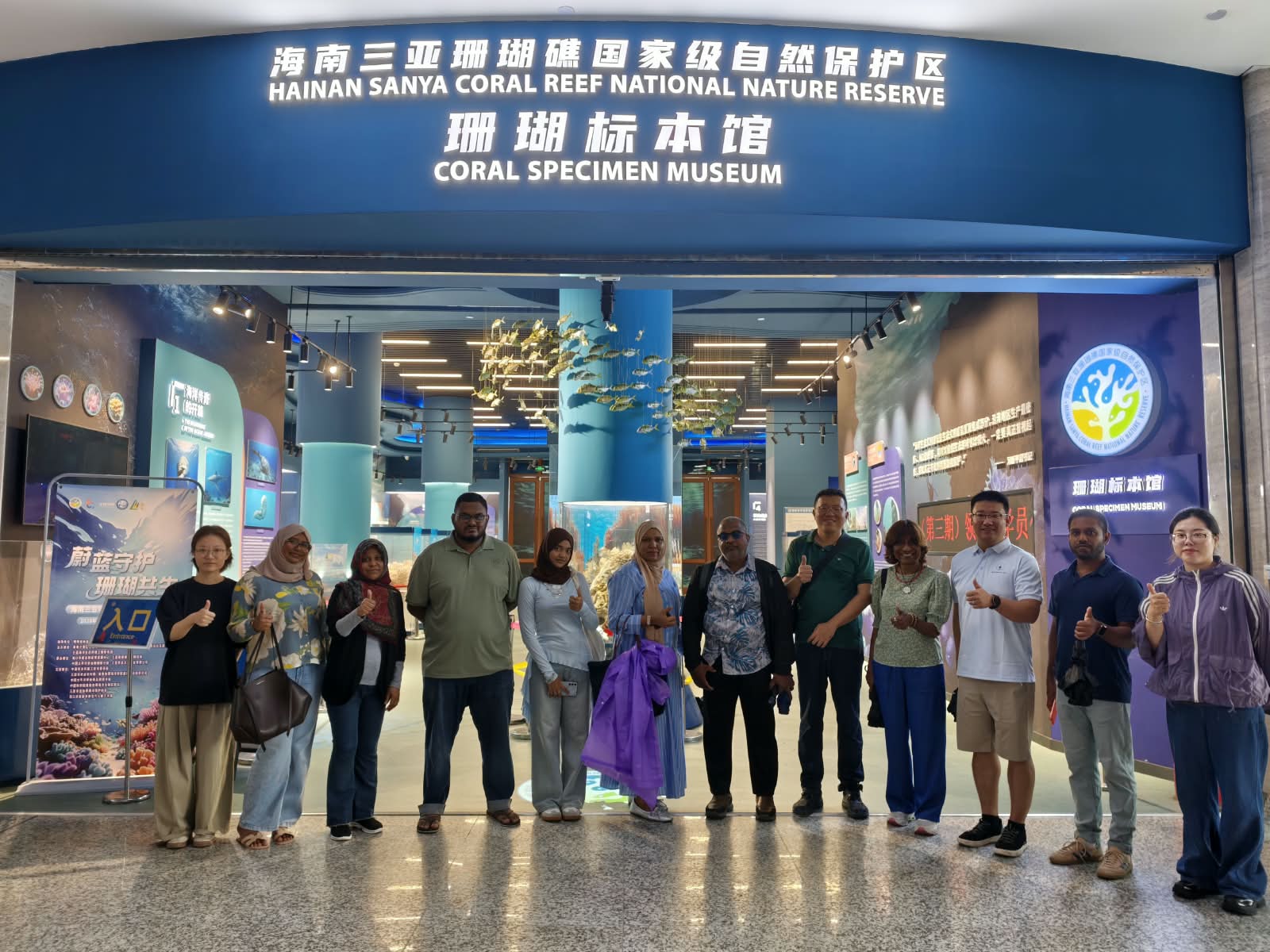
A delegation from The Maldives National University (MNU), comprising five staff members and three students, visited Hainan, China, from 11 to 14 November 2026, in a programme organised by Hainan University’s School of Marine Biology and Fisheries in partnership with the Chinese Embassy in the Maldives. The visit provided a valuable learning opportunity for the MNU College of Fisheries, offering first-hand exposure to China’s developments in marine science, aquaculture and sustainable marine resource management.
The delegation visited aquaculture enterprises and farms in Wenchang, including the Fengjiawan Aquaculture Base, where they gained insights into modern aquaculture practices and industry development. The programme also included a visit to West Island in Sanya and its coral farming platform, providing an opportunity to learn about coral cultivation and marine conservation initiatives. Hainan, a tropical island with rich marine and agricultural resources, offers an interesting context for the Maldives to explore approaches to island development and sustainable resource management. Hainan University, recognised for its strengths in agricultural and marine-related research, provided a valuable academic and practical learning environment.
The learning experience contributes to several United Nations Sustainable Development Goals, particularly SDG 4 (Quality Education) through practical learning and knowledge exchange; SDG 9 (Industry, Innovation and Infrastructure) through exposure to advances in aquaculture; SDG 13 (Climate Action) and SDG 14 (Life Below Water) through marine conservation and coral restoration; and SDG 17 (Partnerships for the Goals) through international academic collaboration. Sustainable aquaculture also supports SDG 2 (Zero Hunger) by contributing to sustainable food production.
The experience strengthened the delegation’s understanding of potential areas for knowledge exchange and future collaboration, particularly in marine research, aquaculture, coral restoration and sustainable fisheries development. It also offered MNU students and staff an opportunity to connect classroom learning with practical developments in the field.