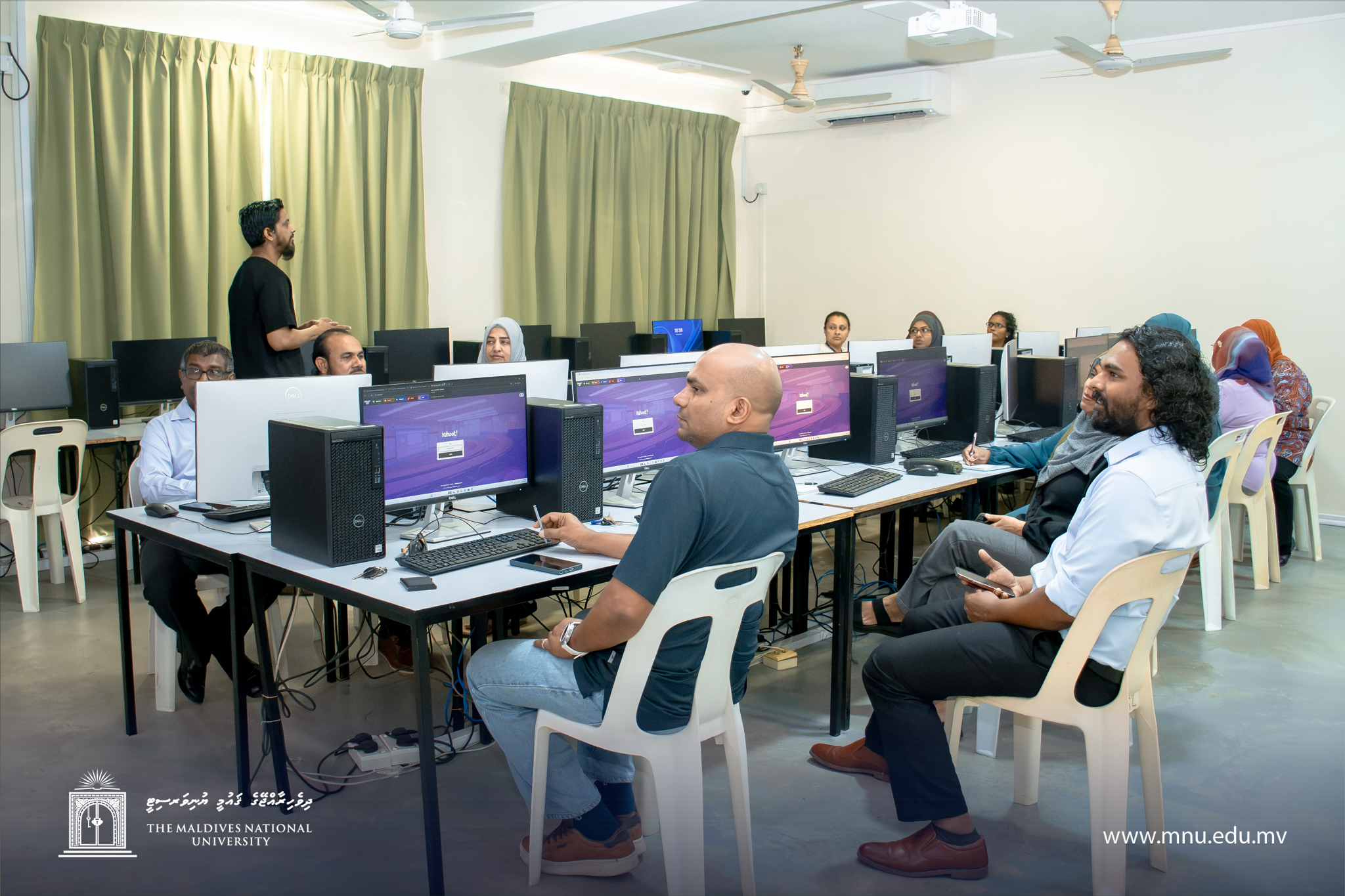
The Maldives National University (MNU) conducted a hands-on workshop titled “Exploring AI for Inclusive Teaching: A Hands-on Lab for Educators” on 13 August 2026, introducing educators to practical and responsible approaches to using Artificial Intelligence (AI) to support inclusive teaching and learning.
The 1.5-hour face-to-face session focused on helping educators explore how AI can be effectively integrated into teaching practices while considering diverse learner needs, ethical considerations, and potential risks associated with the use of AI in education.
The session was facilitated by Ahmed Shareef, a PhD researcher from the Faculty of Organization and Informatics, whose areas of expertise include Educational Technology, Web Development, and Digital Learning Support. Through UDL Asia, he also contributes to research-informed resources and practical workshops aimed at supporting inclusive education.
During the workshop, participants explored practical ways AI can support teaching and learning, including the use of simple and effective prompts to improve teaching materials. The session also encouraged participants to apply an inclusive teaching lens when reviewing AI-generated content and consider whether such outputs adequately address diverse learner needs.
The workshop further highlighted common risks associated with AI, including bias, privacy concerns, and overdependence, while encouraging educators to consider responsible and realistic approaches to integrating AI into their teaching practices.
The hands-on nature of the workshop provided participants with an opportunity to practically explore AI tools and consider how they can be used responsibly to create more inclusive and effective learning experiences. Through practical activities and guided exploration, participants were encouraged to connect AI applications with their own teaching contexts and identify realistic ways to incorporate these tools into their practices.
By the end of the session, participants were able to identify practical applications of AI in teaching, use simple prompts to enhance teaching materials, evaluate AI-generated outputs from an inclusive teaching perspective, recognise common AI-related risks, and develop realistic action plans for the responsible use of AI in their own teaching practices.
The session provided educators with an opportunity to build practical awareness of AI while reinforcing the importance of responsible, inclusive, and purposeful use of emerging technologies in education.
Through this hands-on workshop, the Maldives National University reaffirms its commitment to enhancing teaching quality, promoting inclusive learning, and encouraging the responsible use of emerging technologies in education. By equipping educators with practical AI skills and the ability to evaluate AI-generated content for bias, accessibility, and diverse learner needs, the initiative supports the development of more equitable and effective learning experiences. The workshop also highlights the role of innovation and continuous professional development in strengthening educational practices and ensuring that technological advancements contribute meaningfully to inclusive education.