Activities, events and initiatives supporting SDG 6 uner this catogory
The Maldives National University (MNU), Kulhudhuffushi Campus, continues to promote responsible resource consumption and environmental sustainability through awareness and capacity-building initiatives. On 17 August 2025, the Campus organised an information session for university staff in collaboration with the Utility Regulatory Authority (URA), bringing together 16 MNU staff members and 9 representatives from URA.
The session aimed to enhance staff understanding of utility services and encourage sustainable practices in everyday resource consumption. Participants were introduced to the roles and responsibilities of URA and its affiliated agencies, including initiatives relating to water conservation, energy efficiency and effective waste management at the island level.
Particular emphasis was placed on responsible water usage, reducing unnecessary consumption and adopting practical conservation measures. The session encouraged staff to apply water-saving practices in their daily activities, both within the university and in their households and wider communities.
Participants provided positive feedback, highlighting the value of the information shared on water and energy conservation and sustainable utility management. The initiative strengthened environmental awareness among university personnel and encouraged individual responsibility in conserving freshwater resources.
Through this collaboration, MNU demonstrates its commitment to promoting conscious water consumption and sustainable resource management, contributing directly to SDG 6.4, which calls for substantially increasing water-use efficiency and ensuring sustainable freshwater withdrawals.
The Maldives National University (MNU), Hithadhoo Campus, strengthened its commitment to sustainable resource management through a practical learning visit to Meedhoo on 17 May 2026. The programme brought together 50 participants, including administrative, support and security staff from MNU Hithadhoo Campus, along with local resource persons and hosts from Meedhoo.
The visit, titled Responsible Gardening, provided participants with hands-on exposure to sustainable gardening practices that can be adopted both within the university campus and in their homes. The programme covered food safety, home gardening, campus greening, organic waste management through composting and the responsible use of water in gardening activities.
An important component of the programme was demonstrating how water can be used responsibly in gardening and how sustainable practices can be incorporated into everyday activities. Participants had the opportunity to observe practical approaches, discuss their application and consider how similar practices could be adapted to the local campus environment.
The activity extended beyond awareness-raising and resulted in practical sustainability action at MNU Hithadhoo Campus. Following the visit, staff took the initiative to establish a composting station, which is now operational. This demonstrates how practical environmental learning can translate into sustained action within university facilities.
The initiative promotes responsible water use in gardening, environmental stewardship and sustainable campus management, contributing to SDG 6 through water conservation awareness and responsible water-use practices, alongside SDGs 4, 11, 12, 13 and 15.
3. MNU Gan Campus Installs Filtered Drinking Water Systems to Promote Sustainable Water Access
The Maldives National University (MNU), Gan Campus, has strengthened access to safe and clean drinking water through the installation of filtered drinking water systems for students and staff. This initiative reflects the University’s commitment to providing a healthy and sustainable campus environment while encouraging responsible drinking-water practices.
The installation of filtered drinking water facilities provides the university community with convenient access to drinking water within the campus. By making drinking water readily accessible, the initiative also provides an opportunity to reduce dependence on individually packaged bottled water and encourages the use of reusable drinking containers.
Access to clean drinking water is an important component of a healthy learning and working environment. The initiative supports the University’s broader commitment to improving water accessibility and promoting environmentally responsible practices within its facilities.
Through the provision of filtered drinking water systems, MNU Gan Campus contributes to SDG 6.1 by supporting access to safe drinking water, while also providing an opportunity to encourage sustainable water consumption and reduce single-use plastic bottle consumption.
The Maldives National University (MNU) demonstrated its commitment to sustainable resource management through the implementation of environmentally responsible practices during Theveli International Conference, held on 19–20 August 2024. The conference brought together more than 350 local and international attendees, alongside over 186 presenters and paper authors, with approximately 30 staff and organisers involved in coordinating the event.
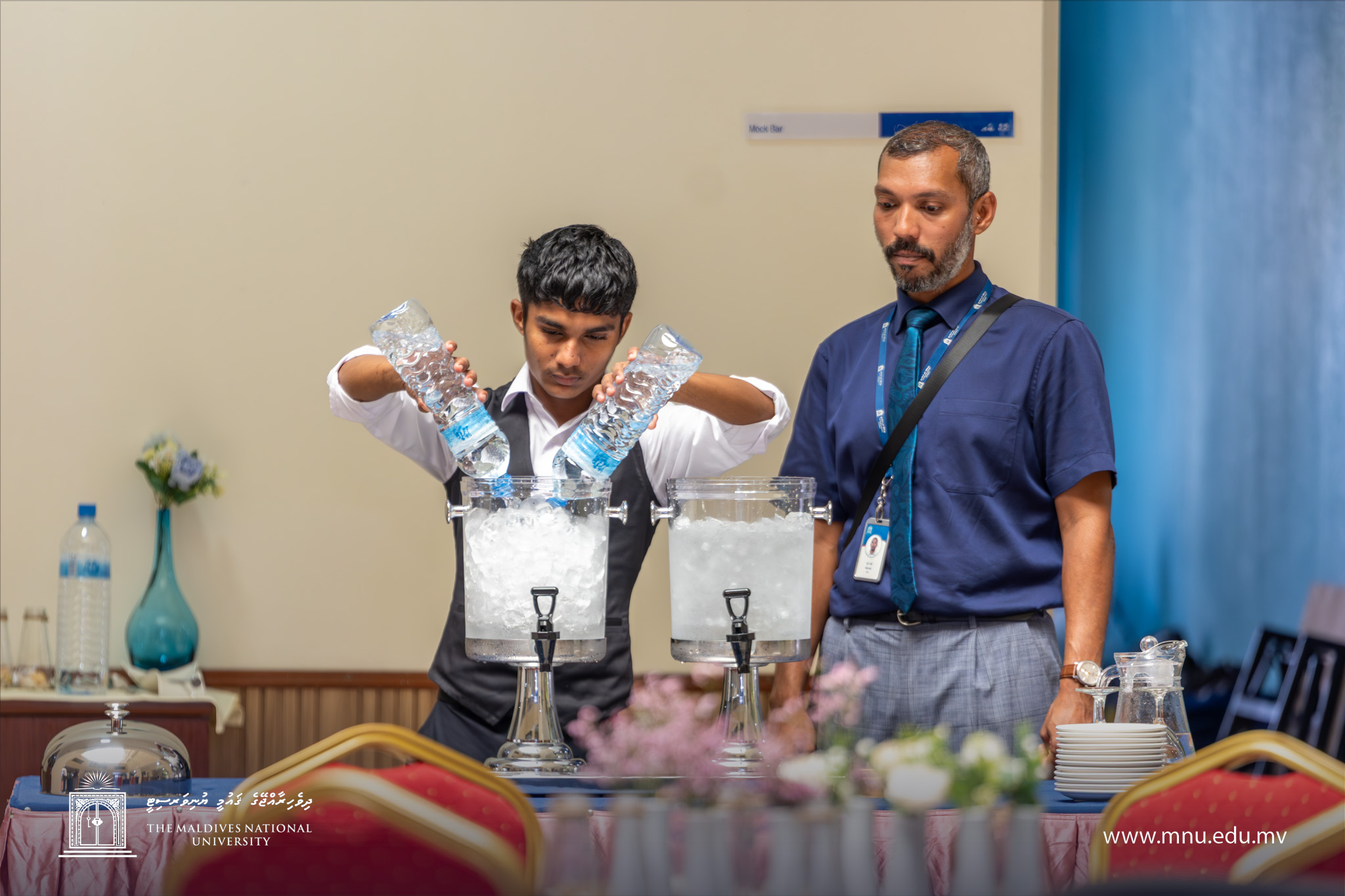
As part of its sustainable event management approach, MNU incorporated responsible procurement practices to reduce the environmental footprint associated with large-scale university events. Bulk water-refilling stations were provided to delegates, encouraging participants to refill reusable drinking containers rather than relying on individually packaged bottled water.
The initiative was supported by a strict prohibition on single-use plastics across procurement arrangements. Vendors were required to provide reusable crockery, glassware and biodegradable serving materials as alternatives to disposable products.
By providing accessible water-refilling facilities, MNU encouraged responsible drinking-water consumption while reducing the use of disposable plastic bottles. The initiative demonstrated how university events can incorporate sustainable water provision and environmentally responsible consumption practices.
Through this initiative, MNU contributed to SDG 6 by encouraging responsible water consumption and supporting pollution prevention, while also advancing SDG 12 through the reduction of single-use plastics and promotion of reusable alternatives.
5. MNU Integrates Water-Efficient Infrastructure into the New Faculty of Agriculture and Food Sciences Campus in Aa. Thoddoo
The Maldives National University (MNU) is strengthening its commitment to sustainable campus development through the integration of environmental sustainability standards into the design of its new Faculty of Agriculture and Food Sciences campus and student accommodation in Aa. Thoddoo.
As part of the building design and tender documentation, MNU has incorporated water-efficient utilities, sanitation facilities and drainage systems to support responsible water consumption and sustainable management of campus resources.
The initiative forms part of a broader approach to developing environmentally responsible university infrastructure. Alongside water-related measures, the proposed campus incorporates renewable energy systems, passive lighting and cooling, accessible facilities, green spaces and sustainable building materials.
By integrating water conservation considerations at the planning and design stage, MNU aims to establish campus facilities that encourage efficient water use and minimise unnecessary consumption throughout their operational life. The development also provides an opportunity to establish sustainable infrastructure standards that can guide future MNU regional campus developments.
The initiative supports SDG 6.4 through the promotion of water-use efficiency, while also contributing to improved sanitation infrastructure and sustainable campus resource management.
6. MNU Advances Water Conservation through Household Water Usage Research under the RECOVER Project
The Maldives National University (MNU), through its participation in the international RECOVER project, has undertaken research to improve understanding of household water consumption and promote sustainable water resource management in the Maldives.
Between October and December 2025, MNU designed and conducted a household water usage survey to investigate water consumption patterns and understand how water resources are utilised at the household level. The survey forms part of the University’s broader research into water security, resource management and climate resilience in small island communities.
Understanding household water demand is important for identifying opportunities to improve water-use efficiency, encourage responsible consumption and support long-term water conservation. The information collected through the survey provides an evidence base for understanding water-use behaviour and identifying areas where more sustainable consumption practices can be promoted.
The survey data analysis has been completed, with the research report under development. The findings are expected to contribute to improved water resource planning and support awareness of responsible water consumption among households and communities.
Through this research, MNU contributes to SDG 6.4 by supporting improved water-use efficiency and sustainable freshwater management, while strengthening the evidence available for water conservation strategies in the Maldives.
The Maldives National University (MNU) strengthened its commitment to sustainable water management by hosting a stakeholder consultation under Objective 5 of the RECOVER project, focusing on Real-World Laboratories (RWL). The consultation, held at MNU in May 2025, brought together government stakeholders, non-governmental organisations, vulnerable community representatives and researchers to discuss water usage, accessibility and water security in Small Island Developing States.
The consultation provided a platform for stakeholders to share their experiences, identify challenges and collaboratively explore practical solutions to improve water security in the Maldives. Particular attention was given to the experiences of vulnerable communities and the need to develop context-specific approaches that address water accessibility and resource management challenges during periods of climate vulnerability.
The Real-World Laboratories approach encouraged collaborative problem-solving and the development of solutions through engagement between researchers, policymakers and community representatives. The outcomes contributed to identifying strategies for more sustainable and resilient water management in the Maldives.
Through this initiative, MNU supports SDG 6.b by encouraging community participation in water and sanitation management, while contributing to SDG 6.4 and 6.5 through discussions on responsible water use and integrated water resource management.