MNU is a partner institution of the international project RECOVER Lead by University of Waterloo, Canada and funded under the CLARE program of IDRC-Canada and FCDO-U.K. Project partners include The Maldives National University (MNU), Sustainability for Seychelles (S4S), University of Mauritius (UoM), University of Waterloo.
RECOVER’s overall goal is to enhance small islands’ capacity to adapt to climate change through more inclusive, and research-informed decision environments. Through 4 pilot studies across three SIDS (Mauritius, the Maldives and Seychelles) referred to as “hubs of innovation”, scalable and systems-changing climate resilience approaches will be co-developed to enhance understanding of small island climate adaptation capacities and possibilities.
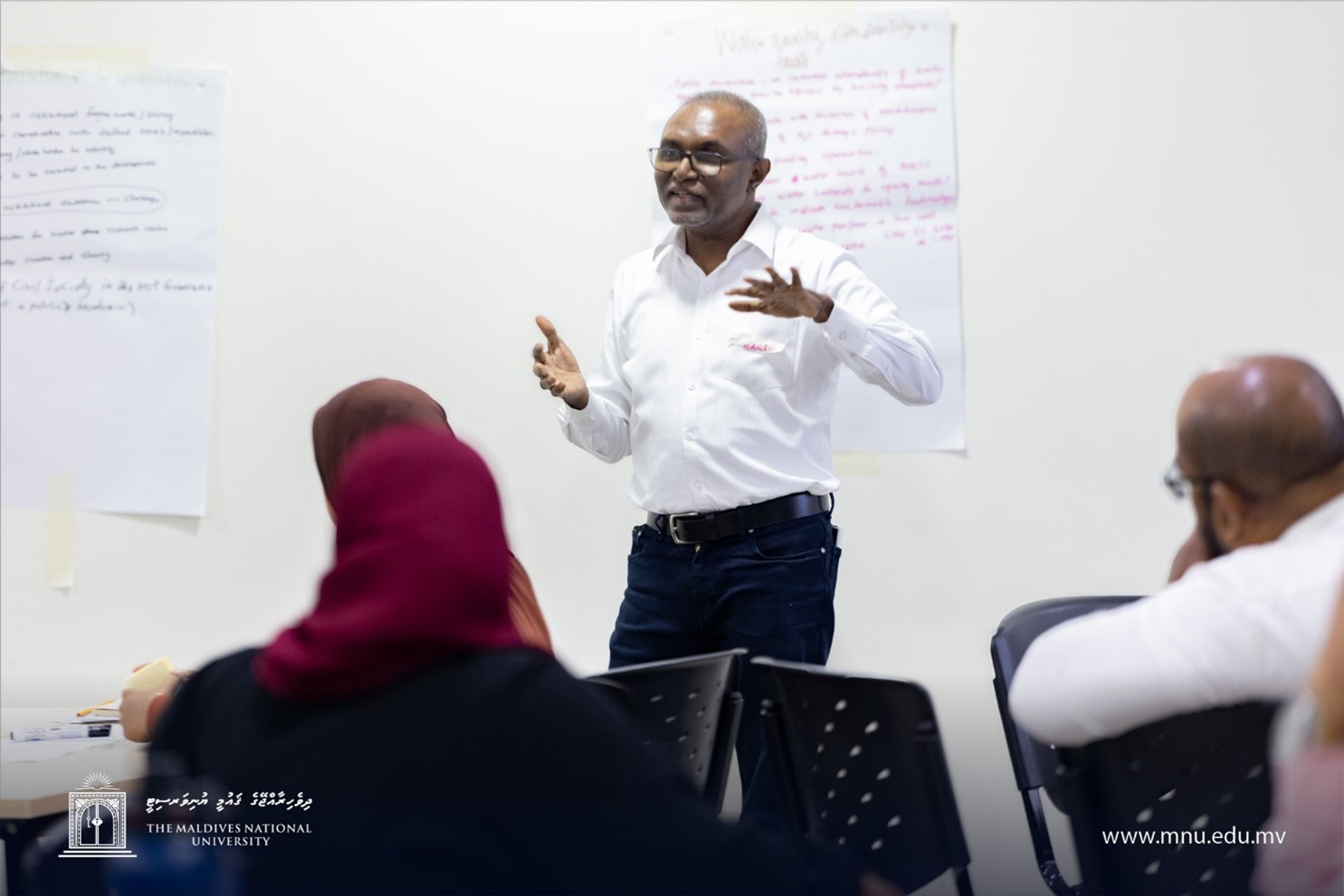
In 2025, the RECOVER project activities in the Maldives implemented by MNU in close collaboration with University of Waterloo made significant progress in expanding its research activities and generating knowledge products. The project broadened its research scope by introducing a new case study on the Biomass Flow Analysis of Food Systems in the Maldives. Three major surveys were fully designed, piloted, and implemented, covering household-level biomass flows, island-level food supply spot checks, and household water use. Key knowledge products included the completed policy brief, “Addressing Water Insecurity for Vulnerable Communities in Greater Malé, Maldives,” while two working papers on Real-World Labs (RWLs) and rainfall analysis reached advanced stages of development. The RECOVER team also co-hosted the CLARE Peer Learning Exchange on “Labs Approaches in CLARE” on 16 July 2025. In addition, project researchers participated in CLARE Exchange workshops in Zambia and Tanzania, respectively, strengthening opportunities for international learning and knowledge exchange.
The RECOVER project has a strong focus on climate adaptation and resilience, directly contributing to SDG 13 – Climate Action. Its 2025 activities also contributed to SDG 2 – Zero Hunger, SDG 6 – Clean Water and Sanitation, SDG 10 – Reduced Inequalities, SDG 11 – Sustainable Cities and Communities, SDG 12 – Responsible Consumption and Production, and SDG 17 – Partnerships for the Goals. These contributions were advanced through research on food systems and biomass flows, household water use and water insecurity, urban resource systems, vulnerable communities, and rainfall trends. The project also strengthened SDG 17 through Real-World Labs, collaborative research, international peer-learning exchanges, and knowledge sharing across the CLARE network.
|
Duration: 2 years (June 2024 to June 2026)
|
|
Grant Amount: CAD 1.2 million
|
|
Funding Body: CLARE program of IDRC-Canada and FCDO-U.K
|
Website