Introduction
Maldives controls one of the largest maritime territories. For that, the country relies heavily on maritime transport for food, fuel, medicine, construction materials, and almost every essential commodity, including maritime security operations across the archipelago.
Historically, Maldivians have been accomplished seafarers and shipbuilders. Traditional boats or dhonis (called in Maldivian language), built by locals using local timber, have enabled fishing, inter-island transport, and long-distance trade across the Indian Ocean. As one of the stories of a local hero, who saved the islands from (private) Portuguese invaders, goes, the boat, ‘Kalhuoffummi’, that was used to navigate the island chain against the captors was crafted and built by Maldivians in 1970. Commercially, Maldivian merchants have sailed seasonally to Colombo and southern India by exploiting the predictable northeast and southwest monsoon winds and presenting themselves as indigenous stewards of the sea.
Over the years, despite technological advancement across the region, much of its indigenous shipbuilding capability has neither improved nor been commercialised at an industrial level. As a result, the country is dependent on foreign-built vessels, overseas Maintenance, Repair and Overhaul (MRO) facilities, and imported spare parts. This includes boats used for security and defence operations.
As rising demand for sea transport places increasing pressure on both commercial and security agencies to expand their fleet, in size and number, it becomes strategically sensible to develop domestic shipbuilding capability, which is essential to strengthening self-reliance and resilience.
This article argues that, despite its limited resources, Maldives can bolster its shipbuilding capabilities by empowering local systems, especially in MRO and strengthening regional cooperation.
Strategic Autonomy and Small State Resilience
For small states, strategic autonomy should not be understood as isolation or total independence from external partners, but as the ability to minimise dependency on foreign actors in areas critical to national resilience and security.
For Maldives, maritime capability is one such area. Developing domestic shipbuilding and ship repair capacity can help address the inherent vulnerability created by dependence on foreign-built vessels, overseas maintenance facilities, and external supply chains. In practical terms, shipbuilding may not eliminate external dependency.
In Singapore, strategic autonomy is achieved not through complete self-sufficiency but by strengthening domestic capabilities in strategic sectors vital to national security and economic resilience.
It would make strategic sense to develop local capabilities to repair, shorten downtime, strengthen local skills, and enable the country to exercise greater economic autonomy, safeguard supply chains and compete in managing essential maritime assets.
In small states, the extent to which such a strategy can reduce vulnerability depends on scale, investment, technical expertise, and the ability to sustain a realistic industrial base. This means that a practical strategy for maritime security would include relying on regional partners wherever the country falls short in effectively mitigating threats at sea.
Maritime Dependency and Regional Cooperation
Aid dependence and regional cooperation are not mutually exclusive. In maritime security, Maldives has benefited from military aid cooperation, but not resulted in a dependency trap.
For example, the Maldives National Defence Force (MNDF) Coast Guard has benefited from India’s military aid, including the commissioning of Coast Guard vessels, equipment and training.
India has been one of the country’s principal maritime partners, transferring patrol vessels such as CGS Huravee and providing repeated refits, technical assistance, machinery upgrades, and spare parts through Indian naval shipyards and dockyards. For example, Huravee has undergone multiple major refits in India, illustrating the continuing reliance on foreign Maintenance, Repair and Overhaul (MRO) support for operational readiness.
In recent cooperation, Türkiye has delivered a Doğan-class fast attack craft CGS Dharumavantha, currently the largest naval vessel operated by MNDF Coast Guard.
Australia has also expanded bilateral maritime cooperation by donating a Guardian-class patrol vessel to enhance maritime intelligence, surveillance and reconnaissance (ISR) capabilities across the country’s vast Exclusive Economic Zone.
This fleet expansion will also come with demand for sophisticated technological and repair platforms.
Delivering equipment has aimed to bolster Maldives’ capabilities at sea, including building long-term interoperability with India and Australia. Since the early 1990s, the DOSTI exercise with India has helped Maldives to navigate its security training and operations at sea in collaboration with the Indian Navy.
Such defence cooperation does not merely constitute a negative dependency effect. Rather, dependency occurs with observable national stagnating effects of aid cooperation and undermines local economic growth.
For example, modern patrol vessels incorporate sophisticated propulsion systems, navigation equipment, communications technologies, and electronic components that often require original manufacturer support and specialised spare parts. When repairs require access to overseas dockyards or foreign technical expertise, maintenance and overhaul costs increase, vessel availability declines, and operational readiness may be compromised. Compromising dependency becomes particularly apparent during emergencies when rapid repair and redeployment are essential and must be acquired by foreign aid.
In this context, sustainable maritime security ultimately depends on strategy – i.e., for example, enhancing domestic MRO capacity.
Building Domestic Ship Repair Capability
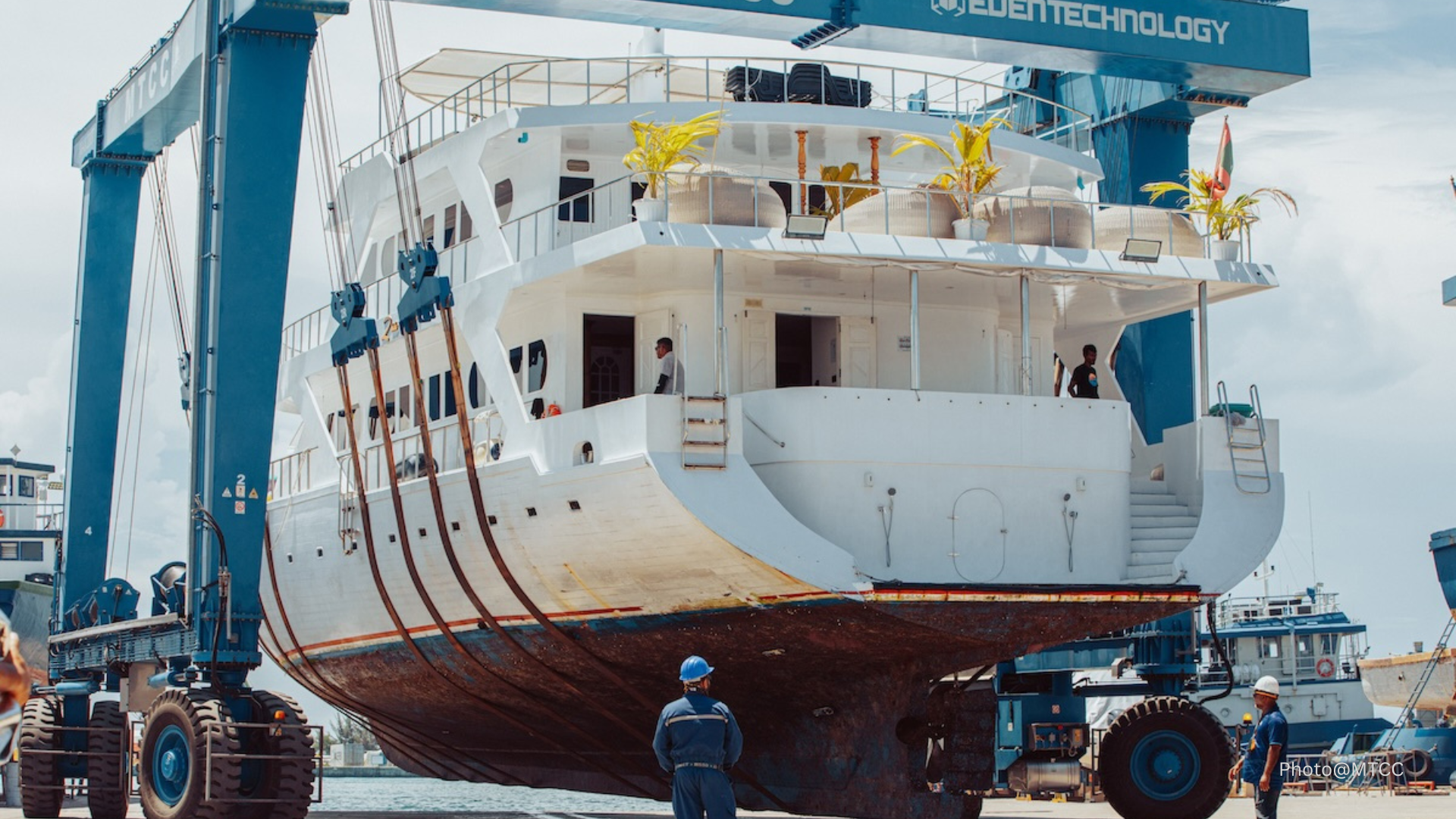
Developing indigenous ship repair capability is integral to greater maritime resilience and a necessary condition of maritime security strategy. For example, Maldives could initially prioritise expanding domestic dry-docking facilities, hull maintenance, marine engineering services, diesel engine overhauls, electrical repairs, corrosion control, and fabrication workshops.
Strategic factors will include domestic MRO facilities that would significantly reduce vessel downtime by eliminating the need for routine overseas repairs. Local engineering expertise can lower maintenance costs and reduce dependence on expensive imported technical services. Local supply chains can encourage greater use of commercially available components and compatible replacement parts where technically feasible, thereby reducing reliance on original equipment manufacturers for every repair.
Maldives currently records little formal shipbuilding activity. However, boat building, repair and metal fabrication remain recognised components of its maritime economy – i.e., as a maritime state, Maldives’ main industries like tourism, shipping and fisheries can benefit from industrialised local shipbuilding.
Moreover, sustained provision of MRO services to regional fishing vessels and commercial operators could enable the diversification of the economy while strengthening the country’s maritime profile.
Conclusion
Although international partnerships have substantially strengthened the operational capabilities of the MNDF Coast Guard, the country’s increasing dependence on foreign maintenance facilities, technical expertise, and specialised spare parts presents a strategic vulnerability.
For Maldives, developing domestic shipbuilding and, more importantly, ship repair capability offers a realistic pathway towards reducing this external dependency – i.e., rather, by becoming a more interoperable maritime security partner, regionally and globally.
Author
Lt Col Ahmed Jameel is a serving officer in the Maldives National Defence Force (MNDF), with 20+ years of experience in the maritime domain. He also has a postgraduate degree in International Relations from Salve Regina University, USA. The author acknowledges that the statements, opinions and arguments made are his own and do not reflect the Maldivian Government’s policies and position.