Introduction
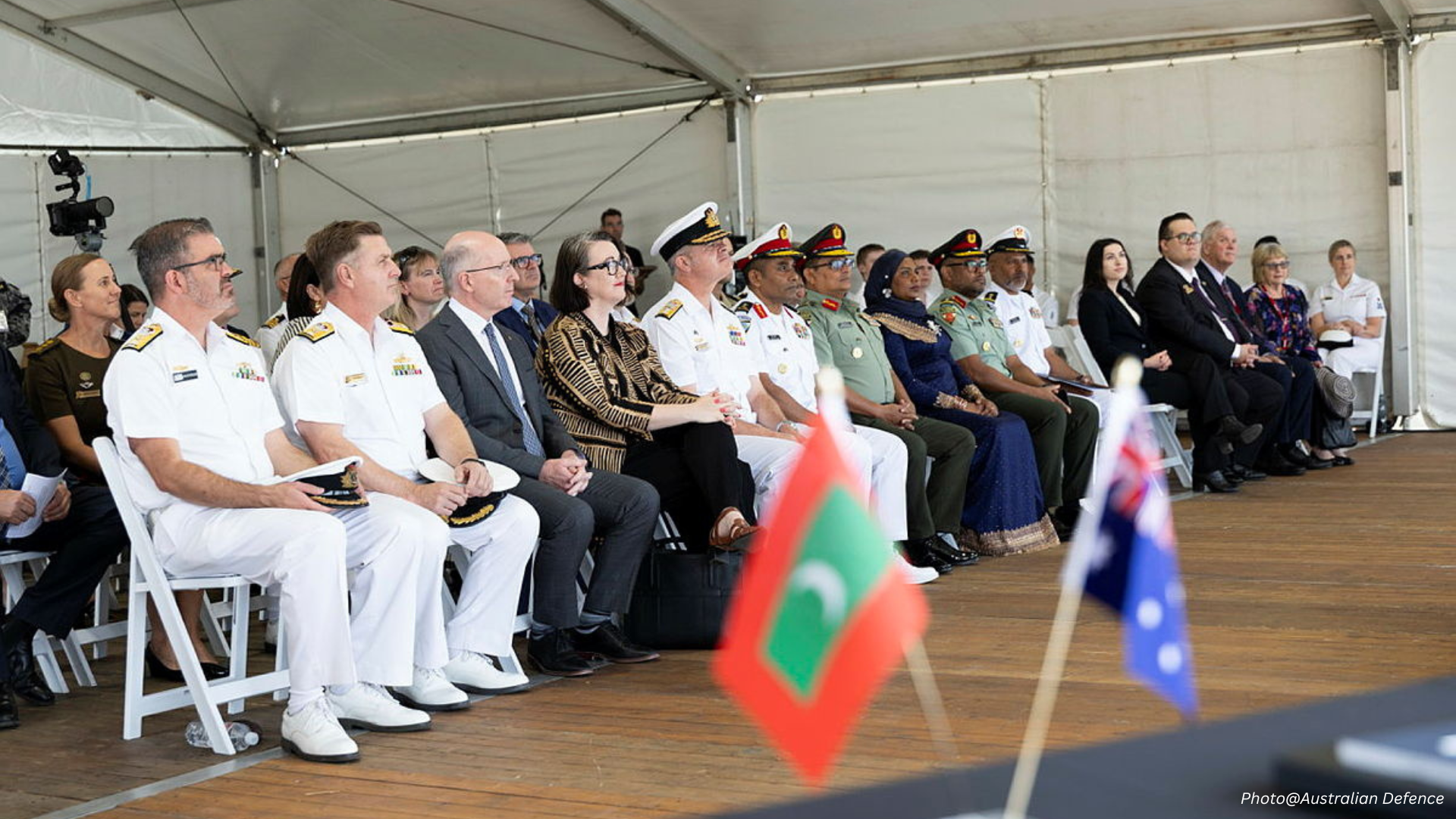
On 2 June 2025, Australian Deputy Prime Minister and Minister for Defence, Hon. Richard Marles MP, during an official visit to Maldives, announced the Australian Government’s decision to gift a steel‑hulled Guardian‑class Patrol Boat – designed and constructed by Austal Australia – to the Maldives National Defence Force (MNDF). Today, at HMAS Stirling in Western Australia, the official physical handover of the Patrol Boat took place between the Australian Defence and Maldives Defence and National Service and MNDF officials.
For Maldives, a Patrol Boat with advanced technological equipment – i.e., with overall length of 39.5m, an overall beam of 8m, a loaded draught of 2.5m and a cargo deck area of 16m², it can accommodate up to 23 personnel (not necessarily the exact spec of Maldives’ boat) – represents a significant addition to the MNDF Coast Guard’s fleet, bolstering its comparable capacity to navigate maritime threats.
For Australia, in its 50 years of diplomatic relations with Maldives, this transfer is monumental; it strengthens defence and security engagement and, in the words of Commander Maritime Border Command, Rear Admiral Brett Sonter, demonstrates a show of the country’s commitment “to working alongside Maldives to uphold a peaceful, secure and resilient Indian Ocean region.”
This development represents a profoundly significant achievement in both political and military cooperation, particularly in advancing the Indo‑Pacific strategy and enabling Maldives to maximise its opportunities to promote regional maritime governance and security, respectively, through building interoperability with Australia – i.e., Australia already holds a footing in Maldives, promoting military-to‑military diplomacy.
The Guardian‑class Patrol Boats and Small States
Not only are great powers interoperable at sea, particularly when navigating security challenges arising from vast, interconnected ocean territories, but small states are too. The United States and its Indo‑Pacific partners, including Australia, pursue security in both the Pacific and Indian Oceans by their force posture, especially through enhanced naval postures, rather than limiting operations to single‑region issues. The US Coast Guard operates beyond national territories, while the Australian Navy and Coast Guard adopt a similar approach, not only through alignment with the US, but also via regional missions and programmes with Pacific Islands’ security forces.
In this context, the Pacific Islands are not only interoperable with Australia or the United States today; they played a part in military missions dating back to the Second World War, particularly during United States campaigns against Japanese forces. Historically, islands such as the Mariana Islands served primarily as logistical resources for the US forces during the war. Today, however, technological advancement and the recognition of territorial rights have enabled these island states to actively assume maritime protection roles alongside broader Australian campaigns against transnational crimes.
The Guardian‑class Patrol Boats are part of Australia’s Pacific Maritime Security Program (PMSP) – i.e., this is a coordinated, all‑round program that delivers capabilities, infrastructure, sustainment, training, and operational alignment to strengthen maritime security across 16 island partner nations. The PMSP reflects Australia’s long‑term, 30‑year commitment to strengthening regional maritime security. It has delivered several Guardian‑class Patrol Boats, landing craft, and other maritime assets; provided major maintenance, sustainment, and supporting infrastructure; offered comprehensive crew training through the Royal Australian Navy and commercial partners; embedded in-country naval advisers; enabled intelligence-led patrols through contracted aerial surveillance; and enhanced regional coordination and communication. 23 Guardian‑class Patrol Boats have been delivered to Australia’s Pacific Partners.
Although Maldives is geographically situated in the Indian Ocean rather than the Pacific, the logic underpinning the PMSP-like initiative is increasingly relevant to Indian Ocean small states whose maritime security challenges mirror Australia’s broader interests in the Pacific, by extension of a incorporation of Australia’s small‑state maritime security model into the Indian Ocean.
A Strategy for Interoperability
Like the Pacific Islands, Maldives sits in an important ocean territory, where the world’s most critical shipping lanes, connecting the Straits of Hormuz, Bab el‑Mandeb, and the Strait of Malacca, traverse. The archipelago occupies a strategic epicentre of the Indo‑Pacific, and with a growing, increasingly sophisticated military and an expanding Coast Guard fleet, the country has a key role in navigating regional security in line with its national interests and priorities.
Among the MNDF Coast Guard’s largest platforms are the Coast Guard vessel Huravee, a Car Nicobar‑class patrol vessel acquired from India, and the vessel Dharumavantha, a TCG Volkan (P‑343), a Dogan‑class fast attack missile boat acquired from Türkiye. Now, with the Australia‑gifted Patrol Boat, the MNDF can further increase its capabilities to protect national waters from illegal vessels, criminal networks, and the effects of natural disasters.
While the exclusive economic zone (EEZ) remains the primary focus, Maldives also considers it important to address threats arising in international waters and distant regions. For example, Maldives’ satellite‑enabled drones (acquired from Türkiye) extend national surveillance far beyond the physical limits of its EEZ, allowing long‑range monitoring without flying beyond 200 nautical miles. High‑altitude operations, advanced sensors, and secure data links enable observation of distant maritime activity while remaining in uncontested airspace. Given limited Coast Guard assets, Maldives can adopt an information‑led enforcement model, cueing scarce platforms toward threats rather than maintaining constant presence. A recent MNDF operation integrating drones with the Coast Guard ship Dharumavantha demonstrated this approach.
With many threats originating outside national waters, the Coast Guard must build capabilities to foresee activities beyond Maldivian maritime boundaries. This is where regional cooperation, a mature component of Maldives’ military institution, becomes integral to national defence. For example, observe the Dosti trilateral exercises between Maldives, Sri Lanka, and India that have shown advanced engagements between regional actors to share information on maritime threats and increase preparedness.
Australian assistance can bolster this form of interoperability within the Coast Guard – i.e., in terms of military diplomacy and military‑to‑military engagements, Australia’s Indo‑Pacific Endeavour (IPE) has made meaningful impacts on connectivity between military knowledge and practice. The supply of a high‑technology vessel to the Coast Guard not only shapes MNDF operational capacity but also builds confidence that the data points created by Maldives can prove as accurate and reliable to Australian counterparts at sea.
The Patrol Boat augments the overall capability of the MNDF Coast Guard. This means that Maldives’ cooperation with Australia will not be limited to the output of this particular vessel alone – this is not purely reciprocal, but rather a mutual calculus. The Patrol Boat will serve as a strategic link that can further improve diplomatic and military cooperation and advance data‑sharing mechanisms more broadly across the Indian Ocean security architecture.
During today’s handover ceremony in Australia, Rear Admiral Brett Sonter assured that:
“Australia’s delivery of this Guardian-class Patrol Boat to Maldives is the product of close cooperation between our two nations and demonstrates the trust, respect and shared purpose that underpins our defence relationship.
“It is also a significant achievement for Australia’s shipbuilding industry and demonstrates the enduring value of Australia’s investment in regional maritime capability.
Brigadier General Mohamed Saleem, Commandant, Maldives National Defence Force Coast Guard, similarly emphasised that:
“Australia has been a reliable and consistent developmental partner, and Maldives will continue to work with Australia on areas of mutual concern.
“Maldives recognises the significance of our location and is firmly committed to working with Australia, as well as other regional and international partners, to ensure the safety, security, stability and continued prosperity across the Indo-Pacific region.”
Conclusion
The transfer of a Guardian‑class Patrol Boat marks a decisive step in Maldives–Australia defence cooperation. Beyond capability enhancement, it institutionalises interoperability, reinforces maritime governance, and embeds Maldives within a wider Indo‑Pacific security network. This partnership strengthens collective resilience across the Indian Ocean and advances shared strategic interests.
Author
Dr Athaulla A Rasheed is the Head of Centre at the Centre for Security and Strategic Studies at The Maldives National University. A former foreign service officer and diplomat at the Ministry of Foreign Affairs, Maldives, Athaulla also holds two PhDs in international and strategic studies, and political science from ANU and the University of Queensland, Australia. He is also the author of 2025 book, ‘Small States Maritime Security: The Indo-Pacific Strategy for Maldives’, published by The Maldives National University.