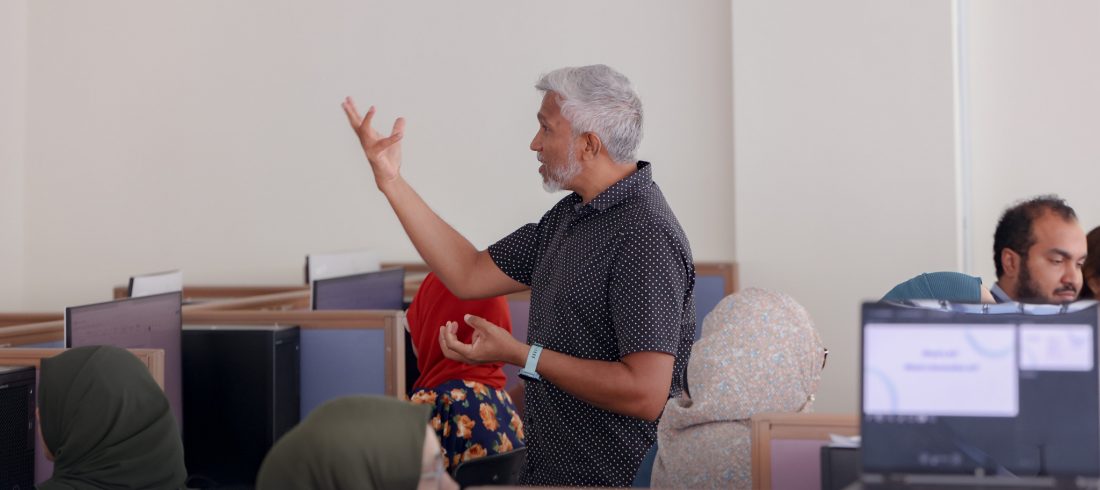
The Maldives National University (MNU) has advanced its digital transformation efforts through a professional development workshop titled “Smart Workdays: Automating Everyday Tasks with AI,” equipping academic and administrative staff with practical knowledge of artificial intelligence to streamline routine tasks, improve workplace productivity, and strengthen digital competencies.
Facilitated by Mohamed Jailam, Chief of Javaabu Academy, the workshop highlighted the growing potential of artificial intelligence to transform everyday working practices in higher education. Bringing together academic and administrative personnel, the programme focused on making AI technologies more accessible and relevant to the diverse responsibilities of university staff.
A central focus of the session was introducing fundamental AI concepts and exploring practical approaches to automating repetitive tasks. Participants were familiarised with accessible AI-powered tools that can support professional communication, improve time management, and simplify routine administrative and academic activities. The training emphasised how the purposeful use of technology can help staff organise responsibilities more effectively and strengthen workplace efficiency.
A key highlight was the introduction of Dhivehi GPT, an AI tool supporting Dhivehi-language applications. By showcasing locally relevant technology, the workshop drew attention to opportunities for integrating AI into tasks involving the national language, contributing to more inclusive and contextually appropriate digital working practices.
To encourage continued learning beyond the workshop, participants who completed the programme were offered one month of complimentary access to Dhivehi GPT. This opportunity was intended to enable staff to explore the platform independently, practise newly introduced skills, and identify potential applications within their respective professional roles.
Beyond technical training, the workshop underscored the importance of building digital confidence and encouraging a culture of continuous learning across the university. By involving both academic and administrative staff, the initiative promoted broader awareness of AI-supported working practices and their potential contribution to institutional efficiency.
The programme also highlighted the importance of developing a workforce capable of adapting to emerging technologies while maintaining effective communication, professional judgement, and quality service delivery. Strengthening these competencies can support more responsive university operations and encourage innovation in everyday professional practices.
The initiative aligns with broader priorities of quality education, digital literacy, lifelong learning, decent work, technological innovation, local language inclusion, professional capacity development, and institutional efficiency. Through continued investment in AI-related training, MNU aims to foster a digitally capable, adaptable, and future-ready workforce that supports innovation and sustainable institutional development.