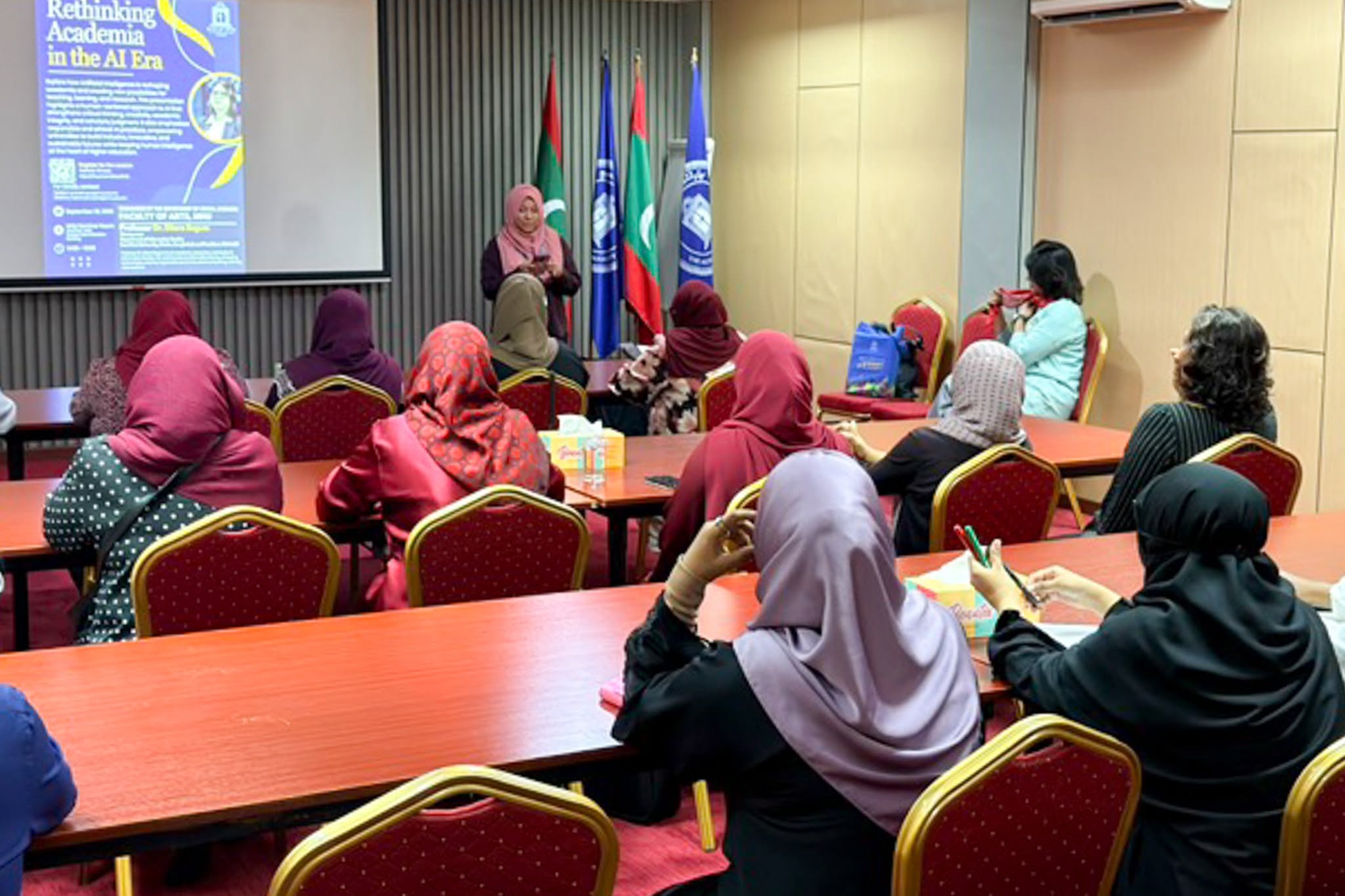
The Faculty of Arts at The Maldives National University (MNU) conducted a guest lecture titled “Rethinking Academia in the AI Era” on 23 September 2026. Facilitated by Professor Dr Dilara Begum of East West University, Bangladesh, the session provided an opportunity for academics to examine how artificial intelligence (AI) is reshaping higher education and influencing teaching, learning, and research practices.
The session explored emerging patterns of AI use among university students, highlighting the importance of developing AI literacy within academic communities. Discussions focused on helping students and educators understand AI capabilities and limitations, use AI tools effectively, and evaluate AI-generated information critically in academic settings.
Academic integrity and responsible AI use were also central themes. Participants considered the ethical challenges associated with integrating AI into university work, including the importance of transparency, responsible use, and maintaining academic standards. The discussion encouraged reflection on how higher education institutions can adapt their practices while preserving the quality and credibility of academic work.
An additional area of discussion was the potential establishment of an AI Literacy Desk to strengthen institutional support for the informed and ethical use of AI. The proposed initiative could provide guidance and resources to help academics and students develop their understanding of AI and apply it appropriately in teaching, learning, and research. This was discussed as a potential approach to supporting AI literacy rather than a confirmed institutional service.
The guest lecture provided a platform for professional knowledge exchange between MNU academics and an international academic expert. By addressing the opportunities and challenges associated with AI in higher education, the session encouraged informed discussion on institutional readiness, academic responsibility, and the evolving skills required in an increasingly technology-enabled learning environment.
The initiative contributed to SDG 4 (Quality Education) by promoting AI literacy and responsible approaches to teaching and learning; SDG 9 (Industry, Innovation and Infrastructure) through discussion of emerging technologies and their application in higher education; SDG 16 (Peace, Justice and Strong Institutions) by addressing academic integrity, ethical responsibility, and institutional guidance; and SDG 17 (Partnerships for the Goals) through international academic knowledge exchange. Its relevance to SDG 8 (Decent Work and Economic Growth) lies in the potential for AI literacy to support the development of skills needed in changing professional environments.