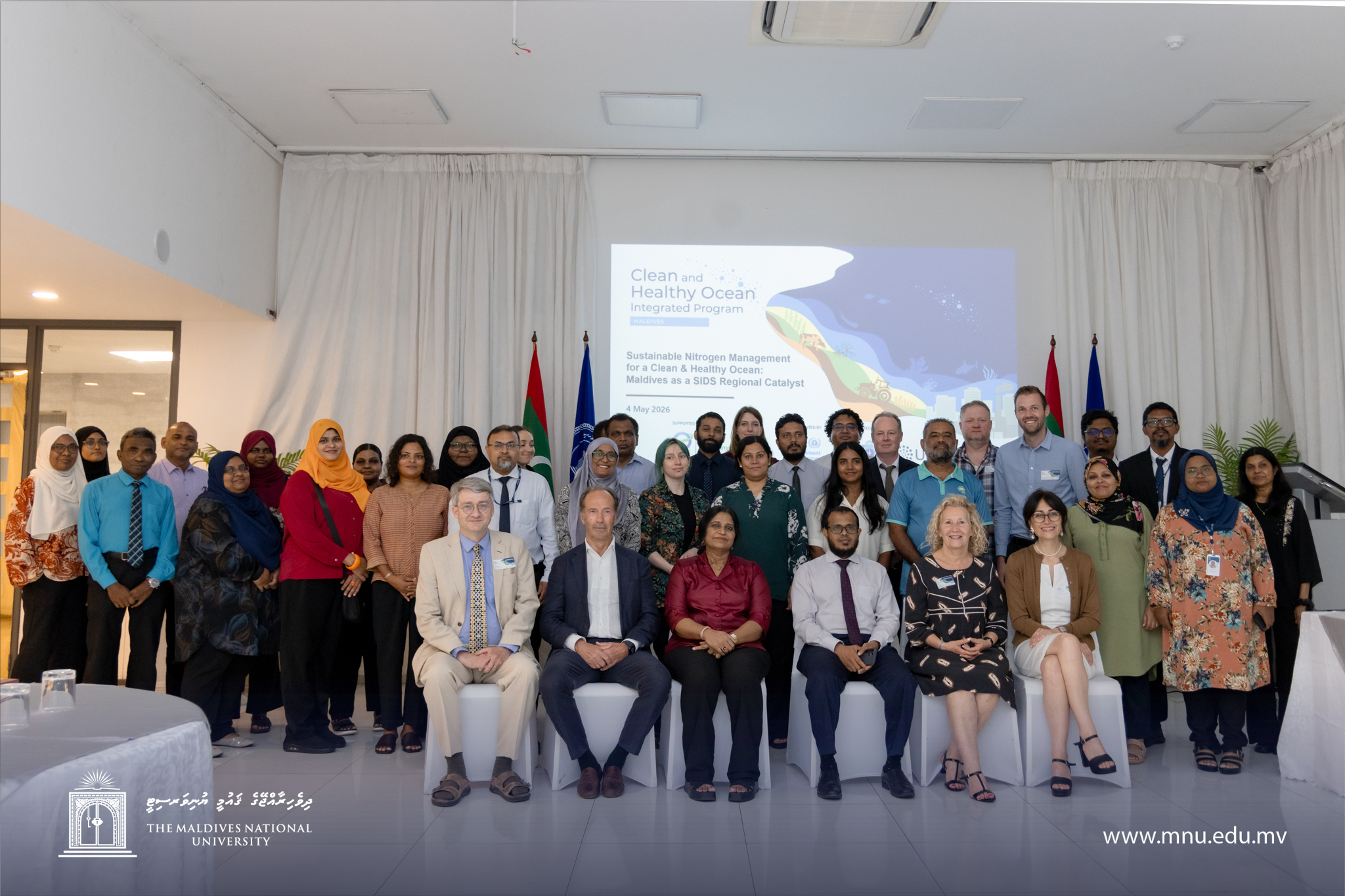
Sustainable Nitrogen Management for a Clean and Healthy Oceans Maldives project is jointly executed by the Maldives National University (MNU) and UK Centre for Ecology & Hydrology (UKCEH) in association with the United Nations Environment Program (UNEP). CHOMV aims to contribute to the global and national efforts to curb marine pollution from agricultural, industrial and municipal sources by delivering transformational change. The program aims to accelerate both global commitments and national reforms and investments to prevent excessive and uncontrolled nutrient loads from reaching coastal waters.
The Maldives is globally important as a biodiversity hotspot, being the fifth most diverse ecosystem of the world’s reefs. As a combined result of climate change (coral bleaching) and nutrient pollution, these reefs are under critical threat, including local effects of relevance for both fisheries and tourism. Degradation of the marine and coastal ecosystems can lead to social and economic impacts including a possible decline in tourism through a loss of the aesthetic appeal of reef tourism, through the loss of important fisheries, and negative impacts on human health through water and air quality. Further impacts include loss of coastal water ecosystem quality (damage to coral reefs, changes in seagrass cover and condition), fish kills (recent observations in 2023 need further examination to better understand the climate and water quality interactions), air quality and climate change, all linked through nitrogen and nutrient pollution. Increasing population, changing consumption and transport patterns, and increasing tourism, provide drivers for worsening nitrogen pollution, which need to be addressed.
The project results framework is structured according to four main components/outcomes, each of which is necessary lead the change.
- Component 1: Strengthened national and international policies for sustainable nitrogen management will provide examples for sharing with other regions and SIDS. A key deliverable under this component will be to develop a national action plan to strengthen policies related to nitrogen losses in order to protect marine ecosystems and support sustainable livelihoods.
- Component 2: Adoption of sustainable nitrogen management practices. The specific investments to be developed and the amplification through Nitro Finance will provide useful resources across the CHO programme and beyond.
- Component 3: The nitrogen education materials and lessons will be shared with the CHO program.
- Component 4: The capacity building for quantitative assessment, demonstration and mobilization will provide necessary data for the Maldives, but also resources on methods and approaches that can be used more widely across the CHO program and wider GEF8 etc.
CHOMV is one of 13 similar global projects funded by the Global Environment Facility (GEF) as part of its Clean and Healthy Ocean Integrated Program delivered by the Food and Agriculture Organization of the United Nations (FAO).
Status: On-going
Key outcomes
Outcome 1: Maldives oversees its first national nitrogen action plan and demonstrates best practices at regional and global level
Outcome 2: Stakeholders adopt sustainable nitrogen management practices and Maldives attracts investment through the promotion of Nitro-Finance
Outcome 3: Mainstreaming nitrogen and nutrient education for project beneficiaries to apply increased awareness and knowledge on nutrient pollution sources, impacts and solutions
Outcome 4: Build a robust system for data collection & and analyis along with a body of evidence demonstrating the benefits of reducing nitrogen and other nutrients (e.g. P) to the marine environment.
Links to Sustainable Development Goals
- The project has the main focus on SDG 14 (Life Below Water), it focuses on marine pollution prevention & reduction. The project also acknowledges the interconnectedness of environmental challenges and recognizes that nitrogen pollution impacts multiple SDGs.
- SDG 2 (Zero Hunger): Best nitrogen management practices in agriculture can enhance soil fertility and crop yields, contributing to food security.
- SDG 8 (Decent Work and Economic Growth): The project’s focus on ’Nitro-Finance’ aims to highlight the economic value of wasted nitrogen resources and explore options for sustainable economic growth and business creation.
- SDG 12 (Responsible Consumption and Production): By promoting sustainable nitrogen management practices across various sectors, the project encourages responsible consumption and production patterns.
- SDG 13 (Climate Action): The project will investigate the role of BMPs in agriculture and nitrogen pollution through the emission of nitrous oxide (N2O).
|
Duration: 5 years (June 2025 to July 2031)
|
|
Grant Amount: USD 4.5 million
|