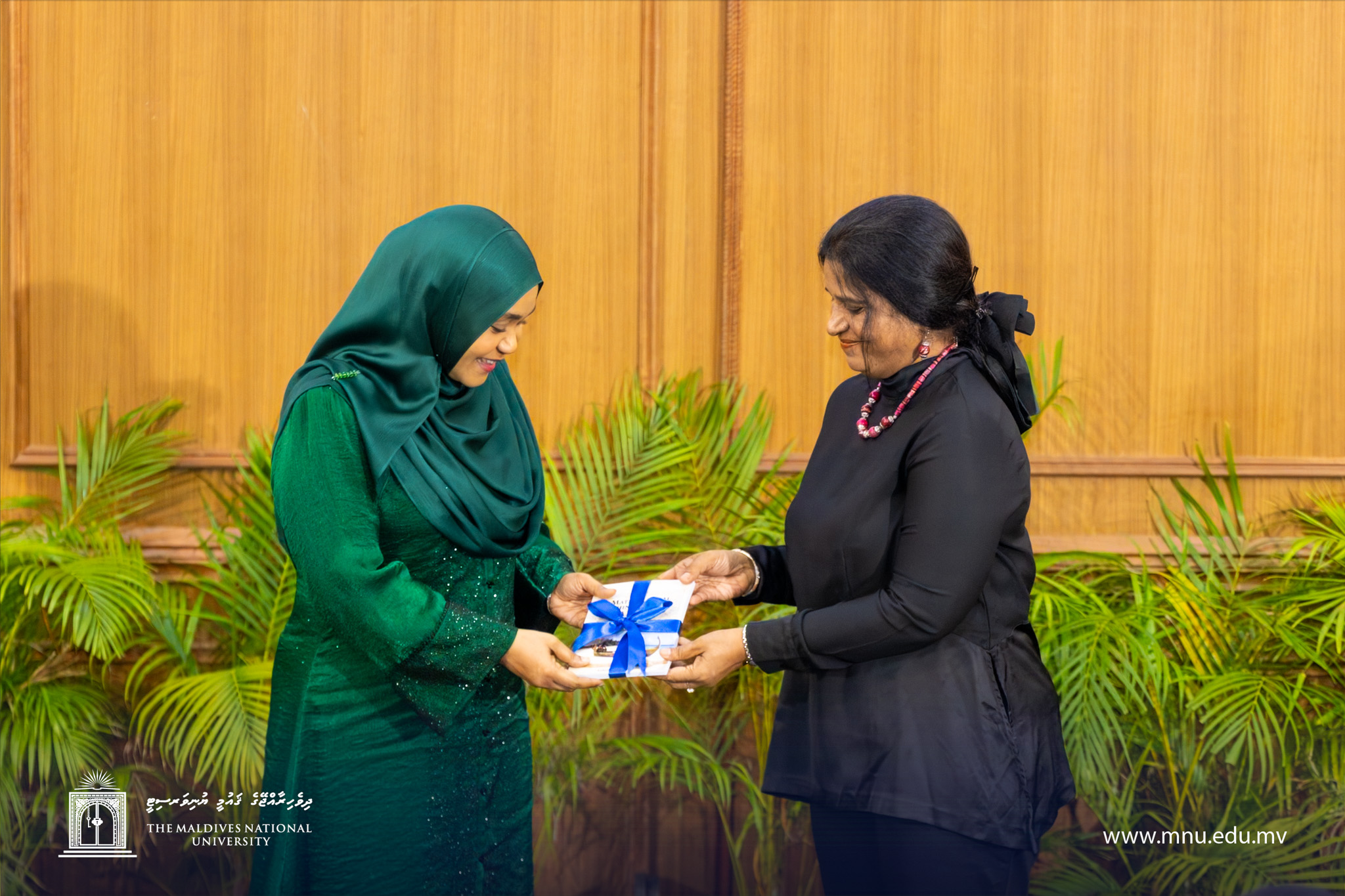
The Maldives National University (MNU) today launched Mathematical Thinking in the Maldives: Ethnomathematics, Cultural Heritage, and Curriculum Integration, a pioneering publication by MNU Vice Chancellor, Dr. Aishath Shehenaz Adam. The book documents the rich mathematical knowledge embedded within Maldivian culture and explores how indigenous knowledge can strengthen contemporary mathematics education.
The book was officially launched by the First Lady of the Republic of Maldives, Her Excellency Madam Sajidha Mohamed, at a ceremony held at the MNU Central Auditorium attended by educators, researchers, students, policymakers, and members of the wider community.
Quote from the First Lady, Her Excellency Madam Sajidha Mohamed
The publication is one of the first comprehensive works dedicated to documenting traditional Maldivian mathematical practices. Drawing on research conducted during Dr. Adam’s master’s and doctoral studies, together with insights gained from her postdoctoral research in Alaska on culturally responsive mathematics education, the book demonstrates that mathematics is not confined to classrooms but is deeply connected to culture, livelihoods, traditions, and everyday life.
The book documents traditional counting systems, measurement practices, estimation techniques, spatial reasoning, and problem-solving methods found in activities such as fishing, boat building, navigation, agriculture, construction, mat weaving, and household life. It also examines how interactions with Arab-Islamic, South Asian, Chinese, and European cultures have influenced mathematical practices in the Maldives while highlighting the uniquely Maldivian ways in which these ideas have evolved over generations.
A key contribution of the publication is the development of an Ethnomathematical Curriculum Model that provides a practical framework for integrating cultural knowledge into mathematics education. The model encourages teachers to connect mathematical concepts with familiar cultural experiences, making learning more meaningful and relevant for students while strengthening appreciation for their heritage.
Quote from Dr. Aishath Shehenaz Adam
[Today marks end of journey that began not with the intenstion of writing a book, but with a simple question? Can Mathematics be part of culture?]
The launch ceremony also featured remarks from internationally recognised scholars in the fields of ethnomathematics and cultural anthropology.
Professor Wilfredo V. Alangui of the University of the Philippines, a leading scholar in ethnomathematics, highlighted the importance of documenting indigenous knowledge systems and recognising the diverse ways in which communities around the world engage in mathematical thinking.
Quote from Prof. Wilfredo V. Alangui
Professor Frank Heidemann of the University of Munich reflected on the significance of cultural knowledge, heritage, and community practices in understanding how societies develop and transmit knowledge across generations.
Quote from Prof. Frank Heidemann
The publication contributes to national efforts to preserve and promote Maldivian cultural heritage while advancing educational innovation. It aligns particularly with Sustainable Development Goal (SDG) 4: Quality Education by promoting culturally responsive approaches to teaching and learning, and SDG 11: Sustainable Cities and Communities through the preservation and documentation of indigenous cultural knowledge. The book also supports broader efforts to recognised local knowledge systems and strengthen connections between culture, education, and sustainable development.
Speaking on the significance of the publication, Dr. Adam noted that mathematics is not only a universal discipline but also a living expression of culture. By recognising and valuing the mathematical knowledge embedded within Maldivian traditions, the book offers pathways towards more inclusive, meaningful, and culturally relevant education while preserving an important part of the nation’s heritage for future generations.
The book is expected to serve as a valuable resource for educators, curriculum developers, researchers, students, and anyone interested in the relationship between culture, education, and mathematics.
About the Author
Dr. Aishath Shehenaz Adam is Vice Chancellor of The Maldives National University and a leading scholar in mathematics education. Her research has focused on ethnomathematics, culturally responsive teaching, curriculum development, indigenous knowledge systems, and mathematics education. Through her master’s, doctoral, and postdoctoral research, she has explored how cultural knowledge can enrich learning and strengthen educational outcomes.