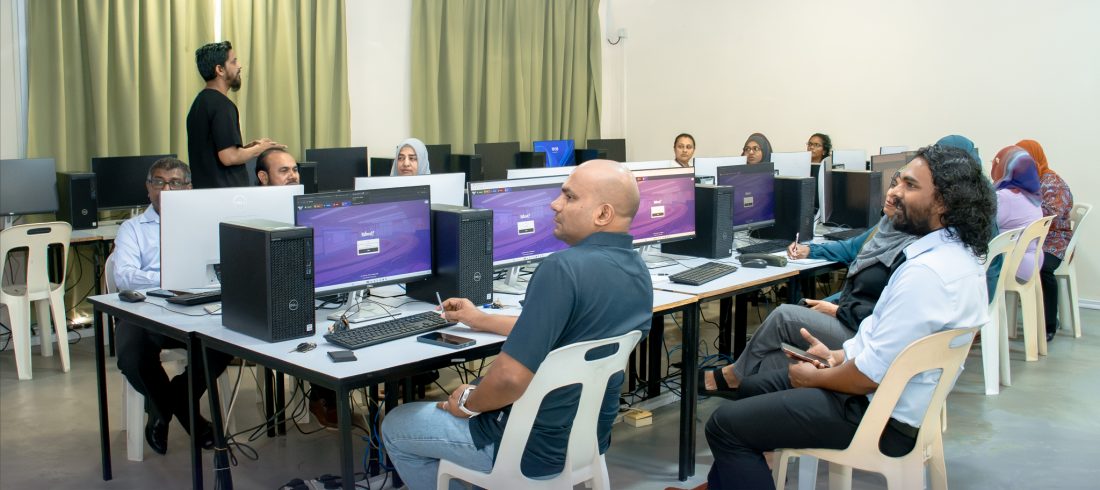
The Maldives National University (MNU) has strengthened its efforts to integrate emerging technologies into academic workplaces through a professional development workshop titled “Smart Workdays: Automating Everyday Tasks with AI,” aimed at helping lecturers use artificial intelligence to streamline routine responsibilities, improve communication, and manage their time more effectively.
Facilitated by Mohamed Jailam, Chief of Javaabu Academy, the workshop highlighted the growing relevance of artificial intelligence in higher education and its potential to support academic staff beyond traditional teaching activities. The programme focused on making AI and automation tools more accessible, enabling lecturers to explore practical applications that can simplify everyday professional tasks.
A central focus of the session was introducing fundamental AI and automation concepts, with particular attention to reducing repetitive workloads and improving workplace productivity. Participants explored how freely available AI tools can assist with routine communication, task organization, and time management, allowing academic staff to identify opportunities for more efficient working practices.
A key highlight of the workshop was the introduction of Dhivehi GPT, drawing attention to the potential of locally relevant AI technologies to support tasks involving the Dhivehi language. The session encouraged participants to consider how language-accessible digital tools could contribute to more effective communication and greater technological inclusion within the Maldivian higher education context.
To extend learning beyond the workshop, participants who completed the programme were offered one month of complimentary access to Dhivehi GPT. This opportunity was intended to encourage independent exploration, strengthen familiarity with AI applications, and help lecturers assess how the tools could support their daily academic responsibilities.
Beyond technical competencies, the training underscored the importance of continuous professional development in preparing educators for an increasingly technology-driven workplace. By strengthening digital confidence and encouraging the responsible exploration of emerging tools, the initiative sought to support academic staff in adapting to changing professional demands.
The workshop also highlighted the wider potential of AI-supported productivity to improve institutional efficiency. Reducing time spent on repetitive tasks can create opportunities for lecturers to devote greater attention to teaching preparation, academic engagement, and other professional responsibilities.
Aligned with priorities of quality education, digital literacy, lifelong learning, decent work, technological innovation, local language inclusion, and professional capacity development, the initiative reflects MNU’s continued commitment to building a digitally skilled, adaptable, and future-ready academic workforce.