MNU contributes to pioneering research published in Scientific Reports, highlighting the growing resource demands of protecting the Maldives against sea-level rise.
The Maldives National University (MNU) is excited to announce its contribution to the Landmark international research study, “Material requirements for adapting to climate change in the Maldives,” published in Scientific Reports, a Nature Portfolio journal. The study provides the first country-level estimates of the physical resources required for coastal adaptation to sea-level rise, offering critical new evidence to inform climate adaptation planning in the Maldives and other Small Island Developing States (SIDS).
Led by Professor Simron Singh of the University of Waterloo, Canada, the research brings together an international team of scientists from the University of Waterloo, University of Augsburg, University of Melbourne, BOKU University Vienna, and MNU. The study was undertaken through the RECOVER (Resilience to Climate Vulnerability and Environmental Risk) project, funded under the Climate Adaptation and Resilience (CLARE) programme, supported by the UK’s Foreign, Commonwealth and Development Office (FCDO) and Canada’s International Development Research Centre (IDRC).
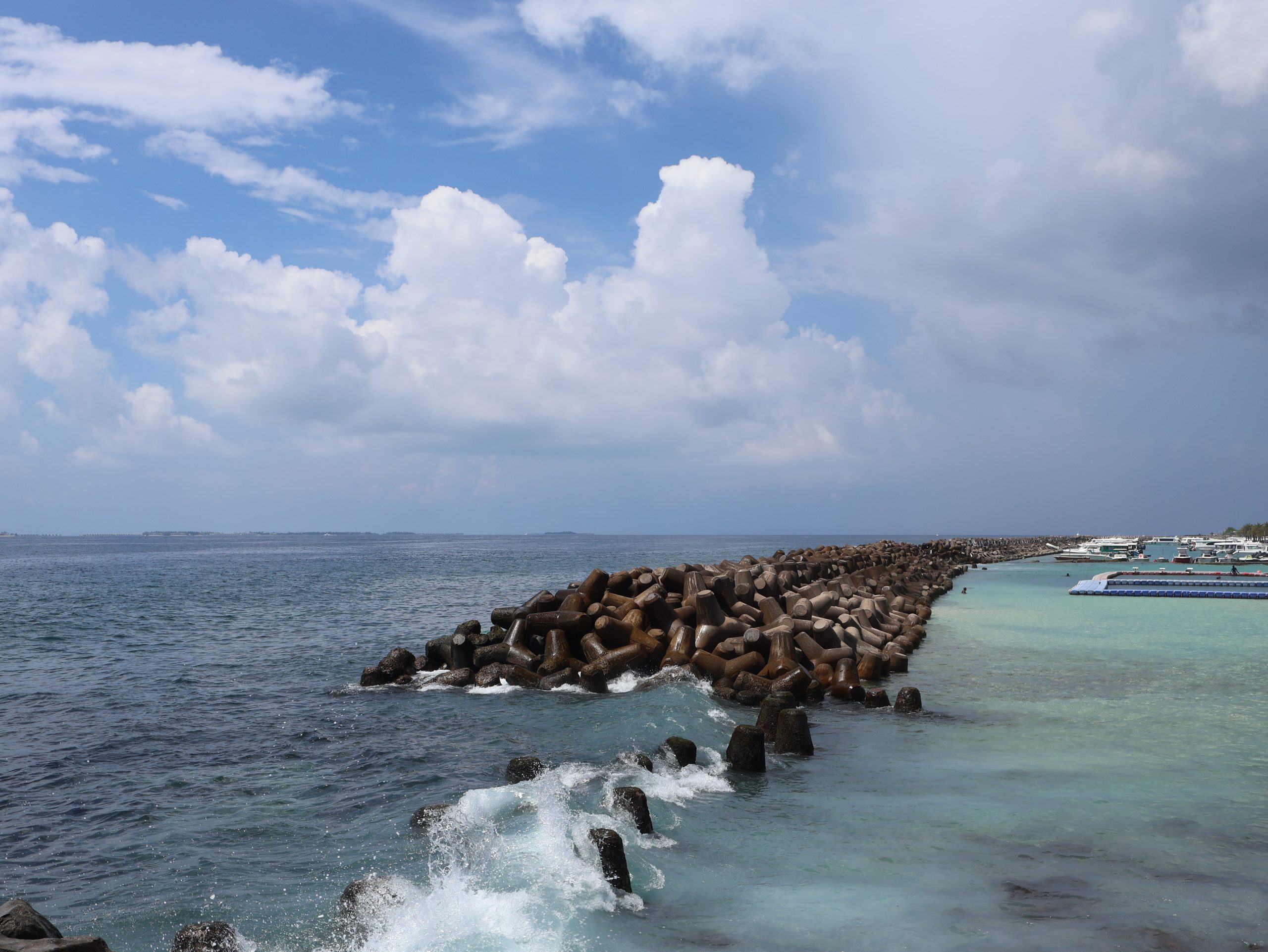
As one of the most climate-vulnerable nations in the world, the Maldives faces increasing pressure to protect its islands, communities and critical infrastructure from rising sea levels. While coastal protection and land reclamation are essential adaptation strategies, their long-term material requirements have received limited attention. Using GIS based material stock and flow analysis and scenario modelling, the research estimated the materials required for major hard-engineered adaptation measures, including breakwaters, groynes, revetments, land reclamation and island raising, over the period 2000–2100. The findings reveal the substantial scale of resources required to sustain these adaptation measures over the coming decades.
For every additional centimeter of sea-level rise, the Maldives could require approximately:
- 1 million tons of sand for reclaimed land.
- 22,200 tons of construction materials for shoreline protection.
These findings demonstrate that climate adaptation extends far beyond the initial construction of coastal defenses, creating substantial long-term demands for materials, infrastructure maintenance, financing and technical capacity.
Reflecting on significance of the findings, Dr. Shazla Mohamed, Senior Research Fellow at MNU and co-author of the study, commented: “This research brings a new perspective to the challenges of climate adaptation in the Maldives. By quantifying the resources needed, we can better understand the implications of our adaptation choices and explore solutions that balance coastal protection with environmental sustainability.”
The study highlights the importance of considering the economic, environmental and resource implications of adaptation decisions, while emphasizing the need for inclusive national dialogue, strengthened climate finance, knowledge transfer and international technical cooperation. Together, these efforts are essential to advancing sustainable adaptation strategies and building a more resilient, resource-secure and sustainable future for the Maldives and other climate-vulnerable Small Island Developing States.
The article can be accessed from: https://www.nature.com/articles/s41598-026-61428-3
For more information please contact: research@mnu.edu.mv