Introduction
Maldives occupies a pivotal position to influence regional politics and security, by drawing the interest of regional actors to invest in and support its development. Situated adjacent to major international shipping lanes and maritime chokepoints, Maldives occupies a strategic position in global trade and energy transit. Key routes linking the Bab al-Mandab and Malacca Straits pass through its surrounding waters, not only facilitating the movement of oil, gas, and commercial goods but also attracting the attention of major security actors, including India or China.
This analysis looks at the strategic role of Maldives’ geo-economy in the Indian Ocean security architecture. Given the potential disruption of maritime traffic arising from the ongoing war in West Asia, policy and technical analysis of Maldives’ geo‑economy, and how that information via maritime domain awareness (MDA) can be used for regional engagements has become increasingly relevant.
Securing Small States’ MDA and Geo-economics
Naval exercises, military engagements, and infrastructure-based investments run under India’s MAHASAGAR vision and China’s Belt and Road-linked projects underscore the strategic significance of the Indian Ocean region. In that, the security of the Indian Ocean would require securing the smaller states, like the Maldives, Sri Lanka or Seychelles. For example, Maldives participates in the Information Fusion Centre – Indian Ocean Region (IFC-IOR) hosted by the Indian Navy. This is a platform for Maldives to interact with small and large security actors. IFC-IOR creates MDA and can build the capacity of Maldives to identify and address maritime security threats at the regional level. Hence, Maldives can shape regional politics using its economic bargaining power derived from tourism, trade, and broader economic engagements that link it to the rest of the world.
Economic activity – particularly trade, tourism, and foreign investments – across the Indian Ocean has elevated the strategic imperative for robust MDA. Maldives’ economy is heavily reliant on tourism and foreign investments, and hence, maritime stability is a guarantor of the sustainability of these activities. In that, MDA systems, like collective security, can build capability for real-time monitoring of maritime traffic, deter illegal activities such as piracy and trafficking, and safeguard critical infrastructure, including ports and offshore assets.
Collective security in practice is constituted by the exchange of information and services between cooperating security partners. In that, while reliance on tourism and regional trade heightens the imperative for maritime security, MDA is reinforced by coordinated surveillance and information-sharing, which can in turn secure the economic trades of Maldives.
Maldives’ Maritime Security and Stability in the Indian Ocean
Maldives’ significance is not confined to the scale of its local defence industry or military force but is rather shaped by its role as a major global tourism hub, an important data point within critical maritime spaces. Hosting more than two million international tourists annually, against a resident population of barely half a million, Maldives seasonally accommodates a population far exceeding its demographic capacity. This reality can have direct implications for the country’s military and defence calculus, particularly in the maritime domain.
Maritime threats and the infiltration of criminal organisations into Maldivian waters go beyond conventional security concerns. They threaten the fragile socio-economic ecosystem of climate-vulnerable islands that depend on uninterrupted maritime access for tourism, trade, food security, and energy supplies. In this context, maritime insecurity does not merely challenge state sovereignty; it amplifies risks to human security, investor confidence, and the sustainability of economic activities that anchor the country’s stability.
Contemporary maritime security challenges faced by Maldives are further intensified by global crises, particularly the one ongoing in West Asia. Instability in and around West Asia has measurable ripple effects on global energy markets, shipping routes, and insurance premiums – all of which affect small, import-dependent states such as Maldives. As an economy that relies almost entirely on external shipments for fuel, food, and construction materials, any disruption along key sea lanes of communication in the Indian Ocean can have immediate and cascading consequences for domestic economic activity. This interdependence is critical for maritime security assessments: what Maldives experiences as an economic shock may also signal broader vulnerabilities within the Indian Ocean security environment.
For example, fluctuations in fuel prices, logistics delays, and declining investor confidence can slow local development projects, constrain public services, and undermine business continuity in the tourism sector. Over time, such pressures can produce strategic challenges that transcend economics, affecting social resilience and national security. Consequently, maritime security data and threat assessments in Maldives offer insights into how global shocks translate into localised instability within small states.
Domestic economic stress, in turn, shapes foreign policy behaviour and partnership choices as Maldives seeks to safeguard sustainability and national interests. Periods of external shock often compel the state to re-evaluate its diplomatic alignments and deepen functional cooperation with key partners. In this setting, maritime security engagement can increasingly merge with broader economic and diplomatic priorities.
Maldives’ case illustrates how economic viability is deeply embedded within national security thinking: any sustained threat to tourism, maritime trade, or investor confidence can ultimately challenge sovereignty itself. External crises can manifest in indirect ways – for example, when global uncertainty discourages tourists from travelling, reducing foreign exchange earnings and fiscal space. To mitigate such vulnerabilities, Maldives always remains a reliable regional security partner and an active contributor to maritime stability in the region. This necessitates a geo-economic approach to maritime security, one that emphasises defence diplomacy, capacity-building, and confidence-building measures rather than purely kinetic responses.
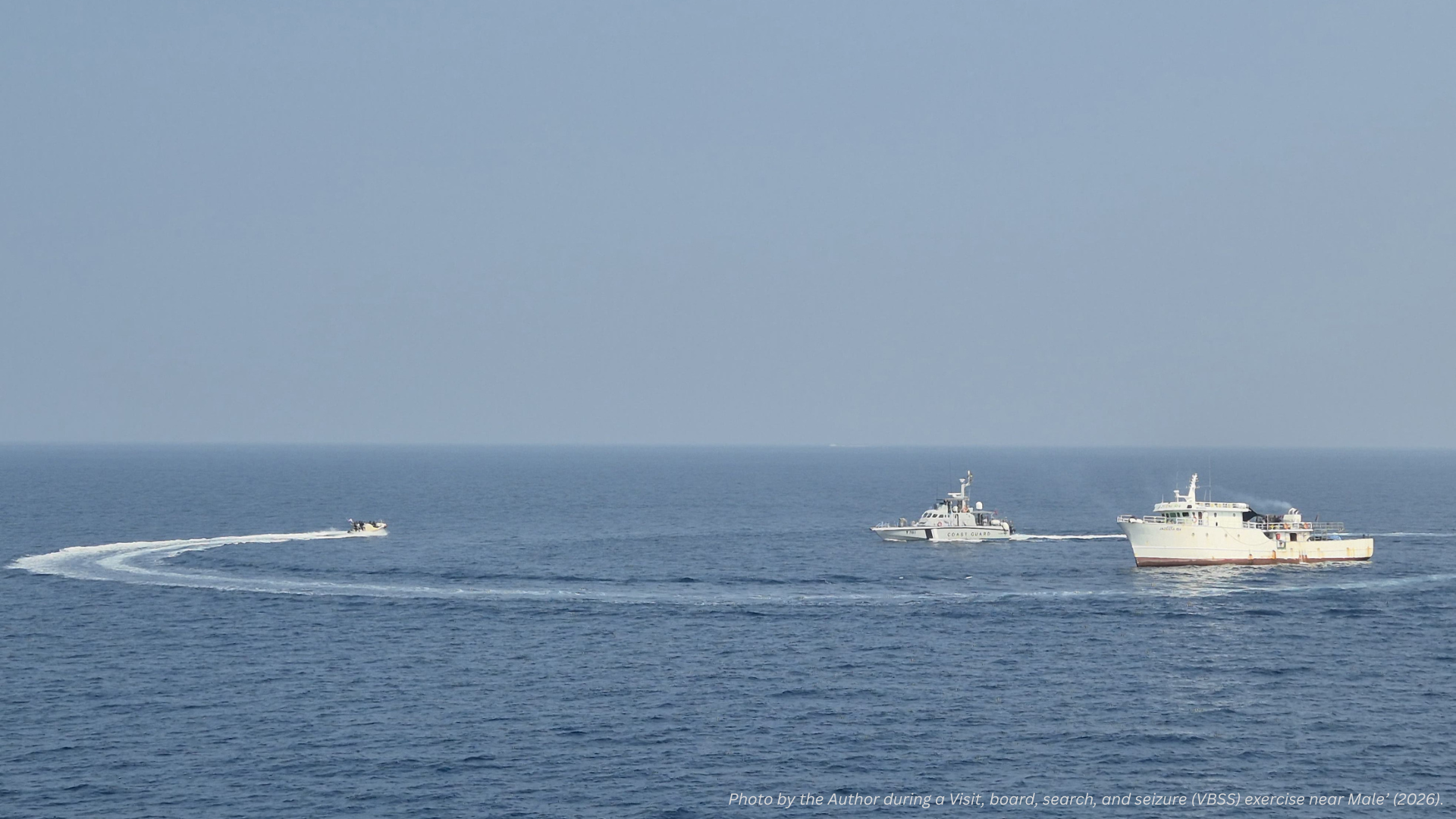
In Maldives, engagements such as coordinated patrols, information-sharing frameworks, and multilateral exercises – i.e., most notably the Dosti maritime exercises – have served not only operational purposes but also strategic signalling functions or an information system. They can enable shared understanding of how economic fragility can elevate security risks and reinforce the logic of cooperative security in the Indian Ocean.
In this way, Maldives’ maritime security posture can contribute to regional stability while at the same time cooperating with the main regional aid partners to ensure sustainable engagement on all fronts that contribute to the country’s safety, development and security. The military can be a main area that continues inter-state engagements, and hence, as a champion of diplomacy – i.e., see Maldives ‘ long-standing role in climate diplomacy – Maldives can navigate defence diplomacy alongside the tools of foreign policy. Sustainable security in one of the world’s most strategically consequential oceanic spaces is crucial.
Conclusion
Maldives’ maritime security underscores the inseparable link between geo-economics and regional stability in the Indian Ocean – its most important economic engine, tourism, relies on the maritime domain’s safety. Despite global shocks, how Maldives can inform the security of the ocean can, in turn, affect the country’s geo-economic position. As a small, trade- and tourism-dependent state, its resilience rests on effective MDA, defence diplomacy, and cooperative security frameworks, offering broader lessons for managing economic vulnerability and maritime governance in strategically contested maritime spaces.
Author
Col Amanulla Ahmed Rasheed is a serving officer in the Maldives National Defence Force (MNDF). He has two postgraduate degrees, in Management from Kotelawala Defence University, Sri Lanka and Art and Science in Warfare from the National Defence University, Pakistan. The author acknowledges that statements, opinions and arguments made are of his own and do not reflect the Maldivian Government’s policy and position.