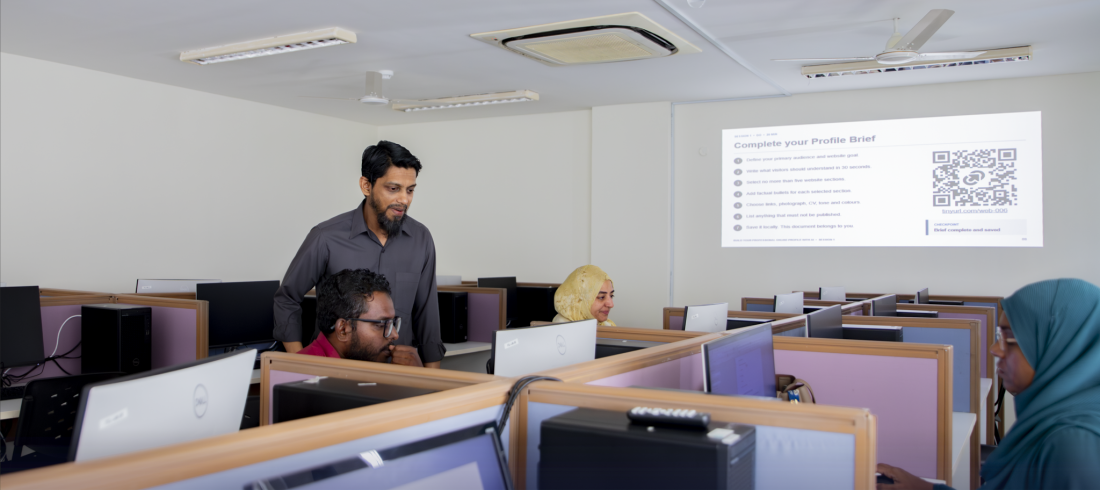
The Maldives National University (MNU) has advanced its efforts to strengthen inclusive and technology-enhanced education through a hands-on professional development workshop titled “Exploring AI for Inclusive Teaching,” aimed at equipping academic staff with practical artificial intelligence skills while promoting responsible, student-centred teaching practices.
Facilitated by Ahmed Shareef, the workshop introduced academic staff to accessible AI applications and simple prompting techniques that can support the development and improvement of educational resources. The training emphasised that educators do not require advanced technical expertise to begin exploring how AI can assist with instructional preparation and respond to diverse learning needs.
A central focus of the programme was the practical use of AI tools to generate, refine, and adapt teaching materials. Participants were encouraged to consider how AI-assisted resources could support different learning abilities, preferences, and educational backgrounds, contributing to more accessible and engaging learning experiences across higher education.
The workshop placed particular emphasis on evaluating AI-generated content before incorporating it into teaching. Academic staff explored the importance of reviewing materials for accuracy, suitability, inclusivity, and potential bias, reinforcing the need to ensure that emerging technologies support equitable learning opportunities rather than unintentionally disadvantage particular groups of students.
Ethical and professional responsibilities formed another key component of the training. Discussions addressed data privacy, the risks associated with excessive reliance on AI, and the importance of maintaining educators’ professional judgement when using automated tools. The programme highlighted that AI should complement, rather than replace, thoughtful instructional planning and meaningful interactions between lecturers and students.
Moving beyond introductory knowledge, the workshop encouraged participants to develop realistic action plans for applying AI within their own teaching contexts. This practical approach aimed to help educators translate new skills into manageable improvements while considering the specific needs of their students and the responsibilities associated with technology-supported learning.
The initiative also underscored the importance of continuous professional development as higher education adapts to rapid technological change. By strengthening AI literacy and encouraging critical engagement with digital tools, MNU seeks to support academic staff in adopting innovative teaching approaches without compromising educational quality, accessibility, or ethical standards.
Aligned with priorities of quality education, inclusive and equitable learning, reduced educational inequalities, digital literacy, responsible innovation, ethical technology use, and lifelong learning, the workshop reflects MNU’s commitment to fostering a teaching environment where technological advancement supports meaningful learning opportunities for all students.