Introduction
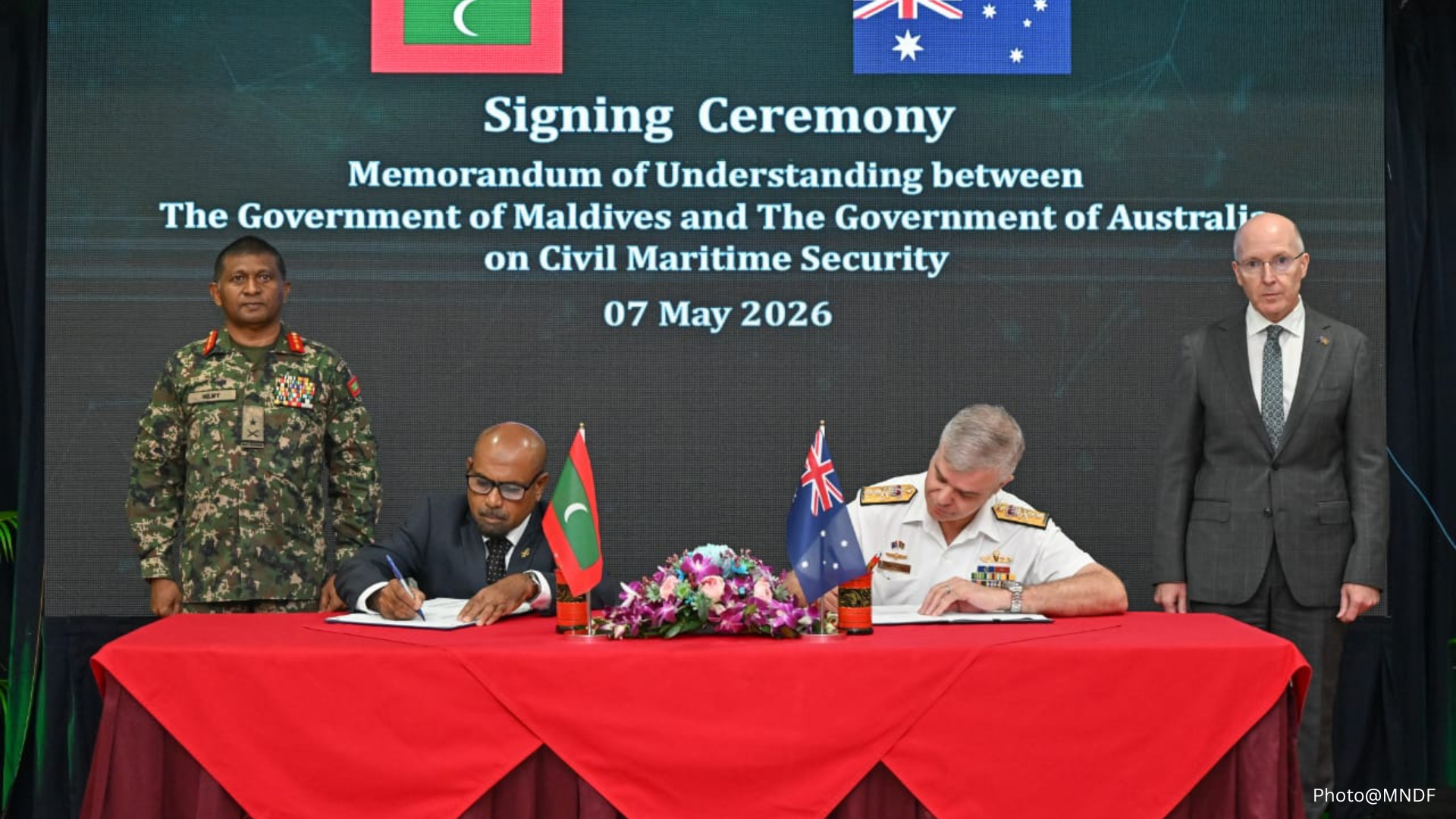
On 7 May 2026, during a visit to Maldives by Rear Admiral Brett Sonter, Commander of the Australian Border Force, Australia and Maldives entered a defence agreement.
This marks the second high-level defence engagement between the two countries within a month, underscoring Australia’s increasing strategic presence in Maldives, especially in maritime security cooperation. These developments reflect Maldives’ interest to bolster military capabilities to protect its national territory from threats arising at sea and from land afar.
Australia’s strategic activity with small states follows a distinctive pattern. Consider Australia’s 2026 National Defence Strategy (NDS) and the evolving defence diplomacy aligned with a United States-centred, realist-based balance-of-power security architecture. This security design does not align with the Pacific Islands’ identity-based security framework, as advanced by the 2018 Boe Declaration on Regional Security and the ‘Blue Pacific’ identity and can also undermine smaller Pacific states’ security priorities. For example, see the Pacific Islands’ disagreement over the AUKUS policy.
Nevertheless, with multifaceted and unique national concerns, such as climate change, the Pacific Islands and small states alike inevitably seek aid from Australia, India, or China, for that matter. This generates a small states’ act of hedging against competing regional powers. However, in such small states’ dynamics, Australia must prioritise promoting shared strategic objectives that reinforce rules-based order in security cooperation, while structuring its military cooperation with Maldives through a long-term, localised institutional lens. In doing so, it can avoid mirroring other foreign donor investments that lack transparency and public accountability in the receiving state.
This analysis assesses Australia’s role in strengthening the rules‑based dimensions of its military cooperation with Maldives.
Hedging versus cooperation dynamics
Small states pursue strategic autonomy when partnering with regional metropolitan powers – i.e., Pacific Islands have often adopted a balancing approach to the United States (US) Indo‑Pacific strategy by entering into security agreements with both Western allies and China. In 2022, Solomon Islands signed a security pact with China to address multiple security concerns. In response, the US expressed concern, and the National Security Council (NSC) committed to “intensify its engagement in the region to meet 21st-century challenges, from maritime security and economic development to the climate crisis and COVID-19.” A US$190 million Australia’s 2024 security pact to bolster policing capabilities in Solomon Islands can be interpreted as Canberra’s strategic response to counterbalance the latter’s cooperation with China in policing assistance.
From a security perspective, small states deliberately balance national interests with engagement by external actors for defence and development. Island nations in the Pacific, as well as Indian Ocean islands such as Sri Lanka and Maldives, face structural vulnerabilities linked to climate‑induced sea‑level rise and tropical cyclones. In these states, alongside war‑like threats and transnational criminal activity such as piracy at sea, these environmental pressures increase the urgency to seek assistance across multiple domains.
Consequently, the concept of cooperation pursued by small states can remain autonomous and detached from great power regional strategic goals. For example, despite divergent military objectives between US allies and China, Sri Lanka may choose to sign security agreements with New Delhi and Beijing. This dynamic allows smaller states to expand their military activities using resources supplied by competing powers, but it can also blur Indo-Pacific metropolitan states’ commitment to democratic and rules‑based principles in strategic cooperation if they view engagements solely through a great‑power‑rivalry lens.
Strengthening institutional reciprocity
As a large ocean state, Maldives faces both challenges and opportunities driven by extensive maritime territory – i.e., approximately 98 per cent of its territory requiring protection lies at sea. Beyond climatic pressures, maritime security remains central to the country’s defence and security strategy, particularly through strengthening Maldives National Defence Force (MNDF) Coast Guard assets. Australia recognises this imperative within its own Indo‑Pacific strategy. For example, maritime security cooperation has been expanded through multiple military‑to‑military engagements under mutual defence agreements, making the April 2026 handing-over of the Guardian Class Patrol Boat, originally designed and produced under the Pacific security programme, to the MNDF a logical endeavour.
However, Australia must ensure that such cooperation integrates Pacific values and the Blue Pacific identity. In engaging Maldives, NDS, with its emphasis on balance‑of‑power strategy, must not blur Australia’s commitment to rules‑based order and allow an overly privileged realist, power‑based underwriting of order over liberal institutional outcomes. On the contrary, consider embedding the Blue Pacific identity, which emphasises institutional strength within security partnerships – i.e., the Blue Pacific framework draws on collective and individual security, respects comprehensive security concerns, and reflects Australia’s recognition of the inherent interests of Pacific Island states.
In Australia–Maldives cooperation, this approach has been operationally observed through the Indo‑Pacific Endeavour (IPE) programme, which establishes military‑to‑military engagements linked to host‑country communities. IPE commenced with Australia’s inaugural P‑8A Poseidon visit to Maldives in late 2022. Subsequent missions have prioritised human capital development, knowledge sharing, and faith‑based engagements with the Maldivian military and local communities. Moreover, IPE operationalises a socialisation approach to defence cooperation by embedding Australian forces within partner militaries through exercises, training, and community‑linked engagement.
For example, as demonstrated in countries such as Japan and the Philippines, IPE activities have included complex maritime and air exercises that build operational familiarity and shared procedures. In Southeast Asia, including Indonesia and Malaysia, IPE has focused on professional military education, humanitarian assistance training, and maritime domain awareness. With Pacific partners such as Papua New Guinea and Fiji, and Indian Ocean states like Maldives, IPE combines patrols with civil‑military interaction. This sustained presence socialises rules‑based defence practices through trust, transparency, and institutional learning rather than episodic activity.
The emphasis on institutional socialisation is based on the premise that military assets and engagements also generate domestic institutional effects that shape mutual foreign policy trajectories. With socialisation of military engagements, Australia can generate a constitutive function for rules‑based defence policy in Maldives. Strengthening public confidence and trust in defence institutions is an important precondition for Australia’s Maldives strategy.
Conclusion
Australia’s expanding defence cooperation with Maldives advances maritime security, but enduring strategic value depends on embedding transparency, institutional reciprocity, and accountability to reinforce rules‑based order while respecting small‑state autonomy and interests. As Maldives advances a highly sophisticated military platform to protect and preserve the national resources at sea and on land within and outside its territory, the national and bilateral strategy it adopts with foreign countries, including Australia, must adhere to the liberal institutional order.
Author
Dr Athaulla A Rasheed is the Head of Centre at the Centre for Security and Strategic Studies at The Maldives National University. A former foreign service officer and diplomat at the Ministry of Foreign Affairs, Maldives, Athaulla also holds two PhDs in international and strategic studies, and political science from ANU and the University of Queensland, Australia. He is also the author of 2025 book, ‘Small States Maritime Security: The Indo-Pacific Strategy for Maldives’, published by The Maldives National University.