Introduction
The DOSTI biennial trilateral exercise – bringing together Maldives, India, and Sri Lanka – has long stood as a pivotal framework for defence diplomacy across the Indian Ocean. Originating in the early 1990s, these exercises have grown from a modest bilateral engagement into a robust trilateral platform that enhances interoperability, maritime domain awareness (MDA), and trust.
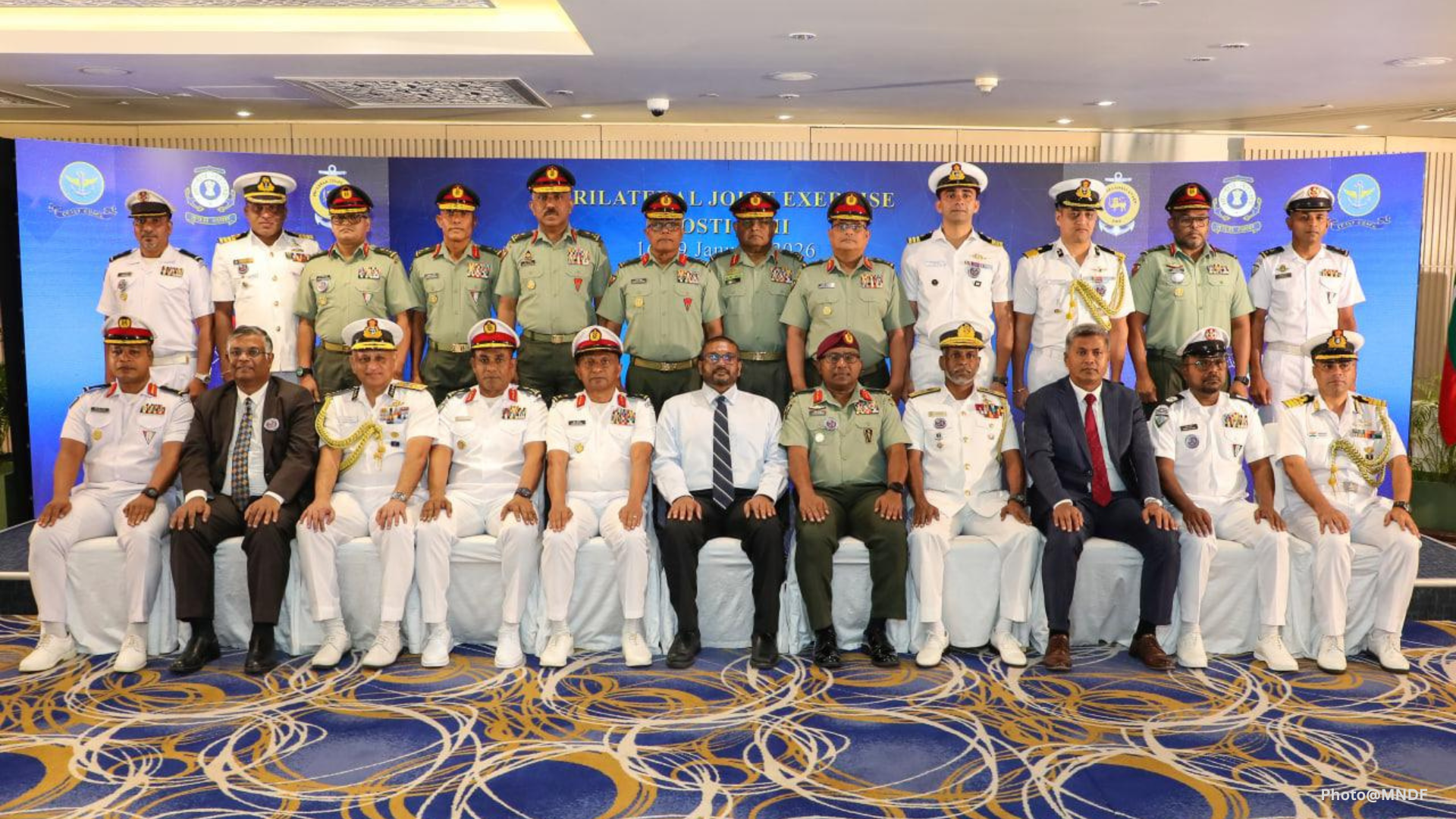
In January 2026, Maldives once again hosted DOSTI XVII (2026), reaffirming its central position in shaping regional maritime cooperation. Sri Lanka’s SLNS Suranimila departed Colombo on 14 January and arrived in Malé on 16 January to participate in the exercise scheduled from 16–19 January 2026. Three Indian Coast Guard ships – ICG Dornier, ICGS Atulya, and ICGS Vajra – joined.
Over the last three decades, DOSTI has evolved in scope and sophistication. What began as an initiative to promote mutual coordination has expanded into a holistic exercise addressing non-traditional security challenges, humanitarian operations, and maritime law enforcement. For Maldives and Sri Lanka – two smaller Indian Ocean states – participation in DOSTI strengthens not only operational readiness but also signals a level of military buildup in small states to meet maritime challenges. There is significant cooperation on capacity building that is based on the mutual trust that these countries have built over the period of time.
India’s broader strategic orientation, expressed through its Neighbourhood First policy and MAHASAGAR vision, embraces cooperative efforts in strengthening Maldives’ military capabilities, especially in the maritime domain. However, the role Maldives plays as an interoperable partner must also come from both societal and institutional levels.
The geopolitical development in the Indian Ocean, which serves as a major site of sea lanes of communication, has drawn the interest of major powers. China’s presence in the region, with its maritime silk route, scientific research, and a base in Djibouti, has been seen with some degree of concern. Groups like QUAD that dominate Indo-Pacific and several other institutional mechanisms have strived to provide a governance structure of the Indian Ocean littorals. In this context, the continuation of the DOSTI exercise and the decision to establish a secretariat of the Colombo Security Conclave reflect how the initial National Security Advisor (NSA) level trilateral meetings between India, Sri Lanka and Maldives have now expanded to include Mauritius, Seychelles and Bangladesh – though Seychelles is yet to become a full member. Interestingly, this time Malaysia participated as a guest in this forum.
Framing Small States’ Drive for Strategic Autonomy
Maldives’ foreign policy trajectory over the past decade reflects the complex agency of small states operating in a competitive geopolitical environment. Since joining China’s Belt and Road Initiative (BRI) in 2013, Maldives has welcomed extensive Chinese investments, including the landmark Maldives–China Friendship Bridge completed in 2018. These developments occurred amid concerns from India and its Indo-Pacific partners, who observed China’s growing influence with caution.
Yet, Maldives emphasises a ‘balanced foreign policy’ stance on forming foreign partnerships, particularly claiming that its partnership with China has not been about balancing great power competition. Rather, it is a mere outcome of political desire to achieve resilient development.
India got its turn when a new government took power from 2019 to 2023. For example, India bolstered developmental engagements to compete with China, particularly by launching additional bridge projects – i.e., three new bridges have been built to connect the capital Malé with three nearby islands, Villingili, Gulhifalhu, and Thilafushi.
Meanwhile, the incumbent Maldivian Government continues to expand defence and security partnerships beyond India and China. The acquisition of Turkish Bayraktar TB2 armed drones and a TCG Volkan (P-343), a Dogan-class fast attack craft, an Australian Guardian-class patrol boat, and new defence agreements with China signal a diversification strategy shaped by Maldives’ desire for strategic autonomy. Similarly Maldives also signed “Framework for U.S. Department of Defense-Maldives Ministry of Defence Defense and Security Relationship” in 2020
In this context, Maldivian foreign and defence policies reflect agency rather than alignment – demonstrating how small states shape and are shaped by broader geopolitical currents while safeguarding their strategic positioning in the region.
DOSTI’s Role in Diplomacy and Interoperability in the Indian Ocean
Defence diplomacy has become an essential facet of maritime cooperation in the Indian Ocean, and DOSTI remains one of its most consistent expressions. The 2026 exercise brought together the Indian Coast Guard’s ICGS Atulya and ICGS Vajra, Dornier aircraft, and the Sri Lanka Coast Guard’s Suranimila. These engagements centred on enhancing maritime law enforcement, search and rescue, humanitarian assistance, and disaster response. Such focus reflects the growing need for coordinated responses to evolving maritime challenges, including illegal fishing, trafficking, environmental degradation, and climate-driven emergencies. The exercise that started in 1992 and twenty years later was joined by Sri Lanka in 2012, and the Bangladesh Coast Guard joined the exercise in 2024. It needs to be mentioned that since 2017, both countries have instituted a bilateral naval exercise known as Ekatha. India also has an annual SLINEX maritime exercise with Sri Lanka. Such exercises between the partner countries help in fostering better understanding for maritime cooperation, and exercises like DOSTI only take this forward.
For Maldives, defence diplomacy is not merely symbolic. It is deeply anchored in its operational reality as a dispersed island nation reliant on effective maritime governance. Sri Lanka, which is a participating country, emphasised on shared commitment to regional maritime security and said this exercise strengthens ‘their collective ability to respond to common maritime challenges in the region.’
Over recent decades, the Maldives National Defence Force (MNDF) has been visited by and collaborated in naval exercises and operational missions and received naval assets from the United States, Japan, Australia, India, and others. These engagements, such as the Australian Indo Pacific Endeavour’s faith-based engagements and indigenous music collaborations, often include community outreach, joint training on climate-related maritime risks, and technical capacity development, helping normalise foreign military presence as part of mutual national operations.
DOSTI itself has deep roots, beginning in the early 1990s as a bilateral exercise between India and Maldives before later expanding to include Sri Lanka in 2012, integrating multiple layers of operational coordination, communications drills, and joint response mechanisms. While media reports often provide only brief accounts, exercise remains a vital tool for deepening MDA and strengthening institutional cooperation. The breadth of the exercise – from technical drills to strategic dialogue – demonstrates its enduring relevance.
For Maldives, participation in DOSTI supports Coast Guard capacity-building, improves readiness, and reinforces the country’s role within the regional security architecture. However, it also raises questions about how such engagements permeate national consciousness. Maritime security threats are existential for an island nation, yet understanding of its operational aspects remains mostly within defence institutions. Creating wider public awareness – including through educational, inter-institutional, and community programmes – would help strengthen societal support for maritime governance and enhance the national security ecosystem.
Conclusion
For Maldives, India, and Sri Lanka, DOSTI enhances interoperability, builds trust, and develops operational capacity to address both traditional and non-traditional maritime challenges. It also reinforces agency and autonomy, demonstrating that strategic relevance is not limited by size. The portraying of military exercises as an indication of military buildup in the island state cannot be avoided. However, a whole-of-nation approach, through consistent defence diplomacy, connecting the identities and cultures with military activities, would help make better sense of such joint operations. The information fusion centre in India provides maritime security information in the Indian Ocean region. Exercise DOSTI leans on practical collaboration by enhancing collaboration between the three important maritime neighbours in the Indian Ocean.
Authors
Dr Athaulla A Rasheed is the Head of Centre at the Centre for Security and Strategic Studies at The Maldives National University. A former foreign service officer and diplomat at the Ministry of Foreign Affairs, Maldives, Athaulla also holds two PhDs in international and strategic studies, and political science from ANU and the University of Queensland, Australia. He is also the author of 2025 book, ‘Small States Maritime Security: The Indo-Pacific Strategy for Maldives’, published by The Maldives National University.
Dr Smruti S Pattanaik is a Research Fellow at Manohar Parrikar Institute for Defence Studies and Analyses in New Delhi. She has a PhD in South Asia from the School of International Studies, JNU, New Delhi. She specialises in South Asian Affairs and Indian foreign policy.