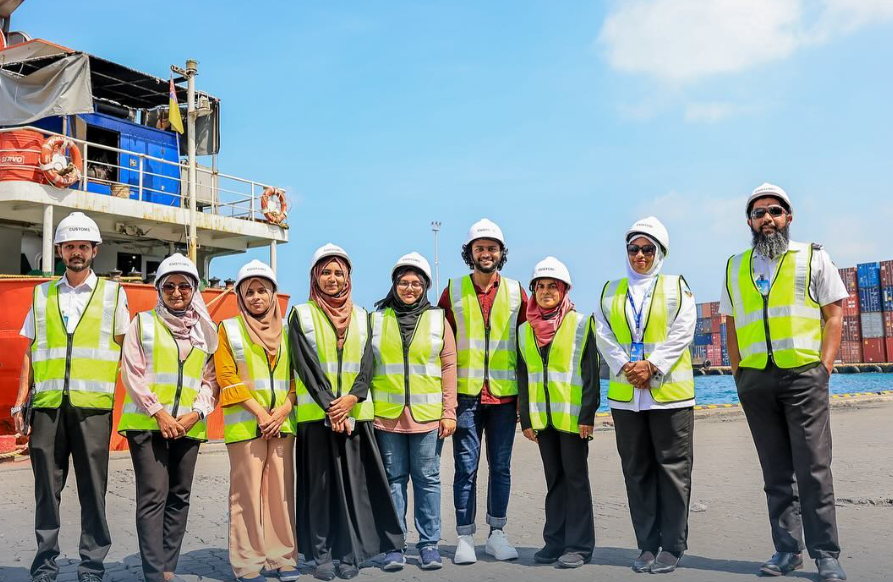
On 28th November 2024, Bachelor of Teaching (Secondary) students specialising in Business Studies, accompanied by Senior Lecturer Maumoona Abdulla visited the Maldives Customs Service as part of an educational initiative to strengthen their understanding of business operations, international trade, and the role of public institutions in the Maldivian economy.
The visit provided students with valuable insights into the functions and responsibilities of the Maldives Customs Service, particularly its role in facilitating international trade, collecting government revenue, enforcing customs laws and regulations, and managing the movement of goods across the country’s borders. Through this engagement, students gained a deeper understanding of how customs operations contribute to economic development, support legitimate business activities, and safeguard national interests.
The educational visit also provided an opportunity for students to connect theoretical knowledge gained through their Business Studies coursework with real-world public sector practices. By exploring the work of the Maldives Customs Service, students were able to relate classroom concepts such as international trade, taxation, government revenue, business regulations, and economic governance to practical applications. The experience further highlighted the importance of transparency, accountability, regulatory compliance, and effective public administration in supporting a well-functioning business environment.
As future secondary school teachers, the visit also offered students practical insights and real-world examples that can be incorporated into their future teaching practices. Such experiential learning opportunities help strengthen subject knowledge and equip prospective teachers with relevant examples to make classroom learning more engaging, meaningful, and connected to the local context.
It supports SDG 4: Quality Education by promoting experiential learning and strengthening the connection between theoretical knowledge and practical application. It contributes to SDG 8: Decent Work and Economic Growth by enhancing students’ understanding of trade facilitation and economic governance. The visit also supports SDG 16: Peace, Justice and Strong Institutions by highlighting the importance of transparent, accountable, and effective public institutions, while reflecting SDG 17: Partnerships for the Goals through collaboration between the Faculty of Education and the Maldives Customs Service.