Tracking Women’s Access and Participation
MNU tracks women’s applications, admissions, enrolment and graduation every year. Student Administrative Services (SAS) compiles these figures by sex from the student information system, and they are published in MNU’s annual institutional report.
This monitoring is now a formal University requirement. The Policy on Women’s Access, Participation and Advancement (MNU/UC/2026/16), approved by the University Council on 27 October 2026, commits MNU to provide equitable opportunities for women to apply for and enter its programmes. It also requires MNU to maintain and review gender-disaggregated data on applications, offers, enrolment, retention and completion (Sections 5 and 13). The policy builds on the equal-opportunity commitment in the Student Admissions Policy (Section B.1), which governed admissions in 2025.
What the 2025 figures show
Women were accepted at about twice the rate of men: 47.9% against 24.1%.
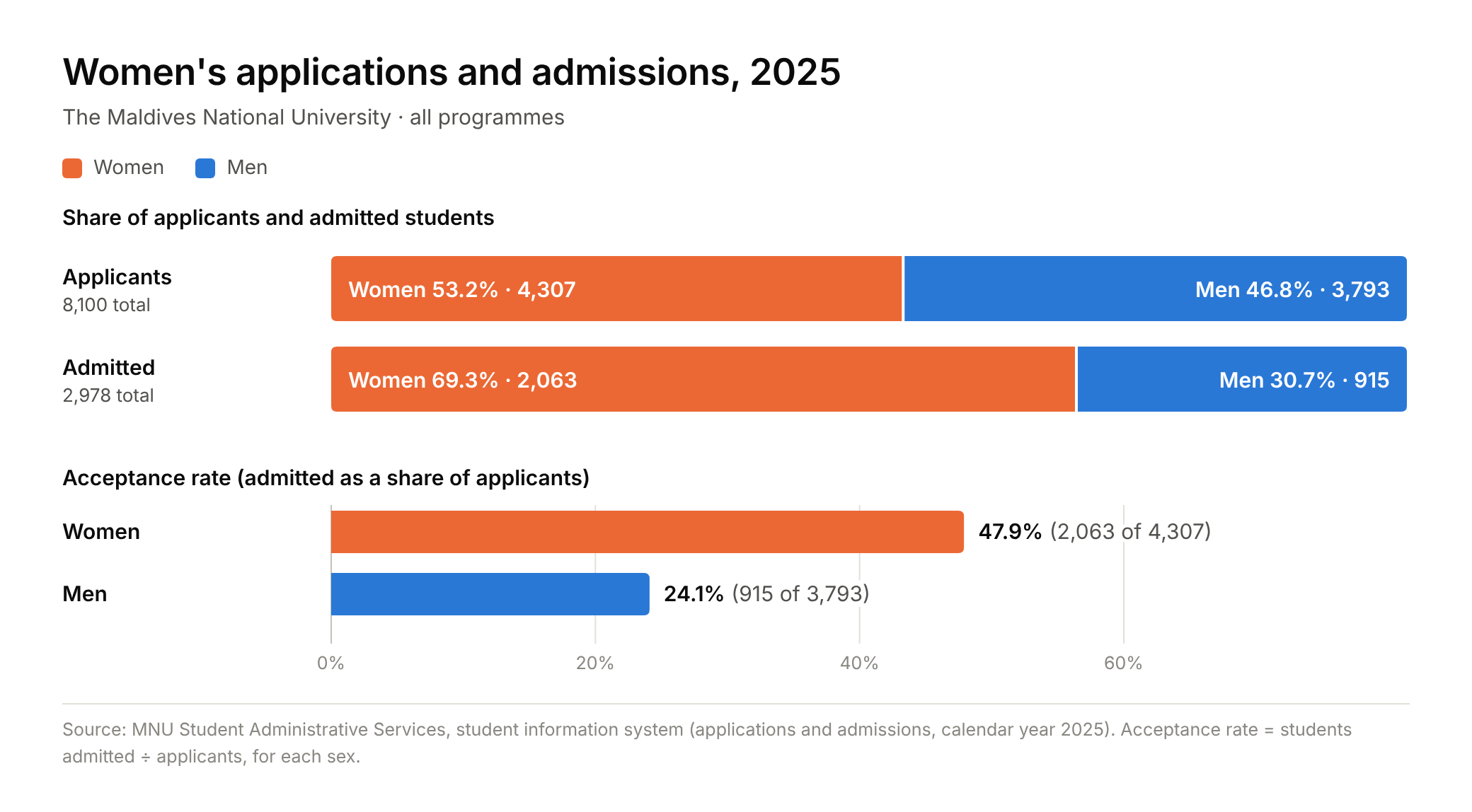
Figure 1. Women were 53.2% of applicants and 69.3% of admitted students in 2025 (SAS records).
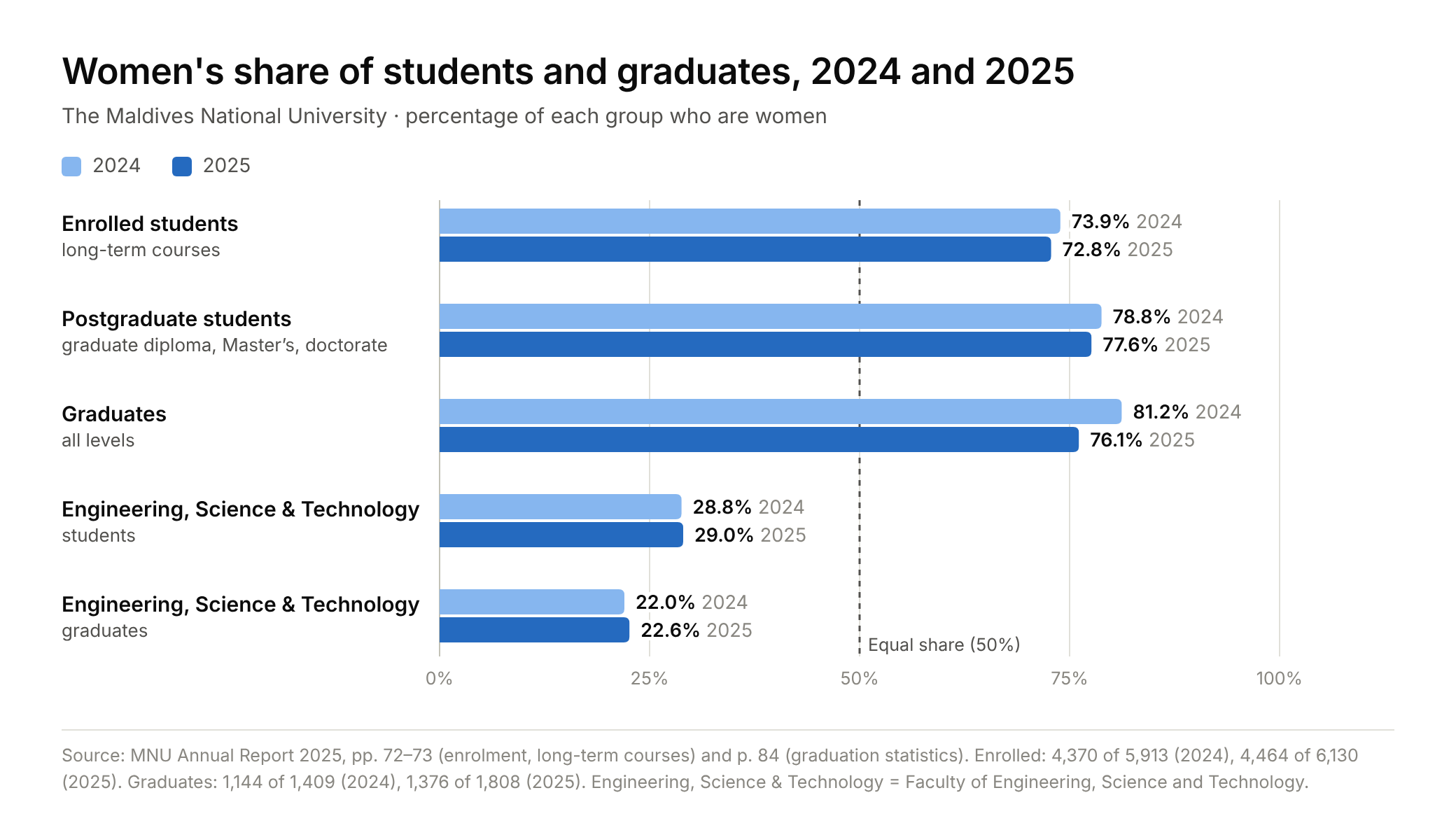
Figure 2. Women’s share of enrolment, graduates and engineering, science and technology, 2024–2025 (MNU Annual Report 2025).
In 2025, women made up 4,307 of 8,100 applicants (53.2%) and 2,063 of 2,978 admitted students (69.3%). Of the women who applied, 47.9% were admitted, compared with 24.1% of the men. Women were 72.8% of students enrolled in long-term courses (4,464 of 6,130) and 77.6% of postgraduate students (319 of 411).
What MNU monitors
- Applications and offers: the number of women and men who apply to and are offered places in each programme, giving acceptance rates for each.
- Enrolment: the share of women by faculty and level of study, including postgraduate and STEM programmes.
- Graduation: graduates by sex and subject area. Under the new policy, SAS will also report retention and completion rates by sex.
- Reporting and review: figures are published each year in the annual institutional report and used in academic planning.
Acting on the gaps
MNU’s monitoring shows that women are well represented overall but remain under-represented in technical fields. In 2025, women were 29.0% of students and 22.6% of graduates in the Faculty of Engineering, Science and Technology. They were 13.2% of engineering applicants. All eight students enrolled in long-term courses at the Centre for Maritime Studies were men.
In response, MNU ran activities in 2025 to encourage more women and girls into these fields:
- Empowering Women in Maritime Industry (17 April 2025): an open forum held by the Centre for Maritime Studies and the Research and Development Office, attended by 80 students, staff and members of the public.
- E-Waste Hackathon (4–7 October 2025): organised by the Faculty of Engineering, Science and Technology. 14 of the 23 participants (60.9%) were girls.
- Robotics and coding outreach in island schools: a Micro:bit workshop on tidal and flood detection for students of M. Atoll School (22–23 July 2025), and robotics-in-education workshops for teachers at L. Ihadhoo and K. Dhiffushi schools. Women academics from the Faculty of Education led these workshops, giving students visible role models in technology.
- Robotics Hackathon 2025 (28–29 May 2025): organised by the Faculty of Engineering, Science and Technology. 10 of the 28 participants (35.7%) were girls.
- EduTech Symposium STEM showcases (17–18 September 2025): school students presented hands-on STEM projects. More than half were girls.
- Robotics and coding outreach in island schools: a Micro:bit workshop on tidal and flood detection for M. Atoll School students (22–23 July 2025), and robotics-in-education workshops for teachers at L. Ihadhoo and K. Dhiffushi schools. Women academics from the Faculty of Education led these workshops, giving students visible role models in technology.
- Empowering Disabled Female Students to Lead Digital Entrepreneurship (Theveli 2025, 18–20 August): a post-conference workshop with 10 female participants.
The Policy on Women’s Access, Participation and Advancement (October 2026) makes this a standing commitment. Section 6 requires MNU to identify fields where women are under-represented and to support them through outreach, mentoring and scholarships. Section 7 requires MNU to monitor women’s retention, progression and graduation, so that gaps in completion can be found and addressed.
Admission & Graduation Snapshot 2025
| Indicator |
2025 |
| Women Applicants (%) |
53.2 |
| Women Admissions (%) |
69.3 |
| Women Enrolment (%) |
76.4 |
| Women Graduates (%) |
82.1 |
| Women Postgraduate Students (%) |
78.7 |
| First Generation Women Students (%) |
73.9 |
| Women STEM Students (%) |
33.1 |
| Women STEM Graduates (%) |
38.6 |