Introduction
Maldives is recognised through images of turquoise lagoons, luxury resorts, and pristine beaches. These visuals have shaped the country’s identity as a tropical paradise and a premier tourist destination.
However, beyond this dominant imagery lies a complex set of security challenges that include climate change, maritime insecurity, economic vulnerability, and disaster risks. Increasingly, these challenges are communicated not only through political statements and policy documents but also through visual representations.
The concept of visual securitisation explains how images are constructed and communicate security. Securitisation theory emphasises the role of speech acts in framing issues as existential threats. Visual securitisation highlights the power of photographs and symbolic imagery in shaping public perceptions of vulnerability and security. Images often transcend linguistic and cultural barriers, creating immediate emotional responses and influencing both national and international audiences.
For small island developing states, such as Maldives, visual communication has become an important form of political influence and present their agency.
This article examines how visual securitisation operates in the Maldivian context, demonstrating how images transform environmental vulnerability, maritime challenges, and societal resilience into security narratives that resonate domestically and globally.
Conceptual Framework: Small State Theory and Constructivism
Small state theory argues that states with limited material capabilities cannot compete with larger powers through military or economic strength alone. Instead, their influence often derives from diplomacy, norm entrepreneurship, and agenda-setting.
Small states seek to shape international discussions by emphasising issues that affect their survival and prosperity. Maldives provides a clear example of this dynamic, particularly through its efforts to elevate climate change-related vulnerabilities in global security debates.
Constructivism complements this perspective by emphasising that security is socially constructed rather than objectively determined. Ideas, identities, narratives, and symbols can drive and shape human thinking in policy making.
From a constructivist perspective, images and projections of ideas and narratives can help project socialised understandings of danger, vulnerability, and protection. Therefore, for small states, visual communication offers a mechanism through which local concerns can gain international visibility, including visual imagery to communicate existential vulnerability in small states.
Visual Securitisation in Maldives
The central argument of this article is that visual securitisation enables Maldives to translate local vulnerabilities into nationally and internationally recognised security concerns. Through images, security is communicated not merely as a condition of protection but as a socially constructed narrative that shapes perceptions of threats and responses.
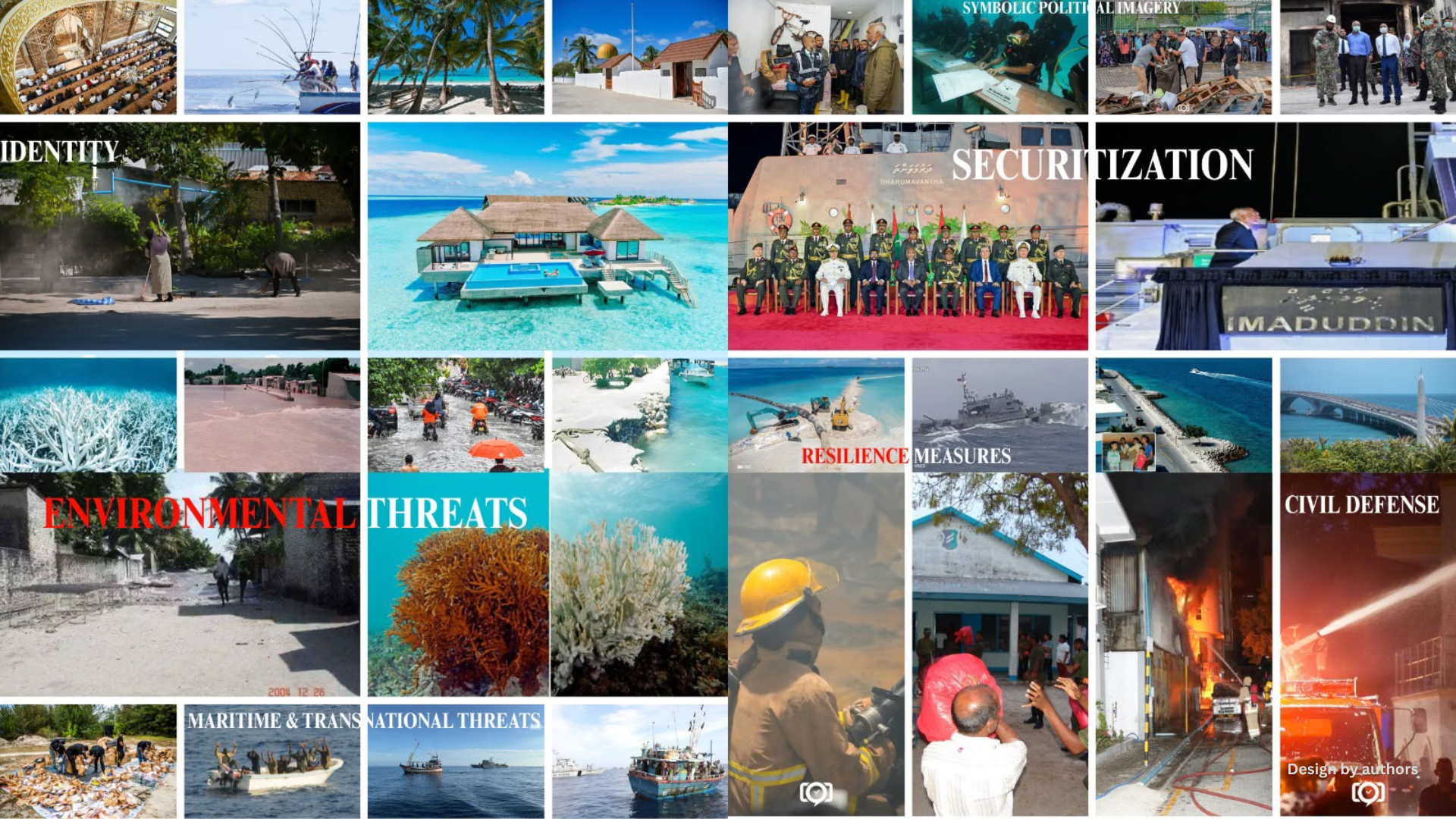
While tourism-oriented imagery images contribute significantly to national branding, they also conceal many of the vulnerabilities experienced by island communities. Visual construction reveals these hidden dimensions by presenting alternative images that highlight environmental degradation, coastal erosion, flooding, and climate-related risks.
Climate vulnerability constitutes the most significant visual security narrative in Maldives. Photographs of flooded islands, eroding coastlines, and damaged coral reefs communicate climate change in a tangible and emotionally compelling manner.
Imagery transforms scientific projections into visible evidence of potential existential threats. As these images circulate through media platforms, government campaigns, and international forums, they reinforce the perception that climate change is not merely an environmental issue but a national security concern.
Maritime security represents a second dimension. Maldives occupies a vast oceanic space that creates both opportunities and vulnerabilities. Images of Maldives National Defence Force (MNDF) Coast Guard patrols, maritime surveillance operations, and intercepted vessels help frame activities such as illegal fishing, drug trafficking, and transnational crime as security challenges that require state intervention.
Through visual representation, maritime risks become integrated into broader national security narratives.
A particularly powerful example of visual securitisation of climate threat was Maldives’ underwater cabinet meeting in 2009. Images of government ministers conducting official business underwater attracted global attention and became iconic symbols of climate vulnerability. Images of underwater cabinet performance communicated existential risk factors, generating domestic and external narratives.
By transforming sea-level rise into a powerful visually-induced narrative, Maldives successfully placed its concerns on the international agenda.
Besides, visual securitisation is not confined to communicating threats. Images of military capabilities, maritime patrol vessels, infrastructure projects, seawalls, and emergency response operations communicate resilience and preparedness. These representations reassure domestic audiences while projecting an image of capability and adaptation to international observers.
Consequently, Maldivian visual security narratives simultaneously emphasise vulnerability and agency, portraying a state that faces serious challenges but remains actively engaged in addressing them.
Writing the Analysis of Imagery
The analysis of images reveals four major findings regarding visual securitisation in Maldives.
First, visual representations play a crucial role in defining national security priorities. Images of climate impacts, coastal erosion, and flooding have significantly contributed to framing environmental vulnerability as a security issue. Their immediacy and emotional impact allow audiences to connect with climate risks more effectively than statistical data alone.
Second, identity serves as an important foundation for visual security narratives. Images depicting island communities, fisheries, religious life, and local culture communicate what Maldivians value and consider worthy of protection. Security narratives are therefore rooted in representations of identity and belonging, linking societal values to broader national security concerns.
Third, visual securitisation enables Maldives to exercise influence beyond its material capabilities. As a small state with limited military power, Maldives relies heavily on symbolic communication to attract international attention. The success of initiatives such as the underwater cabinet meeting demonstrates how visual imagery can transform local vulnerabilities into globally recognised concerns. In this sense, visual securitisation functions as an important source of soft power.
Fourth, Maldivian case demonstrates that security narratives encompass both vulnerability and resilience. While many images emphasise threats associated with climate change and maritime insecurity, others highlight adaptation measures, infrastructure development, disaster preparedness, and security capabilities. Images of seawalls, land reclamation projects, emergency response teams, and maritime patrol assets communicate a narrative of preparedness and institutional capacity.
Collectively, these findings suggest that visual securitisation serves multiple functions. It raises awareness of vulnerabilities, shapes public perceptions of threats, mobilises political support, attracts international attention, and reinforces confidence in state institutions.
Conclusion
Maldives demonstrates how visual securitisation enables small states to transform local vulnerabilities into globally recognised security concerns. By making climate vulnerability, maritime insecurity, and adaptation visible, Maldives has successfully used images as a form of soft power, shaping security discourse beyond the limits of its material capabilities.
Authors acknowledge that this article is a recreation of their Theveli Conference 2026 presentation.
Authors
Hawwa Agula Ahmed is a Master of Research candidate in Security and Strategic Studies at the School of Security and Strategic Studies, Maldives National University (MNU). A former Crime Analyst at Maldives Police Service, she also holds an MSc in Addiction Studies and a Bachelor’s degree in Psychology. Her research interests include transnational crime, national security, and the application of constructivist approaches to security studies.
Nazmeel is a Master of Research candidate in Security and Strategic Studies at the School of Security and Strategic Studies, Maldives National University. He holds a Bachelor of Arts in Political Science and International Relations and works as a Research Analyst at the Ministry of Arts, Culture and Heritage, Maldives. His research interests include maritime security, local fishing practices, and practice-based approaches to the study of security.