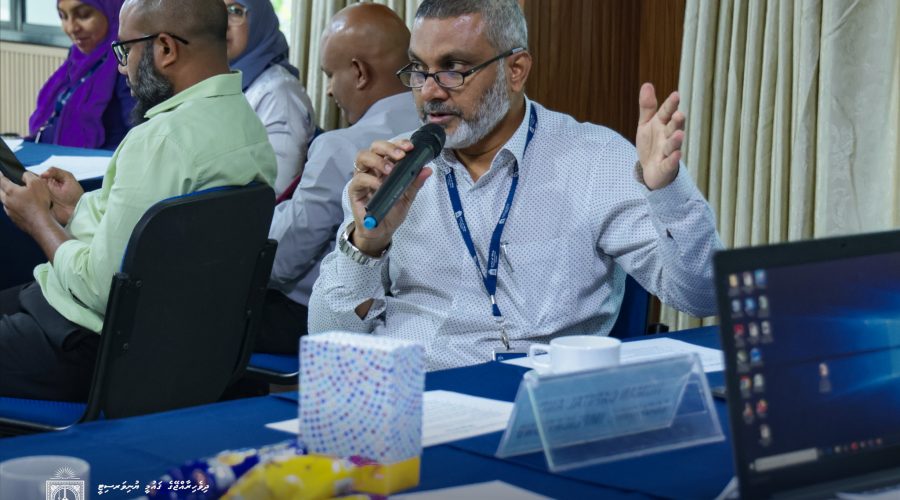
The Maldives National University (MNU) has advanced its efforts to strengthen digital innovation in higher education through a professional development workshop titled “Empowering Educators: Integrating AI in Teaching and Assessment,” equipping academic staff with strategies to integrate artificial intelligence into teaching while promoting ethical and student-centred learning practices.
Facilitated by Dr. Fawaz Shareef, the workshop addressed the growing role of artificial intelligence in transforming higher education, highlighting the importance of using emerging technologies with clear educational objectives rather than adopting digital tools solely for their technological capabilities.
A central focus of the programme was aligning AI applications with Bloom’s Taxonomy, a framework used to classify different levels of cognitive learning. Academic staff explored how AI-supported teaching strategies can encourage critical thinking, creativity, problem-solving, and higher-order learning skills while supporting different stages of knowledge acquisition.
The workshop also introduced approaches to designing AI-supported lesson plans, collaborative learning activities, and assessments tailored to varied cognitive abilities. By connecting AI applications with intended learning outcomes, the session explored opportunities to make teaching more purposeful, interactive, and responsive to diverse student learning needs.
Alongside practical applications, the programme emphasised the ethical considerations associated with AI integration in education. Participants were encouraged to critically reflect on the responsible use of AI, including the importance of academic integrity, fairness, and maintaining human judgement in teaching and assessment decisions.
The training further highlighted the evolving role of educators in a technology-driven academic environment. Rather than positioning AI as a replacement for traditional teaching expertise, the workshop reinforced its potential as a supportive tool that can enhance instructional planning, encourage active learning, and strengthen assessment design when applied appropriately.
Through this initiative, MNU continues to promote professional capacity development and digital readiness among academic staff, supporting the university’s efforts to adapt to emerging educational technologies while maintaining academic quality and responsible teaching practices.
The workshop aligns with broader priorities of quality education, digital literacy, responsible artificial intelligence, educational innovation, inclusive learning, ethical technology use, and lifelong professional development. By encouraging the purposeful integration of AI into academic practice, MNU aims to foster a more innovative, equitable, and future-ready higher education environment.