Introduction
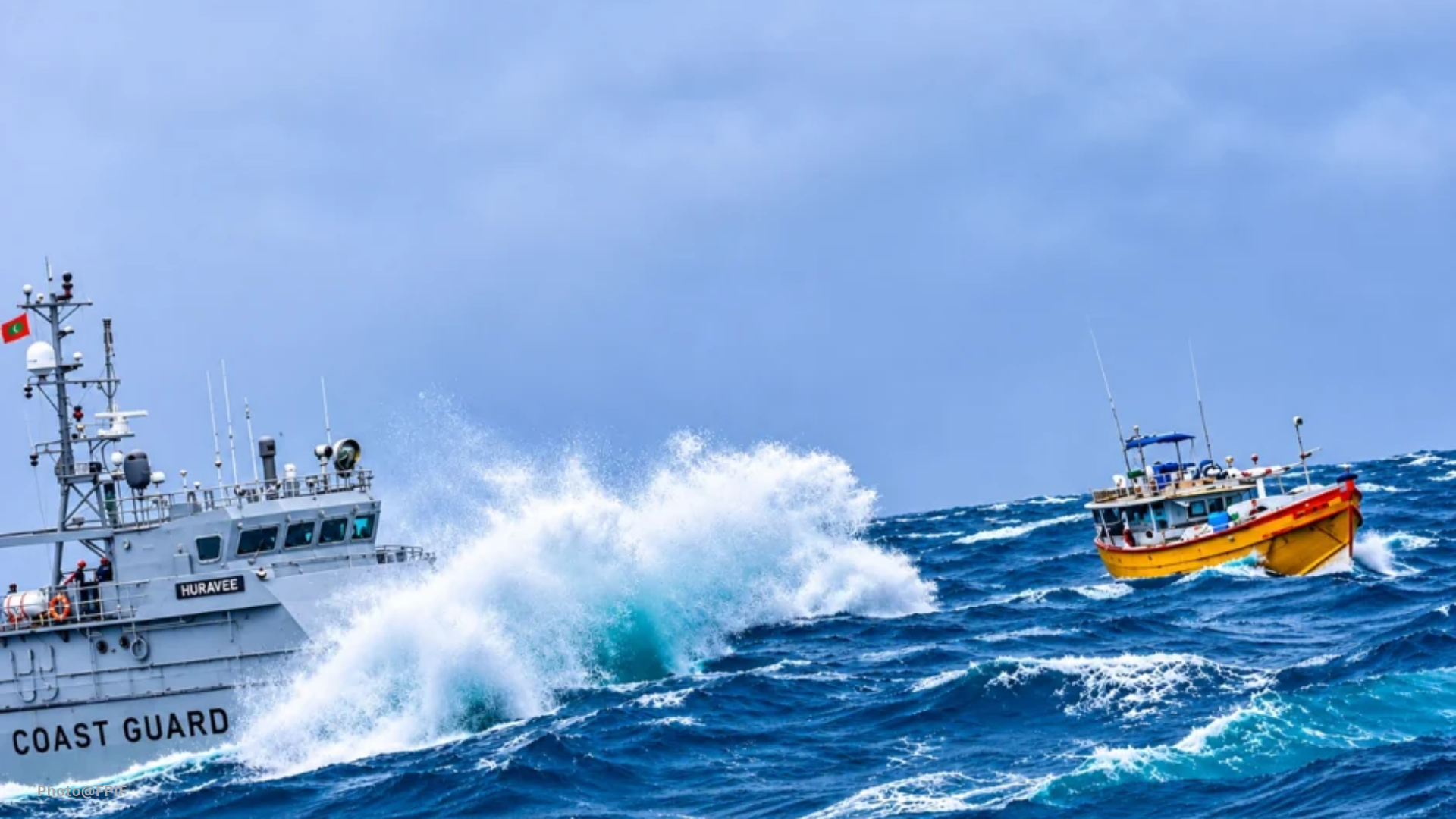
The geography of Maldives is a strength and a weakness. Consider understanding the latter: when weather conditions worsen, the Maldives National Defence Force (MNDF) Coast Guard’s lines get flooded with Search and Rescue (SAR) calls, fire crews pump out streets, ferries and fishing stop, and navigation becomes hazardous for outsiders, though not totally for local crews who know the atolls and reefs.
This article examines how weather shapes navigation and military operations in Maldives, using securitisation theory.
Securitisation of Weather
In securitising an issue, agencies create a speech act – i.e., an actor presents an issue as an existential threat, and an audience accepts the claim to take extraordinary measures. A vivid example is Maldives. On 17 October 2009, President Mohamed Nasheed and 13 officials held a cabinet meeting underwater and created a rhetoric about the existential threat posed by sea-level rise. This shaped the negotiations at the climate summit held in Copenhagen that year – i.e., Maldives’ has projected its vulnerabilities as an existential identity since the 1980s and has shaped international policy over the last 40 years, calling for emissions. The 2009 summit did the same.
Maldives’ rhetoric formed an ideational speech act, shaping national policy thinking to incorporate climate into security and defence narratives – i.e., MNDF has already incorporated climate into operation plans.
This article applies the same logic to weather at sea – i.e., when storms, rough seas and difficult waters are framed as security problems, they justify military capabilities, partnerships and special measures.
Weather – No Cyclones, But Not Safe from Storms
Maldives is almost free of direct cyclone strikes. Tropical cyclones need the Coriolis force to spin up a low-pressure system. The force is zero at the equator and generally too weak within about five degrees of it, so storms rarely form there. Maldives lies on the equator, so its weather is monsoonal. This involves a southwest monsoon from mid-May to November and a northeast monsoon from January to March. Even the seasons are less predictable; the 2024-2025 northeast monsoon began on 2 January 2025, the longest delay in a decade.
Distant storms still matter. The Maldives Meteorological Service (MMS) notes that cyclones over the Bay of Bengal, the Arabian Sea and the southern Indian Ocean bring intense cloud bands, heavy rain and strong winds, interrupt ferry services and fishing, and create swell surges that flood islands. For example, during Cyclone Ockhi in 2017, which navigated towards Lakshadweep, the seas stayed rough nationwide, and sea transport was discouraged.
The author was involved in the interception and arrest of two Sri Lankan fishing vessels suspected of illegally entering Maldives’ Exclusive Economic Zone (EEZ) during the period of Cyclone Ockhi. Such first-hand accounts have been critical in shaping the author’s perception of the practices involved in managing the crisis.
Weather and Military Operations
The MNDF Coast Guard reported seven marine incidents in a single day during adverse monsoon weather in July 2025, and its reliance on small vessels with limited endurance makes large or long rescues difficult in rough seas. Maritime transport cannot simply stop, because many islands and resorts depend on it for essential goods, yet rough seas and poor visibility raise accident risks.
Limited assets cannot cover a dispersed maritime area at once – i.e., a vessel answering one emergency may be unavailable for another hundreds of kilometres away, so distribution and rapid deployment matter as much as numbers.
On land, the Fire and Rescue Service pumped 16,911 tonnes of floodwater from Malé after 223.5 millimetres of rain in 24 hours in March 2025, while Area Commands assisted islands with sandbags and drainage. Rough seas also interrupt inter-island ferries and make fishing difficult, so weather is felt as an economic security problem as well as a military one.
Navigation – Uncharted Waters as a Local Advantage
Incomplete charts cut both ways. The MNDF Coast Guard commandant has said that the lack of an updated chart poses great challenges in Maldivian waters. Yet, for Maldivians this is also an advantage. Local seafarers have long moved through atoll reefs and channels by experience; Moresby’s nineteenth-century charts stayed in use among Maldivian pilots until the 1990s, and the commandant has noted that travellers face more danger from the inner waters than from the outer ocean.
This knowledge works like a natural defence for a small force. It slows, complicates and raises the cost of unfamiliar vessels operating inside the atolls. A Maldivian patrol boat can use passages through reefs that a larger visiting ship cannot risk.
The grounding of the Indian Coast Guard ship Vajra on 16 January 2026 demonstrates the other side of the picture. The vessel was in Maldives for the Dosti-17 exercise and ran aground on a reef near the Gili Lankanfushi and Villa Nautica resorts, before being refloated with the help of Indian and Maldivian vessels. Public reports did not state a cause, but the episode shows that even a capable regional partner can struggle in waters that Maldivian crews know well. Rough weather and poor visibility magnify the problem, and the lesson applies equally to any foreign navy, whether partner or rival.
The advantage is not absolute. Local knowledge matters most to a force that cannot afford to lose it, and it supports deterrence as well as safety – i.e., crews that know the reefs can move, shelter and intercept where visitors cannot. Malé should, therefore, decide the degree to which it wants to share the prerequisite knowledge at hand.
Conclusion
The weather turns Maldives’ geographic advantage into an operational burden. Although its equatorial location spares it from direct cyclones, monsoons and distant storms still strain the Coast Guard, Fire and Rescue Service, transport and fishing, while atolls and incomplete charts, a hazard to foreign vessels, give local crews an advantage.
Author
Lt Col Ahmed Jameel is a serving officer in the Maldives National Defence Force (MNDF), with 20+ years of experience in the maritime domain. He also has a postgraduate degree in International Relations from Salve Regina University, USA. The author acknowledges that the statements, opinions and arguments made are his own and do not reflect the Maldivian Government’s policies and position.