The Maldives National University (MNU) contributes to SDG 15 by promoting the sustainable management of land and natural ecosystems in support of environmentally responsible tourism development in the Maldives. Through its Climate and Environment Research Framework 2025–2030, developed in collaboration with the Ministry of Tourism and Environment, MNU has identified sustainable and resilient tourism as a research priority, focusing on green resort practices, sustainable ecotourism development and tourism carrying capacity. The University also contributed to protected-area management through the Endheri Project, under which the College of Fisheries and Ocean Sciences conducted ranger training to strengthen national capacity in environmental protection. Furthermore, MNU’s collaboration with the Ministry of Tourism and Environment to develop specialised training programmes in protected-area management demonstrates its commitment to building professional expertise in natural resource conservation. Through its Faculty of Hospitality and Tourism Studies, MNU also incorporates sustainable tourism education into its academic programmes. In addition, campus greening, tree-planting, gardening and composting initiatives promote responsible land use and the maintenance of green spaces. Collectively, these initiatives support the development of tourism practices that balance economic opportunities with the conservation of natural landscapes, terrestrial biodiversity and the environmental integrity of Maldivian islands.
Sustainable land management for tourism under SDG 15 (Life on Land) focuses on ensuring that tourism development does not damage terrestrial ecosystems, natural vegetation, forests, coastal landscapes and biodiversity. In the Maldives, this is particularly important because tourism infrastructure and activities take place in small, environmentally sensitive islands.
MNU contributes to this area through environmental research, protected-area management capacity building, sustainable tourism education and environmental conservation initiatives.
Key contributions of MNU
1. Diploma in Protected Area Management – CATENATE Project (2025)
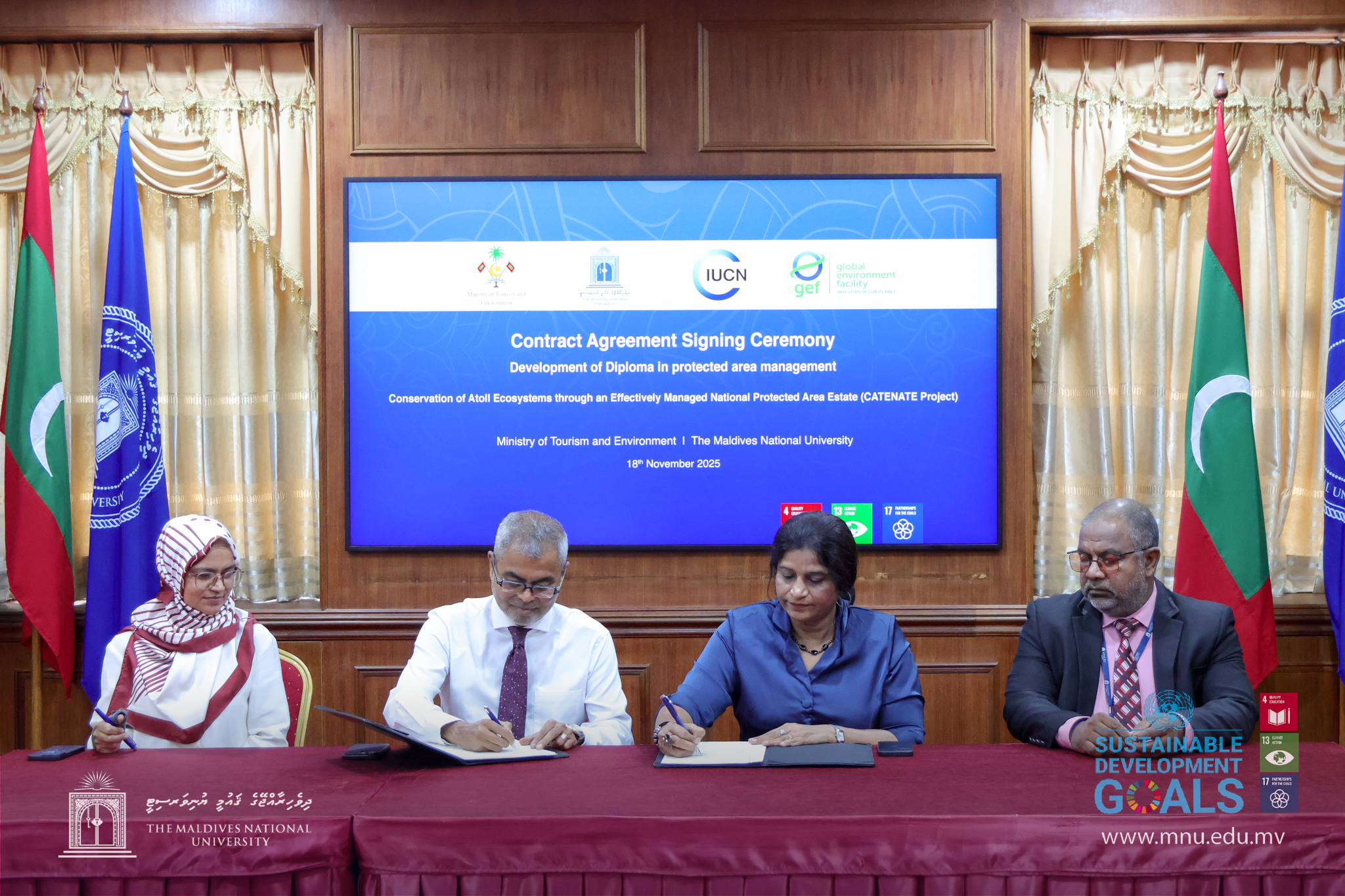
On 18 November 2025, MNU signed an agreement with the Ministry of Tourism and Environment to develop a Diploma in Protected Area Management under the CATENATE Project. The initiative builds on the capacity-building work undertaken through the Endheri Project. This is particularly relevant to sustainable tourism because effective protected-area management helps develop the knowledge and skills needed to conserve natural landscapes and biodiversity while managing tourism activities responsibly.
2. Research on sustainable and resilient tourism
MNU’s Climate and Environment Research Framework 2025–2030 identifies sustainable and resilient tourism as a research priority. It highlights green resort practices, sustainable ecotourism development and tourism carrying capacity. These areas are relevant to managing tourism development within the environmental limits of islands and protecting natural habitats from excessive development. The framework explicitly aligns this research priority with SDG 15, alongside other SDGs.
3. Sustainable tourism education and curriculum
MNU’s Faculty of Hospitality and Tourism Studies integrates sustainability into tourism education through the Sustainable Tourism Development module. Research published by an MNU academic also examines how sustainability education is incorporated into tourism programmes. This helps prepare future tourism professionals to consider environmental protection and responsible tourism development in their professional practices.
4. Campus greening and community environmental initiatives
MNU campuses have conducted tree-planting, gardening, kitchen garden and composting activities. These initiatives promote green spaces, vegetation conservation, soil improvement and responsible land use. Such practices are relevant to maintaining attractive and environmentally healthy island environments that support sustainable tourism.