The Maldives National University (MNU) addresses overfishing primarily through its College of Fisheries and Ocean Sciences (CFOS), which serves as the institutional anchor for fisheries education, research, and policy engagement. Rather than implementing direct enforcement or stock-assessment technologies, MNU’s contribution centres on building the human capacity and scientific knowledge base required for sustainable fisheries management—a foundational role for a small island state where enforcement resources are stretched thin across vast ocean territories.
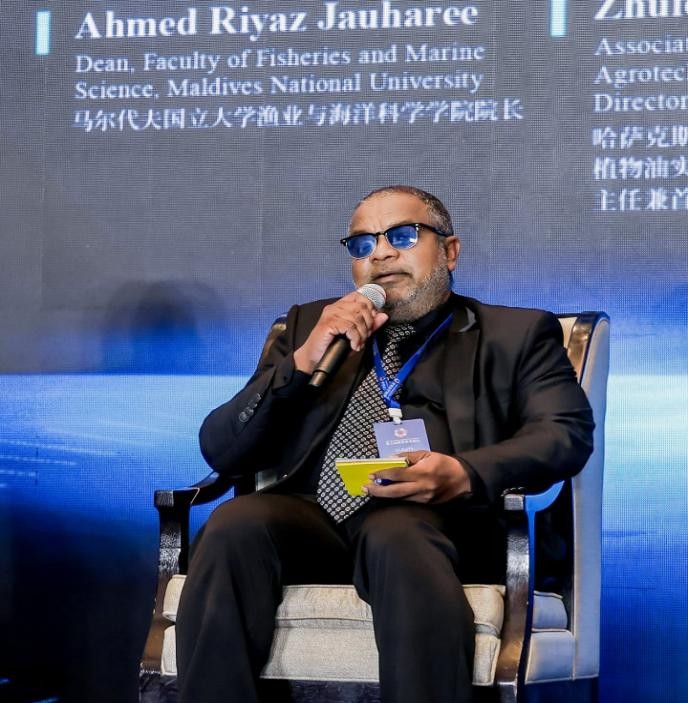
MNU’s most direct influence on overfishing governance comes through CFOS contributing expertise to the development of the Maldives’ Fisheries and Ocean Resources Master Plan (2025–2045). This 20-year strategic framework, led by the Ministry of Fisheries and Ocean Resources with World Bank support, aims to ensure sustainable management of marine resources. The CFOS Dean’s involvement signals MNU’s expanding role in national policy formulation, bridging three decades of experience in research, education, and policy. The establishment of CFOS itself was a partnership between the Fisheries Ministry and MNU, reflecting an institutional recognition that technical expertise for the fisheries sector must be developed domestically.
CFOS delivers degree-level education in fisheries and marine science, with programmes designed to align with the evolving demands of the sector. Dean Jauharee has met with public and private sector officials to discuss skills development, degree-level education, and fisheries research, focusing on creating clearer pathways for Maldivians to pursue careers in fisheries and marine science. In addition, CFOS has also facilitated national level discussions conducted in 2025 to formulate the 20 years Maldives National Master plan (Maldives 20 Years Master Plan Consultations – The Maldives National University)
A significant infrastructure development is underway in Gaafu Alifu Kolamaafushi, where MNU signed an agreement in February 2025 to establish a 15,000-square-foot Fisheries College outreach centre. This facility will provide students with hands-on research and training opportunities, extending fisheries education beyond the capital region to benefit the broader Huvadhoo Atoll and fishing communities nationwide.
MNU has formalised a five-year collaboration with Hainan University’s School of Marine Biology and Fisheries, focusing on marine fishery resource management, coral reef protection, and sustainable resource utilisation through the Science and Technology Backyard Initiative. The agreement facilitates joint research, faculty and student exchanges, and knowledge sharing relevant to SDG 14. The World Bank’s Transforming Fisheries Sector Management project also identifies MNU as an academic and research institute to be engaged in skill and capacity building for the fisheries sector. The project has initiated development of a Advanced Certificate program and two Degree level programs related to fisheries and aquaculture with MNU.
Through an MoU with Sonee Fishing, CFOS organised a seminar in 2025 on responsible sports fishing for recreational fishers (Recreational fishers’ seminar – The Maldives National University), covering catch-and-release techniques, species identification, and the role of sports fishing in conservation. The partner also shares catch data from its annual “Kandu Foari” tournament with CFOS to support fisheries research. This type of industry-academia data sharing, while modest in scale, represents a practical mechanism for generating information on reef fish populations that formal monitoring programmes may not capture.
MNU’s approach to overfishing is indirect but structurally significant. In a country where enforcement capacity for fisheries regulations is constrained by geography and resources , the university’s role in training fisheries professionals, contributing to the national master plan, and generating research through partnerships addresses a critical gap: the shortage of local expertise needed to design and implement management measures.