Advancing the 2030 Agenda: How The Maldives National University Measures and Communicates Institutional Sustainability
The Maldives National University (MNU) has established a structured, transparent approach to tracking and communicating its institutional impact on sustainable development. Through dedicated annual sustainability reporting, MNU documents how its academic curriculum, research output, administrative policies, campus operations, strategic partnerships, and community engagement align with the United Nations Sustainable Development Goals (SDGs).
Building a Reporting Tradition: The 2024 and 2025 SDG Reports
MNU’s reporting mechanism transitioned from high-level commitments to data-driven institutional accountability over two key reporting cycles:
-
Published SDG/Sustainability Report 2024: Marked the university’s inaugural formal SDG reporting exercise. Launched directly by the Vice Chancellor, the 2024 report established MNU’s baseline alignment across its faculties and introduced core initiatives like MNU InnovateHub—the nation’s first university-led business incubator—alongside initial curriculum mapping efforts.
-
Published SDG/Sustainability Report 2025: Titled 17 Goals, One University, the 2025 report provides a comprehensive account of 1,061+ documented initiatives across 39 faculties, centers, administrative units, and 4 regional campuses. It highlights institutional milestones, including 100% SDG coverage (17/17 goals), a student body of 6,839 (76.5% female enrollment), and the completion of MNU’s first doctoral thesis written entirely in Dhivehi.
Report Launch & Executive Leadership Commitment
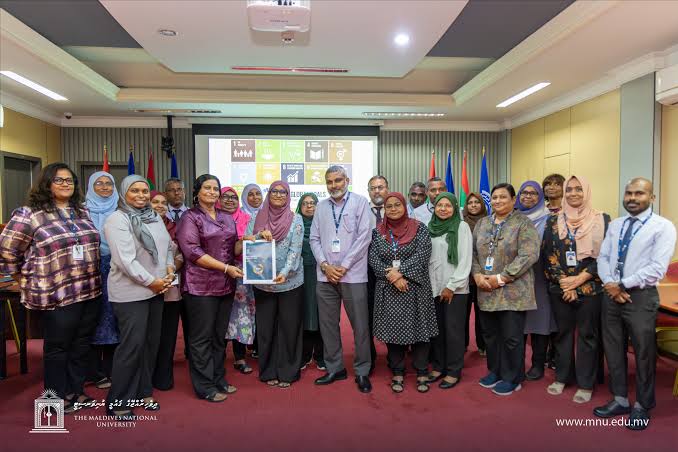
The formal launch of MNU’s sustainability reports serves as an institutional milestone, embedding SDG tracking directly into executive governance rather than treating it as an isolated exercise.
During the rollout of the latest reporting cycle and the simultaneous launch of the Strategic Plan 2026–2030, Vice Chancellor Dr. Aishath Shehenaz Adam emphasized that sustainability for a small island developing nation is a continuous commitment anchored in the philosophy of “iman and ilm” (faith and knowledge):
“Sustainability is not a destination we arrive at; it is a commitment we renew through the choices we make, the knowledge we share, and the communities we serve. As the national university, our role is to educate, contribute to the wellbeing of our people, protect our environment, and help build a more inclusive and resilient Maldives.”
Reporting Methodology and Indicators
MNU employs a multi-layered reporting methodology coordinated by the Policy and Quality Control Unit (PQCU) in conjunction with designated focal points across all campuses and faculties.
Core Methodological Pillars:
-
Ex-Ante Strategic Alignment: Moving away from purely retrospective mapping, the 2026–2030 framework embeds SDG target-setting into project planning, curriculum creation, and campus infrastructure design from inception.
-
Ten Operational Action Pillars: Implementation is structured around 10 strategic pillars covering curriculum mapping, research prioritization, digital transformation, staff development, sustainable finance/procurement, governance, community partnerships, student engagement, campus operations, and global collaboration.
-
Data Collection & Audit Infrastructure: Data is collected across all 14 faculties/schools and 4 regional campuses (Hithadhoo, Thinadhoo, Kulhudhuffushi, and Gan). Operational oversight includes QAA mid-cycle reviews (accreditation extended to October 2028) and internal compliance audits reporting to the Audit and Risk Committee.
-
International Benchmarking: In May 2025, MNU completed its first data submission to the Times Higher Education (THE) Sustainability Impact Ratings (focusing on SDGs 3, 4, 5, 8, 13, and 17) and formally joined the THE Sustainability Impact Network.
Key Performance Indicators Tracked:
| Pillar / Dimension |
Key Indicators & Baseline Metrics (2025) |
| Education & Access (SDG 4, 5, 10) |
• 6,839 total students (2.5% YoY growth)
• 76.5% female student enrollment
• 73% first-generation college students
• 44 active scholarships & Shaheed Awards
• 80+ library information literacy sessions
|
| Research & Innovation (SDG 8, 9, 13, 17) |
• 112 dedicated research initiatives (86 in 2025)
• Theveli 2025 Conference: 239 abstracts from 18 countries
• $4.5M GEF/UNEP CHOMV ocean nutrient project
• 18 PhD programs offered (16 launched in 2025)
|
| Operations & Infrastructure (SDG 7, 11, 12) |
• Network backbone upgraded from 1G to 10G fibre
• 9 building designs incorporating solar PV & passive cooling
• 650+ staff transitioned to paperless digital HR workflows
• 184 localized procurement bid announcements
|
| Regional & Community Reach (SDG 1, 3, 14, 15) |
• 140+ regional campus activities across 4 atoll centers
• 750+ tonnes of beach waste collected (PROMISE project)
• 605 children reached via food safety outreach
• First local delivery of IMO-certified ATOTCO maritime training
|
Visualizing Sustainability: Supporting Photo Highlights
MNU’s reporting documentation incorporates rich photographic evidence showcasing practical sustainability in action across the atolls:
-
Community Health & Clinical Care (Fahi Sihhath): Photographic coverage of nursing students conducting public health outreach, handwashing demonstrations for preschool children, blood pressure screenings, and specialized drills at Kulhudhuffushi Regional Hospital.
-
Hands-on Environmental Stewardship: Action shots from multi-campus tree-planting drives, including the donation and planting of 200 native trees at Aboobakuru School, student beach clean-ups, and coastal protection field studies in Thulusdhoo.
-
Practical Innovation & Technical Training: Imagery documenting student activities at the E-Waste Hackathon, practical sessions inside the newly inaugurated Pharmacy Laboratory, network infrastructure installations, and maritime seafarer exercises.
-
Academic Dialogue & Community Outreach: Visual documentation of the Fahi MNU island outreach trips, regional Job Festivals connecting island youth with employers, and international research exchanges during the Theveli 2025 conference.
Looking Ahead
By combining formal metrics, external benchmarking through THE Impact Ratings, and transparent annual reporting, MNU provides a clear template for how higher education institutions in Small Island Developing States (SIDS) can effectively lead, track, and communicate their contributions to a sustainable future.