Introduction
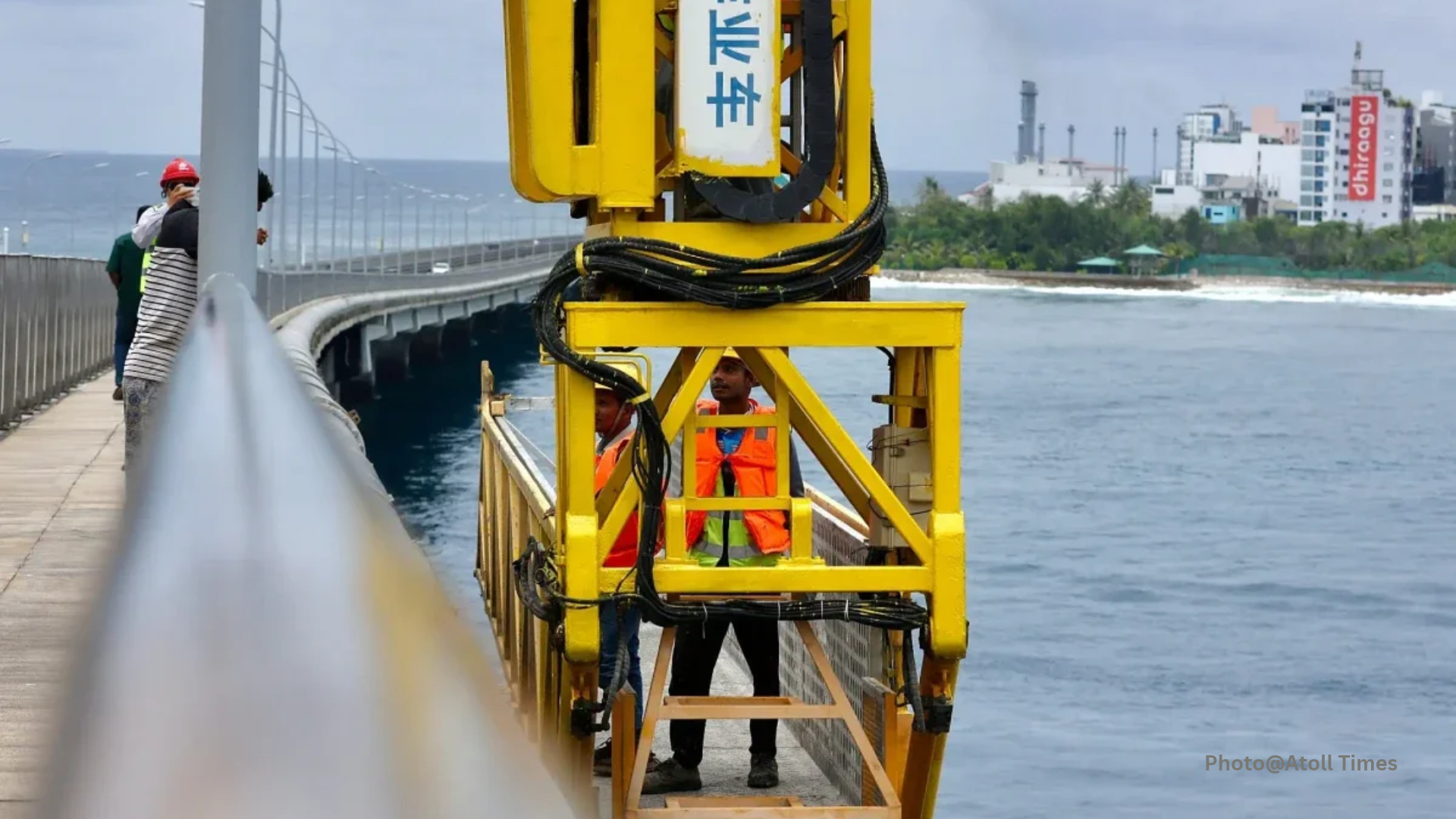
On the night of 24 July 2026, two fuel-carrying barges broke free from their anchorage between Malé and Dhoonidhoo during severe weather and heavy rain. Drifting uncontrolled, the vessels ran aground on the Malé reef near the Carnival area before striking a main pillar of the Sinamalé Bridge.
After passing beneath the bridge, the two heavily deteriorated iron vessels drifted out of Malé Atoll and eventually sank roughly 30 nautical miles outside Maldivian territorial waters; the Maldives National Defence Force (MNDF) Coast Guard safely rescued all nine crew members aboard while they were drifting, approximately two nautical miles outside Malé Atoll. The author was directly involved in this operation.
Notably, both vessels reportedly entered Maldivian waters without authorisation weeks earlier and were under the custody of the Maldives Customs Service.
Although post-incident inspections found no structural damage to the bridge beyond surface scratches, Infrastructure Minister Dr Abdulla Muththalib described the episode as a “near miss,” warning that an uncontrolled vessel could just as easily have struck the Thilamalé Bridge or Velana International Airport.
This analysis discusses how the incident exposes a critical vulnerability – i.e., how Maldives’ most consequential physical infrastructure sits directly within an active, congested, and inadequately monitored maritime environment.
Small-State Vulnerability and Asymmetries
Robert Keohane and Joseph Nye’s theory of asymmetric interdependence offers a useful lens here. It distinguishes sensitivity (how quickly a state feels the effects of a disruption) from vulnerability (how costly it is to recover once that disruption happens). Maldives scores high on both. With few alternative routes and critical assets packed into a small area, such as the bridge connecting Greater Malé and maritime waterway channels, can create increasing vulnerability to natural and man-made incidents and highlights the country’s dependence on external factors. This is especially the case when there are few home-grown backup options to fall back on.
This vulnerability is exacerbated by geography – i.e., in Maldives, critical infrastructure and ordinary sea traffic share the same crowded waters, unlike larger states that can spread key assets across land. This means Maldives cannot simply absorb serious and long-lasting damage to this critical infrastructure. The main reason is that it cannot cushion the fiscal damage in terms of curbing the damage and rebuilding. Therefore, the damage felt by Maldives could be proportionally higher than in a landlocked and developed country. Maldives, at a whole-of-government level, needs to shift from reacting after incidents happen to adopting proactive monitoring and preventative models.
The Sinamalé Bridge is not merely a transport link. It is the physical and symbolic spine connecting Malé, Hulhulé, and Hulhumalé, carrying the bulk of inter-island commuter traffic, freight movement, and access to Velana International Airport.
Government operations, tourism logistics, and the daily lives of tens of thousands of residents heavily depend on this infrastructure. This high stake further exacerbates the vulnerability caused by the lack of resources to curb maritime incidents that threaten such infrastructure. As such, the bridge must be classified and protected as maritime critical infrastructure, and the near-miss collision demonstrates that Maldives’ current framework for monitoring and intercepting drifting or unauthorised vessels needs further assessment.
International Port State Control Practice
A central failure in the Sinamalé incident was that the vessels involved had reportedly entered Maldivian waters without proper authorisation and remained under Maldives Customs Service’s custody for a period before drifting uncontrolled. This raises questions about how such vessels were monitored, secured, and inspected while in national waters.
Maldives’ efforts to improve its state apparatus are significantly linked to regional and international frameworks. For example, one could ask how Maldives applies Port State Control (PSC), which is the internationally recognised regime by which a state inspects, and where necessary detains or restricts, foreign or unauthorised vessels within its jurisdiction.
Under IMO-backed regional agreements, such as the Paris MoU, Tokyo MoU, and the Indian Ocean MoU (IOMOU), of which Maldives is itself a member, port authorities inspect foreign-flagged vessels for compliance with conventions such as SOLAS and MARPOL, and can detain those found with serious deficiencies, including inadequate mooring, anchoring, or seaworthiness, until corrective measures are taken.
A key feature shared across these regional regimes is the New Inspection Regime (NIR), under which every vessel is assigned a rolling risk profile based on its inspection and detention history, determining how frequently and how closely it is subsequently inspected. This transforms PSC from a one-time checkpoint into a continuously updated, risk-based system, and MoU members share this inspection data, so a vessel flagged as high-risk in one member state’s waters is visible to others, including Maldives through its own IOMOU membership.
Maldives must draw its policy and practices from this established regime. First, unauthorised or seized vessels held in or near Malé’s harbour, particularly aged or structurally compromised ones, such as the barge involved in this incident, should be subject to mandatory seaworthiness and mooring inspections. Inspections must adhere to IOMOU standards before and when vessels are allowed to remain at anchor, with unseaworthy vessels moved to a secure and well-monitored holding area away from critical infrastructure corridors.
Second, Maldives should actively draw on the IOMOU’s shared inspection database to assign a locally maintained risk profile to vessels under Maldives Customs Service or MNDF custody, flagging those with elevated drift or structural risk, particularly during the monsoon season when severe weather is more frequent.
Third, as Minister Muththalib indicated, the planned acquisition of dedicated intercept tugboats by Maldives Ports Limited should be paired with a standing operating protocol that defines trigger conditions, such as severe weather warnings, for pre-emptive patrols near the Sinamalé and Thilamalé Bridges.
Finally, jurisdictional clarity between Maldives Customs Service, the MNDF Coast Guard, and Maldives Ports Limited over custody and monitoring responsibility for detained vessels must be formalised through binding inter-agency standard operating procedures, since ambiguity in this area appears to have contributed to the delayed detection of the vessels’ unauthorised entry.
Rather than creating an entirely new structure, this coordination could be channelled through existing mechanisms, such as the planned National Maritime Information Fusion Centre (NMIFC), that are designed to integrate Coast Guard, Maldives Customs Service, and Maldives Police Service data and decision-making rather than leaving agencies to monitor overlapping risks in isolation.
Conclusion
The Sinamalé Bridge collision was, by fortune rather than design, a near miss. But the underlying conditions that produced it, aged unauthorised vessels moored near critical infrastructure with inadequate monitoring during severe weather, remain unaddressed. As a small state with limited redundancy and disproportionately high vulnerability to localised disruption, Maldives cannot treat this as an isolated maritime accident. It must be understood as a warning about the adequacy of the country’s maritime critical infrastructure protection regime.
Adapting elements of established port state control practice, combined with a small-state resilience posture that prioritises anticipatory rather than reactive protection, offers a practical path to ensuring that the next drifting vessel is intercepted long before it reaches Malé’s bridges.
Author
Lt Col Ahmed Jameel is a serving officer in the Maldives National Defence Force (MNDF), with 20+ years of experience in the maritime domain. He also has a postgraduate degree in International Relations from Salve Regina University, USA. The author acknowledges that the statements, opinions and arguments made are his own and do not reflect the Maldivian Government’s policies and position.