Roza Ibrahim | Head of Centre


Roza Ibrahim | Head of Centre
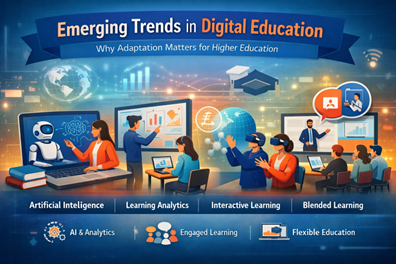
Digital education has firmly established as a core part of teaching and learning in higher education. Over the past decade, it has undergone a paradigm shift towards blended, online, and technology-enhanced learning. Given its importance, higher education institutions must adapt to this transformation to enhance quality, remain relevant, and foster learner engagement. As educators we must always be updated with the latest educational trends and understand why and how these technologies impact higher education. There are several emerging trends that are currently shaping higher education. Among them, the most significant are artificial intelligence, learning analytics, interactive and engaging and blended and hybrid learning models (OECD, 2025)
Artificial Intelligence (AI) is one of the most widely discussed and rapidly adopted technologies in education today. While the benefits of technology are widely celebrated, there are also some concerns about its potential drawbacks. A recent Microsoft special report (2025) highlights the expanding role of AI in personalized learning. Also, AI is increasingly used by teachers for content development, assessment design and automated feedback. Further, intelligent tutoring systems and AI-powered tools facilitate instructors to recognize learners’ strengths and challenges, and this allows them to design focused and prompt support. However, while AI offers efficiency and innovation, its integration into education must be guided by ethical, pedagogical, and academic integrity considerations, as educators caution.
Learning analytics is another important emerging trend in digital education. It enables educators to make data-informed decisions by monitoring student engagement, tracking learning progress, and evaluating course design. By analyzing access patterns, participation data, and learner performance, educators can identify areas for improvement and provide early support to students who may be at risk (Forsström et al., 2025).
Today’s learners expect interactive and engaging learning experiences that go beyond passive content consumption. It requires thoughtful learning design, meaningful activities, and clear communication. Advances in educational technologies have enabled the use of virtual labs, gamification, simulations, and immersive AR/VR environments. They help to visualize complex concepts, provide hands-on, safe, and repeatable practice, to support active learning, collaboration, foster critical thinking, and problem solving.
Additionally, an emerging focus in digital education is of blended and hybrid learning models. Blended learning in this context is defined as a combination of face-to-face and online learning to create flexible and student-centered learning experiences. These models allow institutions to respond to diverse learner needs while maintaining academic rigor and continuity. Given the geography of the Maldives as an island nation, blended and hybrid learning is a highly suitable strategy for the country.
At The Maldives National University (MNU), the Centre for Educational Technology and Excellence CETE plays a critical role in MNU’s digital transformation journey in enabling faculties to leverage these tools effectively. Its work includes professional development for academic staff, instructional design support, Learning Management System (LMS) guidance, monitoring and evaluation, and advocacy for effective use of educational technology. This support ensures that digital adoption is purposeful, gradual, and aligned with teaching and learning priorities. Through these efforts, CETE ensures that MNU not only keeps pace with technological advancements but also provides a learning environment that prepares students for the challenges of tomorrow, blending innovation with quality.
Further Reading / References