Introduction
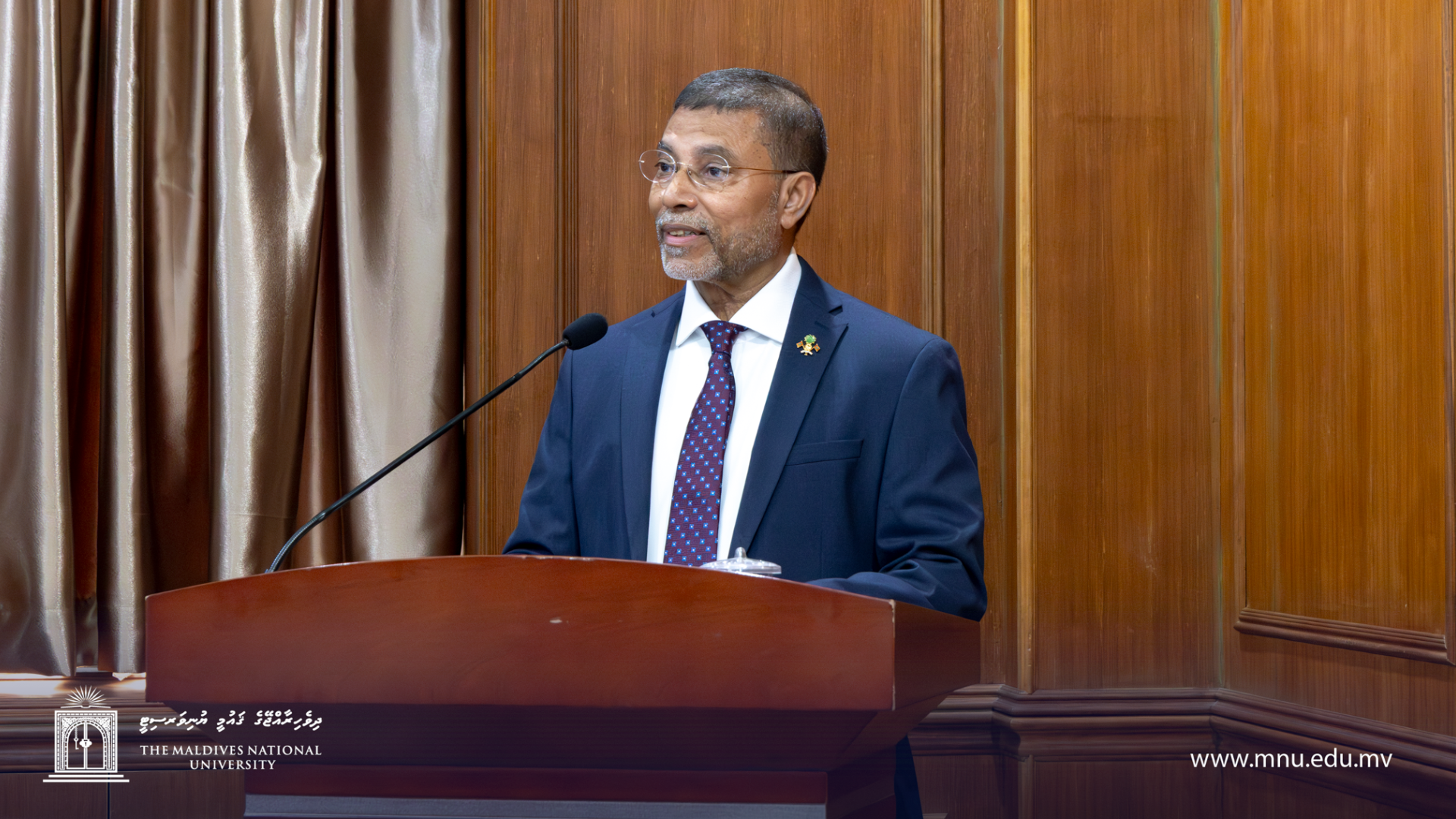
In his keynote address at the Academic‑Policy Dialogue Seminar with the National Defence College (NDC) delegation from India held at The Maldives National University (MNU), today, National Security Advisor Ibrahim Latheef, DC (Retd.), Lt.Col (Retd.) emphasises that the Maldives is “an ancient nation with a long and proud history” and that its people possess “a strong national identity and a deep commitment to our sovereignty, independence, rich culture and Islamic values.”
These foundations, he argues, shape the country’s strategic outlook and foreign policy behaviour. Latheef situates Maldives–India relations within this broader identity framework, highlighting the historical, geographical and cultural ties that bind the two countries, while also underscoring Maldives’ agency as a small state navigating an increasingly complex geopolitical environment.
This analysis reiterates Latheef’s statement through the lens of small‑state identity formation and intersubjective construction in international relations. It explains how Maldives’ national security identity – i.e., rooted in history, culture, sovereignty and resilience – drives its foreign policy choices and informs its engagement with India.
It also examines how climate change, maritime geography and regional cooperation shape Maldives’ sense of agency in the global environment. The analysis argues Maldives–India dialogue is strengthened when both countries recognise the intersubjective foundations of Maldives’ identity and its evolving security priorities.
Framing Small‑State Identity
Small states often construct their identity through intersubjective processes – i.e., interactions between domestic experiences and external engagements. Latheef’s speech reflects this dynamic. He notes that “a nation’s strategic outlook is shaped not only by its geography and security environment, but also by its history, identity, values and aspirations for the future.” This aligns with constructivist theory, which argues that states act based on socially constructed meanings rather than material capabilities alone.
Climate change has been one of the most powerful forces shaping small‑state identity. For Maldives, rising sea levels, coastal erosion and ocean‑based vulnerabilities have produced a sense of existential insecurity. Latheef’s emphasis on national resilience – i.e., protecting “people, economy, maritime domain, critical infrastructure and essential supplies” – reflects how domestic experiences of climate threats shape national interests.
This internal construction leads to policy choices such as:
- prioritising climate‑resilient infrastructure;
- adopting land reclamation and coastal protection models; and
- integrating climate security into national development planning.
These choices demonstrate that small states do not passively absorb external pressures; they actively formulate interests based on domestic realities.
Externally, climate change has fostered shared narratives among small island developing states (SIDS). Latheef’s speech echoes this collective identity when he notes that “small and medium-sized nations also have an important role in shaping the international order” and that “no nation is too small to stand proudly in defence of its sovereignty.”
This reflects how SIDS have co‑constructed a global discourse on climate vulnerability, leading to coalitions advocating for adaptation finance, loss‑and‑damage mechanisms and recognition of climate security at the United Nations.
This intersubjective construction does not challenge neorealist assumptions that small states are marginal actors. Instead, it shows that small states can exercise agency by shaping norms, mobilising narratives and influencing international agendas.
Maldives’ Identity as a Proud Country
Latheef’s keynote address provides a rich textual basis for analysing how Maldives frames its identity and how this identity shapes its relationship with India.
Latheef’s assertion that Maldives is “an ancient nation with a long and proud history” is more than a cultural statement – i.e., it is a strategic one.
By emphasising historical continuity, he positions sovereignty as a deeply rooted national value. This framing reinforces the Maldives’ desire to engage internationally without compromising independence. It also signals to India that partnership must be grounded in mutual respect and recognition of Maldives’ sovereign agency.
Latheef highlights Maldives’ maritime identity, noting that while the landmass is small, the Exclusive Economic Zone spans “more than 923,000 square kilometres of the Indian Ocean.” This reframing – i.e., from small island state to large ocean state – asserts strategic significance. It also aligns with India’s own maritime vision in the Indian Ocean, creating a shared conceptual space for cooperation.
By emphasising Maldives’ location near major sea lanes and its dependence on maritime connectivity, Latheef constructs a security identity centred on ocean governance, maritime safety and regional stability. This identity naturally intersects with India’s strategic interests, making dialogue essential.
Latheef’s reference to Islamic values, cultural heritage and national pride serves two purposes:
- It reinforces domestic unity and resilience.
- It signals to external partners that Maldives’ foreign policy is grounded in cultural authenticity.
This values‑based identity shapes how the Maldives approaches partnerships. Latheef states that Maldives remains open to “constructive partnerships with all countries that respect these principles.” India is framed as one such partner, described as “a longstanding, time-tested and reliable friend.”
Agency and Sovereign Capabilities
Latheef’s speech repeatedly emphasises agency: “We must safeguard our national interests, strengthen our sovereign capabilities and engage constructively with partners who respect our sovereignty.” This reflects a small‑state strategy of balancing autonomy with cooperation.
India–Maldives relations are thus framed not as dependency but as partnership. The Maldives seeks capacity‑building, maritime cooperation and institutional strengthening, but always within a sovereignty‑first framework.
One of the most striking elements of the speech is Latheef’s emphasis on human relationships. He notes that strategic cooperation is built “not only through agreements and institutions, but through human relationships, mutual respect and trust.” This intersubjective framing is crucial for small states, which often rely on diplomacy, trust and dialogue to navigate asymmetrical power relations.
The visit of the NDC delegation is therefore framed as a symbolic and practical step in deepening intersubjective understanding between MNU and NDC, and Maldives and India.
Conclusion
The National Security Advisor’s keynote address provides a compelling articulation of Maldives’ national security identity and its approach to international engagement. By emphasising history, culture, sovereignty and resilience, Latheef constructs an identity that is both proud and pragmatic.
For Maldives–India relations, the speech underscores the importance of dialogue grounded in mutual respect, shared maritime interests and recognition of Maldives’ agency as a small but strategically significant state. Future cooperation will depend not only on institutional mechanisms such as IORA and the Colombo Security Conclave, but also on intersubjective understanding – i.e., how each country perceives the other’s identity, priorities and vulnerabilities.