Hussain Majid | Associate Instructional Designer


Hussain Majid | Associate Instructional Designer
Since the establishment of universities, its syllabus has functioned as a means for providing cognitive knowledge on various disciplines and skills required to perform numerous daily and industry-related tasks and performances. These syllabuses, in general, have remained as a linear contract, following an established routine procedure. This included handing over a static timeline at the beginning of the semester, by which every student is expected, regardless of the individual differences, to go through at the same pace and level. Every student must meet a high-stakes midterm and a final exam, which is the same for all the students, without any flexibility for individual differences. This rigid framework operates under a deeply flawed assumption that, for example, fifty distinct individuals entering a lecture hall with varied academic backgrounds, cognitive styles, and learning paces, can process information identical in delivery and timing.
In an era characterized by rapid global transformation, the core pillars of society, including personal lifestyles, market demands, and daily operational skills, are undergoing a profound evolution. As the contemporary workforce increasingly prioritize dynamic, future-proof competencies over traditional expertise, higher education must actively mirror these shifts. Consequently, a comprehensive re-evaluation and modernization of university syllabi is no longer optional; it is an institutional imperative to ensure academic curricula remain aligned with the realities of the modern world.
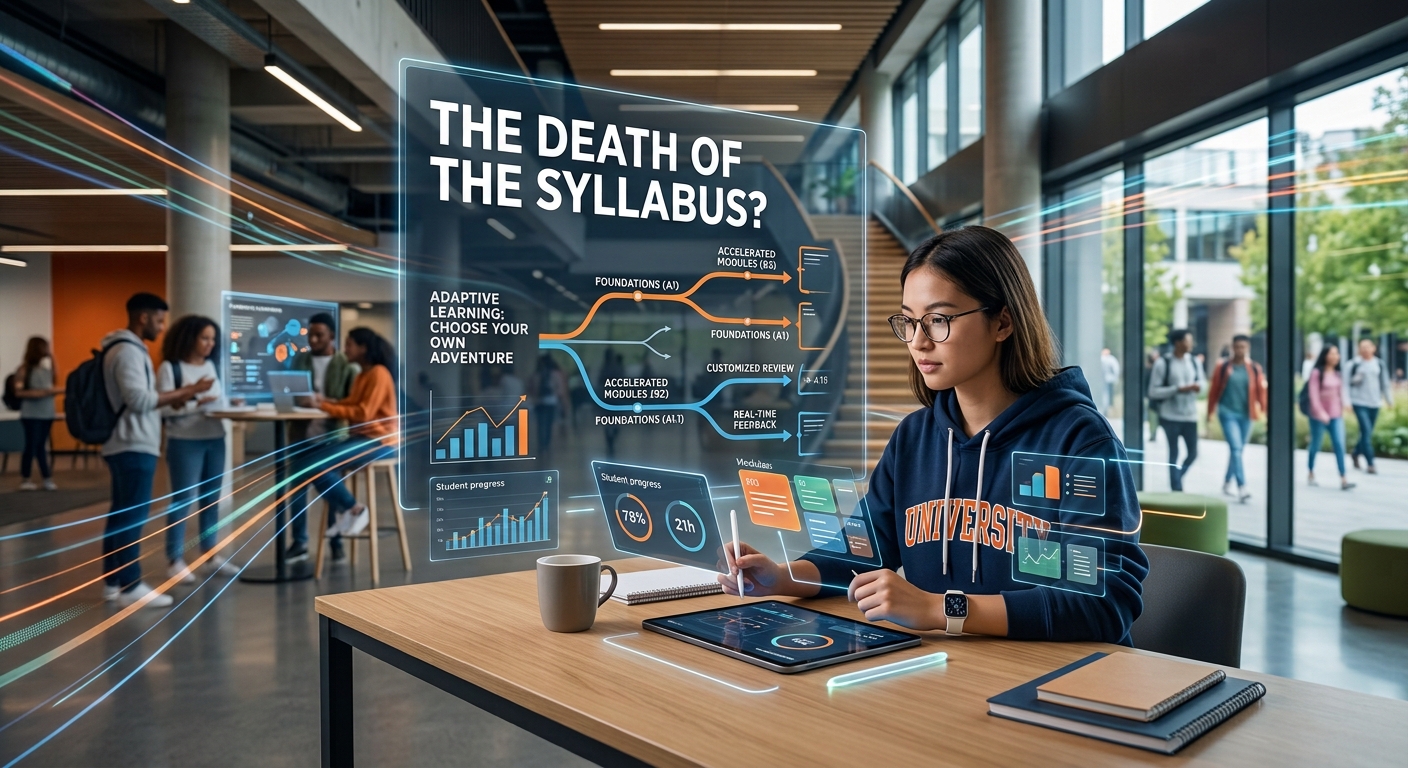
To address the required changes, a fundamental paradigm shift is underway in higher education in different parts of the world. Driven by advancements in artificial intelligence (AI) and machine learning, institutions are transitioning away from fixed, one-size-fits-all curricula toward Adaptive Learning Systems (ALS) (Gligorea et al., 2026). This emerging model effectively transforms the traditional syllabus into a dynamic, “choose-your-own-adventure” educational pathway, fundamentally altering the roles of both student and instructor.
Unlike traditional Learning Management Systems (LMS) that merely host static PDFs and video files, adaptive learning environments function similarly to an algorithmic GPS for education (Ferrario, 2026). When a user encounters traffic or an accident, a navigation application dynamically recalculates the route. Similarly, an ALS uses continuous, formative data analytics to recalibrate a student’s coursework in real time based on his/her performance, engagement patterns, and behavioral signals (Skillwell, n.d.).
The mechanics of this personalization operate across three primary dimensions:
This is no longer a theoretical exercise; major research institutions have spent years deploying these technologies at scale to combat high failure rates in historically difficult gateway courses.
Arizona State University (ASU), frequently recognized for its systemic digital transformation, partnered with adaptive learning platforms to overhaul its introductory mathematics and science sequences (The Change Leader, 2025). Rather than forcing every student through identical weekly lectures, ASU integrated adaptive software that continuously assessed individual competencies. The results were stark: success rates in introductory algebra increased significantly, while simultaneously reducing course withdrawal rates.
Similarly, other institutions have integrated systems like ALEKS (Assessment and Learning in Knowledge Spaces) and Knewton into chemistry, mathematics, and business administration curricula (Flückiger, 2025). Because these platforms provide a private, non-judgmental environment to make mistakes and receive immediate feedback, they eliminate the performance anxiety associated with falling behind a peer group (Queen’s Online School, 2026). Advanced students bypass redundant material, while those requiring remediation receive tailored support without the stigma of traditional intervention.
The dismantling of the static syllabus inevitably raises critical questions regarding the future of university faculty. If software can dynamically sequence content and provide automated tutorials, does the traditional professor become obsolete?
On the contrary, data from institutional adoptions suggests that adaptive learning systems elevate, rather than diminish, the role of the educator. By automating routine content delivery, basic grading, and foundational diagnostic assessments, faculty are liberated from administrative overhead (Pugliese, 2016).
Furthermore, ALS dashboards provide professors with granular, real-time analytics regarding student engagement and conceptual blind spots across the entire cohort (Čep, Bernik & Tomicic, 2025). Instead of discovering that a third of the class misunderstood a core principle via a failed midterm exam result, an instructor can see the exact concept causing friction on any given time. This transforms the traditional lecture into targeted, small-group interventions, high-level discussions, and personalized human mentorship which are areas where algorithmic platforms cannot compete (Flückiger, 2025).
The evolution from a static, linear syllabus to a hyper-personalized, branching educational model marks a significant maturation in educational technology. By centering the learning experience around individual student competency rather than arbitrary institutional timelines, higher education is moving closer to an environment where equity, retention, and genuine mastery coexist. The syllabus is not dying; rather, it is evolving into a living, responsive architecture designed for the modern learner.